





Buildings Sold

Total Building Sales

Total Square Feet Sold

NYC CRE Market Expertise

Prefer to watch instead of read? Stay tuned for the BKREA video series — short, topic-specific videos breaking down the newsletter’s biggest pieces: construction updates, new deals, legislative changes, and more. Same insight, just a faster format.

New York developers filed 903 building permits in Q2, up from 793 in Q1, covering 16,546 residential and hotel units and 20.6 million square feet. Queens and Brooklyn accounted for about 71 percent of filings, while Manhattan had just 30 permits and roughly 1,600 units, down from more than 8,000 in Q1. The report ties the drop to Q2 having no mega proposals like Q1's 1,458 unit filing at 548 West 36th Street and others.Manhattan still carries the biggest footprints. The average Manhattan filing was about 105,000 square feet against a citywide average of roughly 23,000, led by Extell's 80 West 67th Street in Lincoln Square, an 86 floor, 430 unit supertall at about 1.64 million square feet.Two things to watch on the policy side. The state repealed the 12:1 FAR cap last April, and 24 filings came in at exactly 99 units to stay under the 100 unit threshold for 485X wage requirements.
Source: New York YIMBY Q2 2026 report.
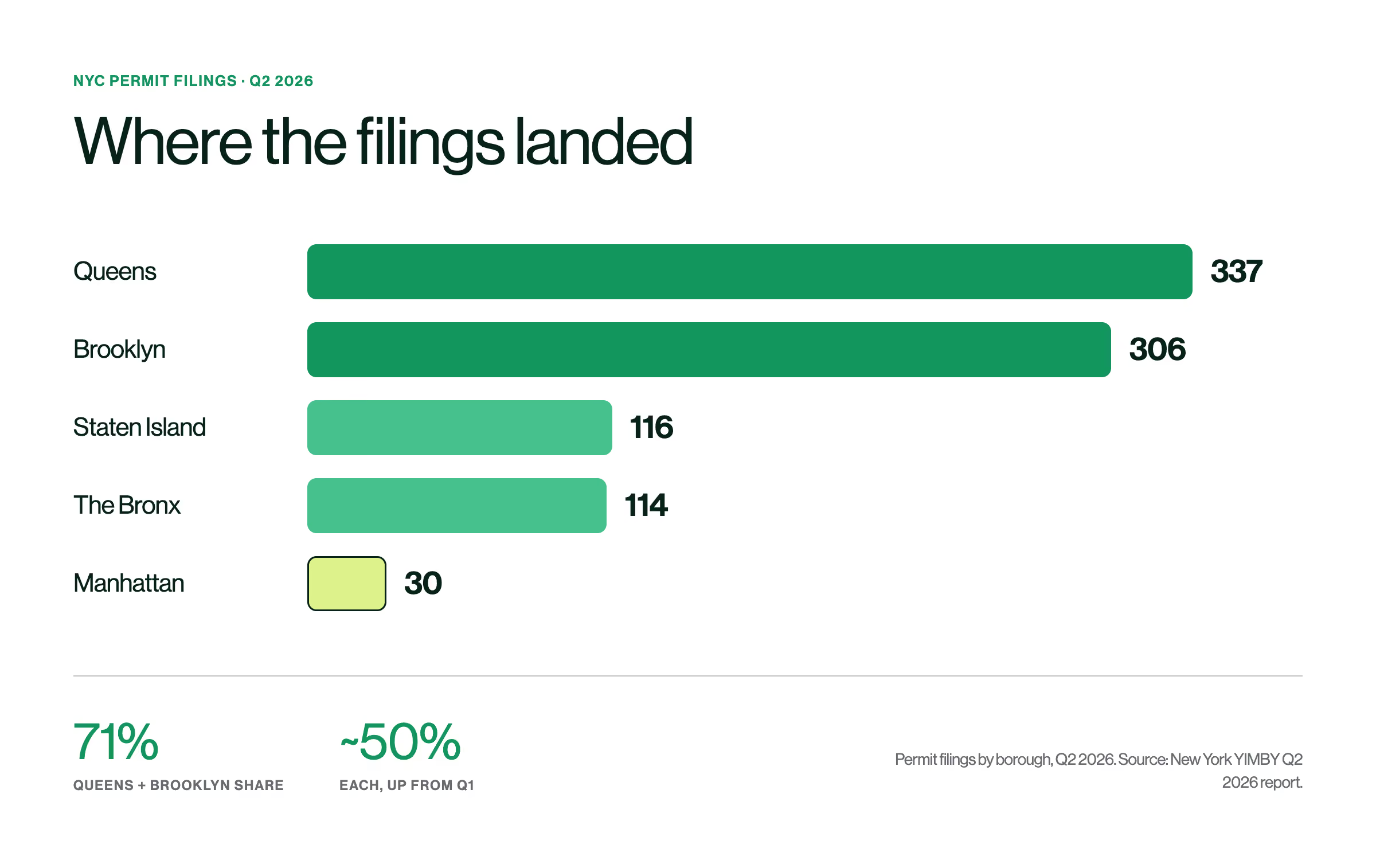
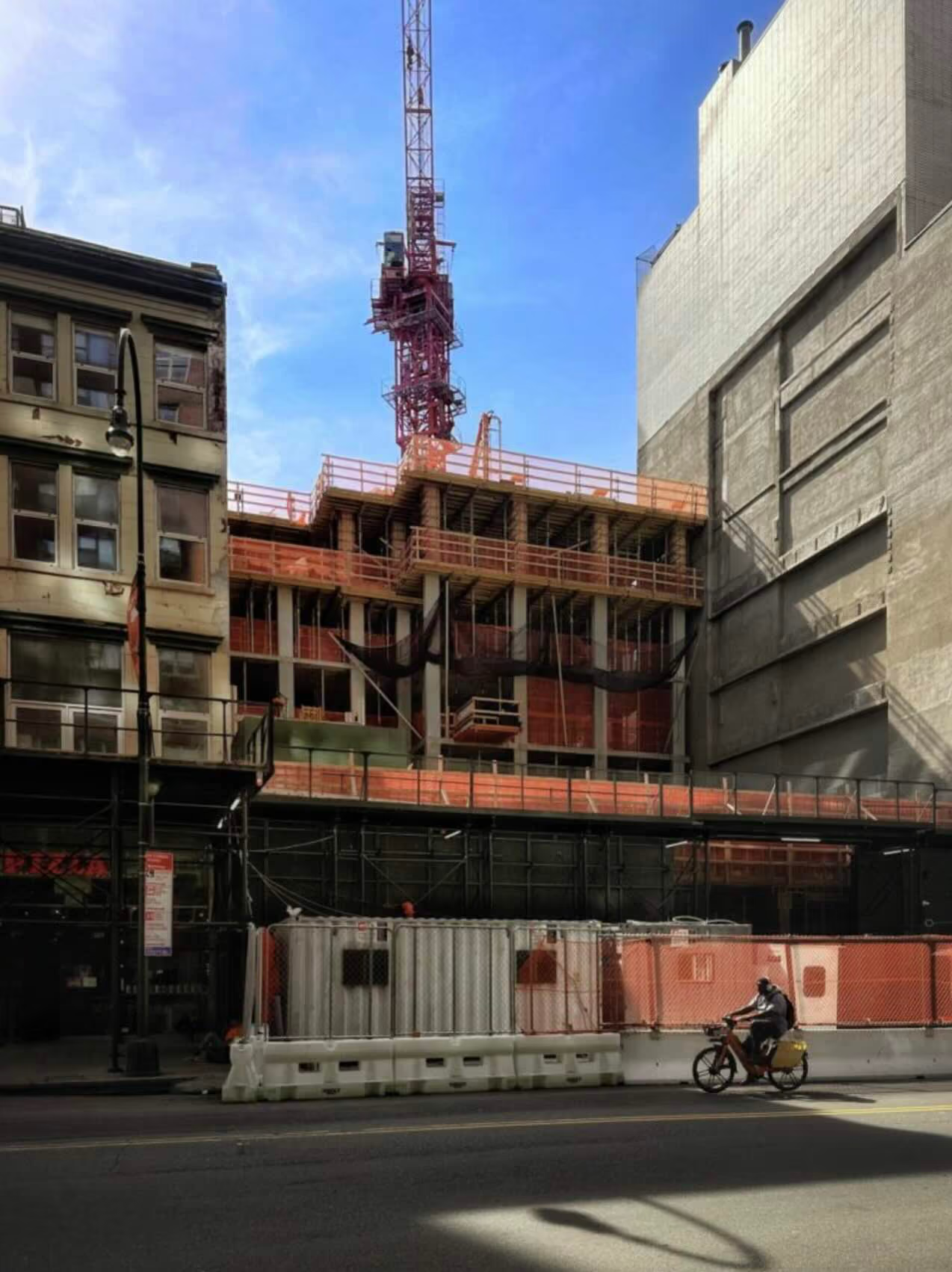
Photo Credit: YIMBY
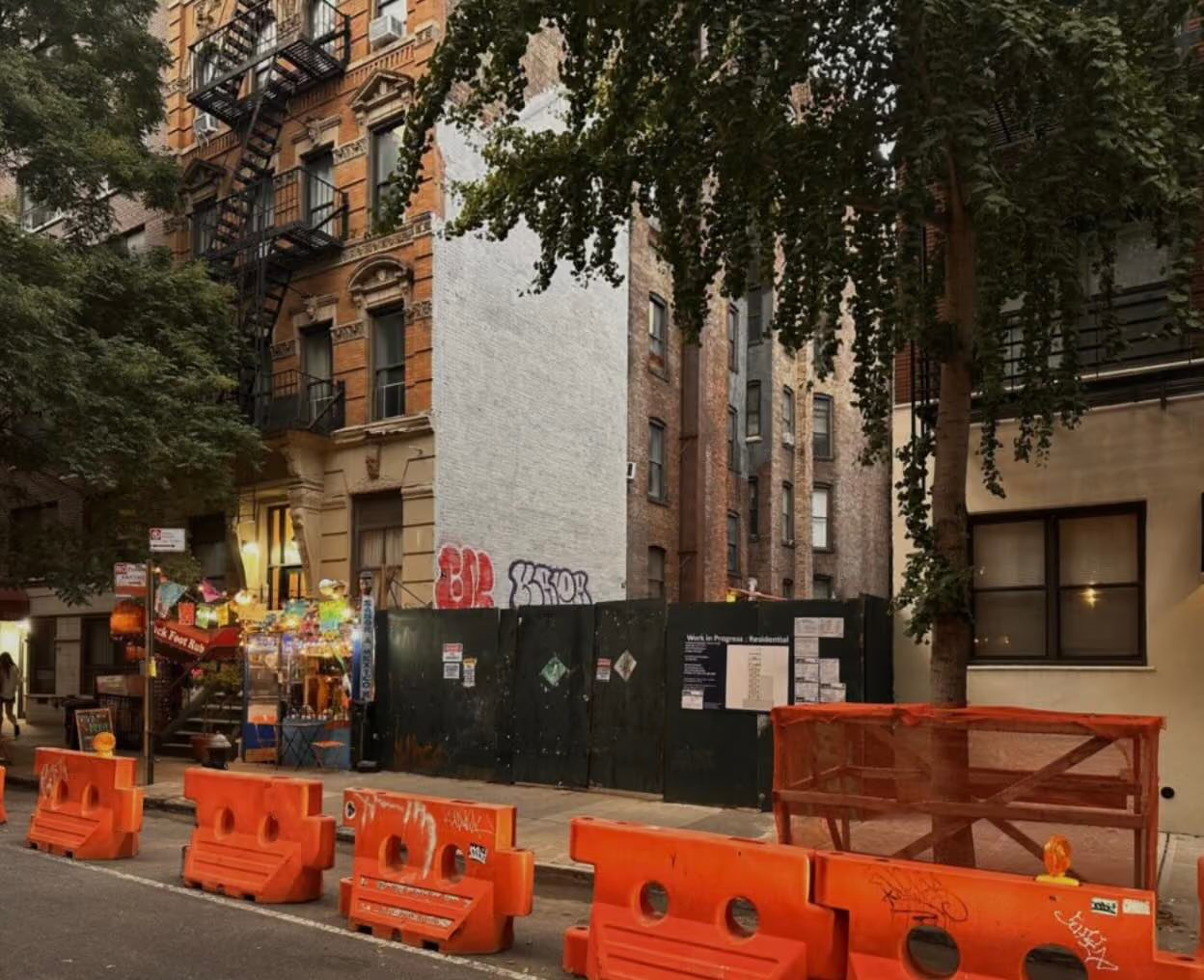
Photo Credit: YIMBY

Photo Credit: YIMBY
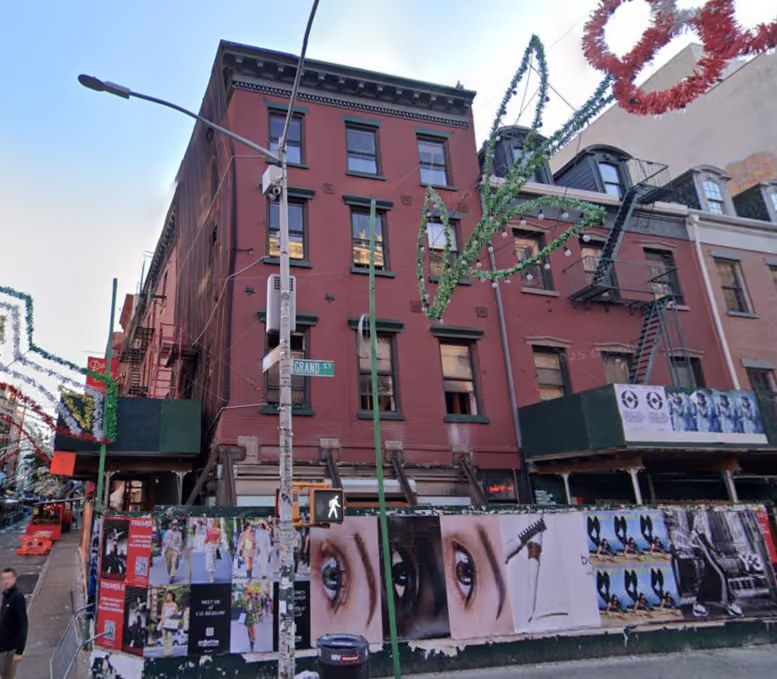


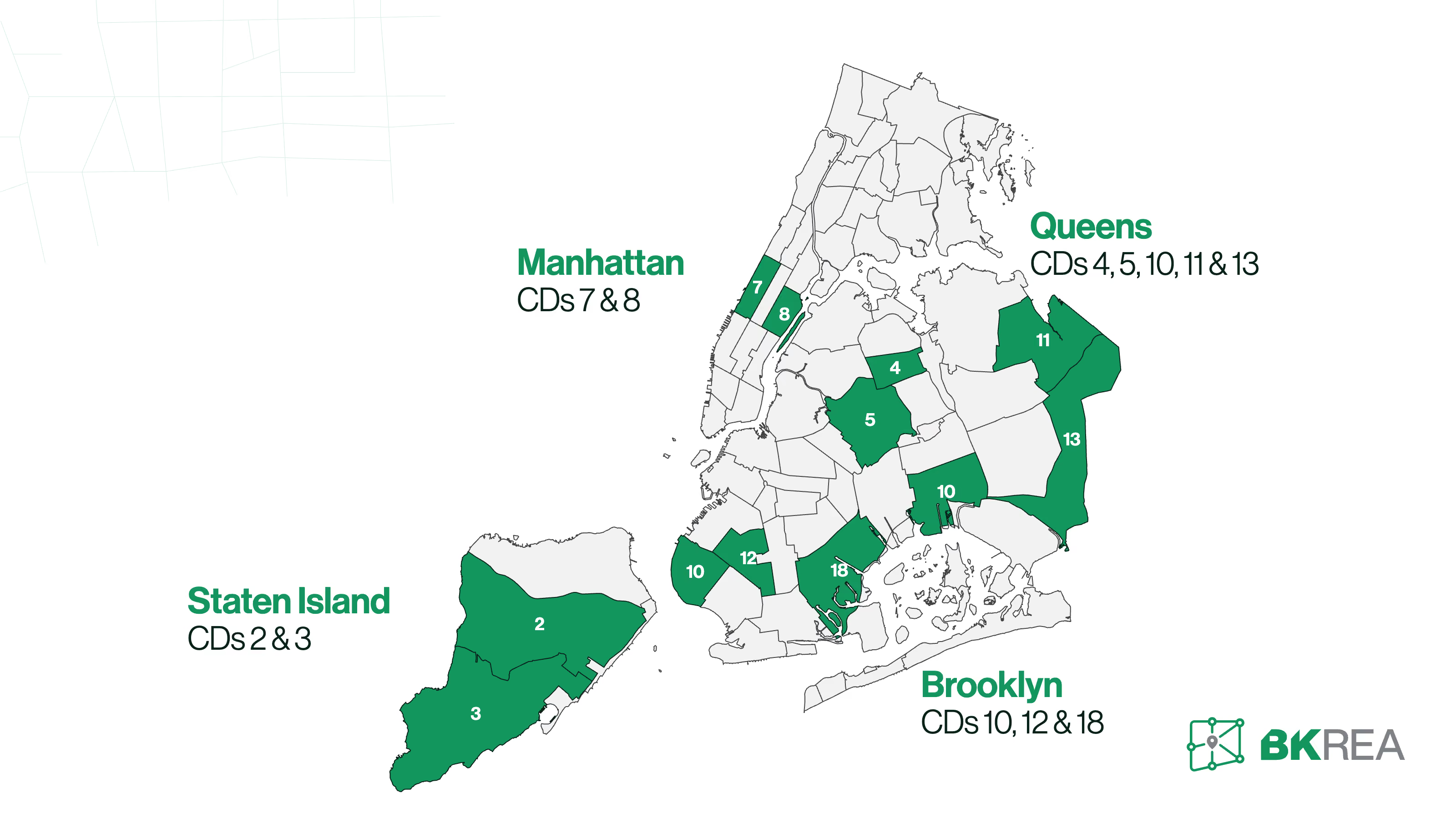
New York City has named the 12 community districts where the voter-approved Affordable Housing Fast Track begins in January 2027. Mayor Zohran Mamdani and Department of City Planning Director Sideya Sherman made the announcement.
New York City voters approved changes to the City Charter in November 2025 to address the uneven distribution of affordable housing. Starting January 1, 2027, eligible rezoning proposals that create affordable housing in the 12 designated districts will go through a streamlined 90-day public review. That cuts roughly four months from the traditional Uniform Land Use Review Procedure (ULURP).
They are the 12 districts with the lowest rate of affordable housing production. Together they are one-fifth of the city's 59 community districts, but they produced just 1% of its new affordable housing over the last five years. Of the 65,777 affordable homes created between 2021 and 2026, these districts added only 724.
New Yorkers vote on five City Charter amendments on Election Day, Nov. 3, 2026. The proposals come from Mayor Zohran Mamdani's Commission on Government Efficiency (COGE), part of his push to streamline city government and cut red tape. Early voting begins Oct. 24 and runs through Nov. 1. Two of the five proposals touch real estate directly.
This proposal bundles three measures. The real estate piece would cut the timeline for selling small pieces of city-owned land from about seven months to 90 days. Multiple agencies could review certain sales or leases at the same time, and there would be no final review from the City Council. The same proposal would also drop the hearing requirements and the City Council and City Planning Commission approvals when the city leases office space for its own employees.
“It will bring 40 approvals from 18 separate offices and agencies into one place, saving builders time and frustration”— NYC Mayor's Office
The other two parts of Proposal 3 speed up transportation projects such as bike and bus lanes. Voters get one yes-or-no vote on all three together.
This proposal would create a centralized permitting "hub," so applicants deal with one entity rather than waiting on approvals across multiple agencies. It would authorize more city officials to approve construction projects.
It would also move permitting for city-owned waterfront structures from the Department of Small Business Services to the Department of Buildings, and let the DOB commissioner appoint more officials who can approve construction documents.
On July 16, Mayor Zohran Mamdani released the Rental Ripoff Report, a package of 23 policy actions shaped by testimony from more than 2,400 New Yorkers at hearings held in all five boroughs between February and April. The hearings, established through Executive Order 8 in the Mayor's first week in office, surfaced a familiar list of grievances — pests led all testimony at 16%, followed by mold and leaks at 13% each — and the administration has now translated that feedback into a sweeping enforcement agenda.
For owners, the message is unambiguous: the City intends to use "every tool at its disposal," including executive action, agency rulemaking, legislation, and litigation, with "repeat-offender" landlords squarely in the crosshairs. Among the immediate executive actions, HPD will investigate every heat complaint individually rather than consolidating complaints by building, tenants will be able to schedule certain inspections directly, and the City will move to formally recognize tenant unions — expanding tenants' ability to organize and bargain collectively over building conditions.
The report also reaches into the leasing process itself. Landlords will be required to disclose when rental listings have been altered using artificial intelligence or other digital tools, and fees and utility charges will face tighter oversight.
Perhaps most consequential for the ownership community is the Legislative Task Force the Mayor's Office to Protect Tenants will convene. On its study list: financial penalties under the Underlying Conditions Program for failure to remediate mold, a strengthened Alternative Enforcement Program for chronic violations, digital service of HPD violations, and a long-overdue modernization of the property registration system — which today remains paper-based and doesn't require so much as an email address. Council Member Pierina Sanchez, who chairs Housing and Buildings, flagged J-51 reauthorization as a priority for the task force as well.
The report builds on the administration's Block by Block housing plan, which charts a path to build 200,000 affordable homes and preserve another 200,000. The takeaway for our readers: compliance costs and enforcement exposure are rising, and the regulatory posture toward multifamily ownership in New York has shifted decisively. Owners with open violations — particularly mold, heat, and pest conditions — should expect faster, more granular scrutiny.

Credit: NYC GOV
Released May 2026 by the Mamdani Administration
New York City released what it believes to be its most expansive housing policy plan in modern history, committing over $22 billion over five years. The two core targets are building 200,000 new affordable homes and preserving 200,000 existing homes over the next decade. The backdrop: a 1.4% rental vacancy rate — the lowest in 50 years — with essentially zero vacancies in low-cost units and over 100,000 people in shelters nightly. The plan attempts to span enforcement, preservation, new construction, zoning, homeownership, homelessness, and permitting reform, and has direct implications across the commercial real estate industry — from multifamily ownership and development to debt markets, land, and conversions.
The city has allocated more than $5 billion for affordable housing in FY27–FY28 alone — a 35%+ increase over prior years. HPD will finance roughly 8,000 new affordable units per year near-term, scaling to 21,000+ per year by FY31. 30% will target extremely low-income households (0–30% AMI); 20% will target very low-income households (31–50% AMI). This level of public capital is intended to crowd in private and federal financing, and significantly increases the volume of subsidized deals entering the development pipeline.
The plan pursues citywide transit-oriented development (TOD), neighborhood-scale rezonings, and new high-density zoning districts (including R12, a new high-density category). Starting January 1, 2027, affordable housing projects in the 12 community districts with the lowest recent affordable production will receive a fast-tracked 90-day public review, versus the normal seven-month process. The city's land portfolio (~15,000 properties) has been tasked with yielding at least 25,000 units over 10 years. Major development sites being planned include Sunnyside Yards (100+ acres, 20,000+ units) and Brooklyn Marine Terminal.
The SPEED Task Force produced seven initiatives designed to cut affordable housing development timelines by 8 months across all projects, and by up to 2 years for projects requiring a zoning change. The most significant change: DCP's pre-certification process for zoning actions will be reduced from an average of approximately 2 years to 6 months. The affordable housing lottery (Housing Connect) is being overhauled, with a target of cutting the median approval time from 210 days to under 100 days.
Insurance premiums for affordable and rent-stabilized buildings tripled from roughly $600/unit to $1,800/unit between 2018 and 2025, contributing directly to financial distress across the regulated housing stock. The city is investing $100 million to establish a new city-backed insurance program targeting 20,000 regulated units by 2027 and expanding to 100,000 by 2030. Additional cost relief is being pursued through façade inspection reform (extending baseline cycles from 5 to 6 years), expanded water affordability benefits, J-51 tax abatement extension through 2036, and a reassessment of property tax capitalization rates for majority rent-stabilized buildings — which resulted in an average 1.3% tax reduction for affected buildings in FY27.
The city's new "Fix the City" program will identify and pursue comprehensive enforcement actions against at least 10 of the most distressed landlord portfolios in 2026. Enforcement tools include roof-to-cellar inspections, 7A proceedings (court-ordered management removal), Emergency Repair Program cost recovery, criminal referrals, lender engagement to force compliance or foreclosure, and expedited Housing Court proceedings. The explicit stated outcome is ownership transfer to mission-driven buyers. Separately, heat complaints — 300,000 in 2025 — will now each be investigated as individual cases beginning October 1, 2026.
HPD plans to grow homeownership production by 85% in FY27–FY28 compared to FY24–FY25. New programs include Our Home (conversion of rental buildings to resident-owned cooperatives), a basement apartment legalization pilot (15 Community Districts initially), and a manufactured ADU permitting pathway (DOB rules to be promulgated in 2026). The Plus One ADU program provides up to $395,000 in financial support per unit. The Mayor's Office of Deed Theft Prevention was created by executive order in April 2026. HomeFix home repair loan maximums were raised from $60,000 to $100,000 per home, plus $30,000 per additional rental unit.
At least 12,000 new residential units are expected from office-to-residential conversions enabled by the "City of Yes for Housing Opportunity" zoning reforms and the State's 467-m tax program. A persistent bottleneck — asbestos plan review through DEP's ATRU unit — is being addressed with a staffing doubling that is estimated to cut review times by 2 months. The conversion pipeline is concentrated in older Class B/C office buildings with full-floor plate sizes and configurations suitable for residential use.
NYCHA houses over 500,000 residents in 177,000 apartments across 335 developments. Its 20-year Physical Needs Assessment is $78 billion, though 2026 marked the first slight decrease in that figure. The city's 5-Year Capital Plan for NYCHA is $5.6 billion — the largest in recent history. About 25% of the portfolio (44,600 units) has been renovated or has a defined path via PACT, the Public Housing Preservation Trust, or Comprehensive Modernization. Some 6,088 units remain vacant, with a $374 million investment targeting turnover. NYCHA is also moving to expand its role as a public developer via Build First redevelopment, Transfer of Assistance pilots, the new SMRRT revolving loan, and sales of development rights.
The Affordable & Efficient Code Reform (AECR) Task Force will convene in late 2026 to review specific NYC Construction Code provisions that add cost without proportionate safety benefit. Primary areas under review include elevator sizing standards (currently requiring larger cabs than comparable European/Asian markets), plumbing material restrictions (plastic pipe prohibition in interior water distribution), and shared/SRO housing legalization. Industrialized and modular construction is being actively promoted, with EDC investing in workforce development, site identification for manufacturing facilities, and IDA incentives. The Construction Justice Act (Local Law 21 of 2026) establishes a $40/hour combined wage and benefits floor for all workers on city-assisted housing projects.
Two pieces of legislation with significant market implications are being pursued. The SAFER Homes Act revamps the Third-Party Transfer (TPT) program — a mechanism by which the city can take title to distressed properties and transfer them to mission-driven owners. It focuses on buildings with accumulated unpaid municipal charges (taxes, water bills) and serious Housing Maintenance Code violations, with provisions protecting existing homeowner equity and creating pathways to resident ownership. The Community Opportunity to Purchase Act (COPA) would give pre-qualified affordable housing operators an exclusive window to purchase properties when listed, plus a right to match any third-party offer once that window closes.


Prime Office/Retail


NoHo

User
Upper East Side

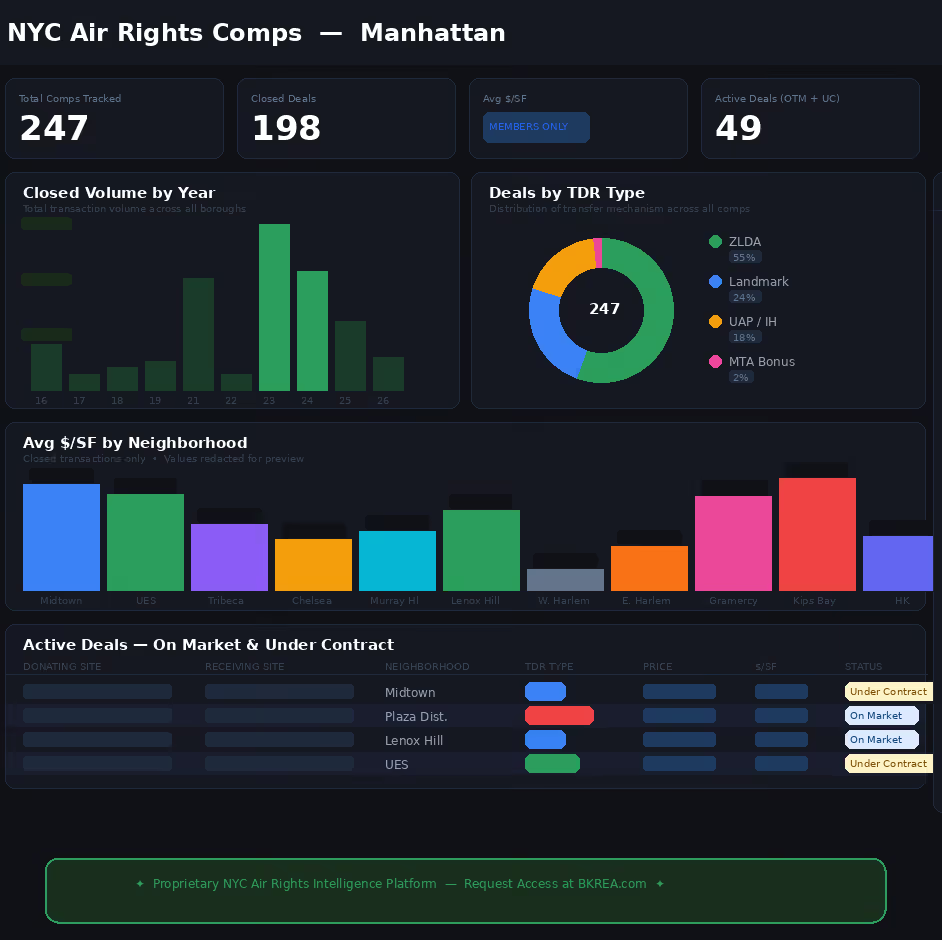
For the first time, BKREA is bringing institutional-grade air rights market data to a single, proprietary platform. The Manhattan Air Rights Intelligence dashboard tracks hundreds of transferable development rights transactions across every submarket in New York City — giving developers and investors instant access to comps, pricing trends, deal structures, and active listings in one place. Filter by neighborhood, TDR type, deal size, price per square foot, and more. Whether you're underwriting a receiving site, valuing a donating parcel, or benchmarking a deal against the market, this is the intelligence layer the air rights market has never had — until now.
The dashboard preview above is for illustrative purposes only. Comp counts, pricing, and data visualizations shown are representative samples. Actual platform data, coverage, and figures will vary. Access is available to select clients upon request.


Robert Knakal’s latest Commercial Observer article examines the difference between dollar volume and transaction activity in Manhattan’s investment sales market. While 2026 is currently on pace to slightly exceed 2025 in dollar volume, the number of properties changing hands remains below the market’s long-term average. The analysis shows that capital is returning and several major sectors are improving, but transaction velocity has not yet fully recovered.
The article provides a data-driven framework for understanding Manhattan investment sales beyond headline dollar volume. By comparing both dollars invested and the number of properties sold, it highlights an important distinction between how much money is moving and how much the market itself is moving.
“Dollar volume tells us how much money is moving; properties sold tell us how much the market is moving.”
What is Manhattan investment sales volume projected to reach in 2026?
Based on first-half activity, Manhattan is currently on pace for approximately $20.346 billion in investment sales volume.
How many properties is Manhattan projected to sell in 2026?
With 341 properties sold during the first half of 2026, the market is currently on pace for approximately 682 sales.
How does that compare with the historical average?
Approximately 704 Manhattan investment properties sold annually on average from 1984 through 2025.
Which sectors are showing the strongest improvement?
The article identifies office, retail, land, hotels and free-market multifamily as areas showing positive momentum.
Which sector remains under pressure?
Rent-regulated multifamily remains the primary outlier, with constrained revenue growth and rising operating expenses creating continued economic pressure.
What would signal a new phase of the recovery?
A meaningful increase in the number of properties changing hands above the long-term average would indicate that transaction velocity has strengthened substantially.

BKREA announced the exclusive listing of a 10,470-square-foot commercial garage condominium at 525 East 80th Street on Manhattan’s Upper East Side. Located in Yorkville, the property offers 52 legal parking spaces and is being marketed for investment and owner-user purposes, with potential for a build-to-suit transaction. The offering is led by Bob Knakal, Chairman & CEO of BKREA, and Ana Barrie, Managing Director.
525 East 80th Street demonstrates BKREA’s focus on identifying specialized commercial real estate opportunities that may appeal to a targeted group of investors and owner-users. The combination of 52 legal parking spaces, 10,470 square feet, and a Yorkville location gives the property a distinct position within the Upper East Side market.
“The scale of the space and the number of parking spaces make this a particularly unique offering for the Upper East Side.”
What is being offered at 525 East 80th Street?
A 10,470-square-foot commercial garage condominium with 52 legal parking spaces.
Where is the property located?
The property is located at 525 East 80th Street in Yorkville on Manhattan’s Upper East Side.
How can the property be used?
The offering is being marketed for investment and owner-user purposes, with potential for a build-to-suit transaction.
Who is representing the property?
The offering is led by Bob Knakal, Chairman & CEO of BKREA, and Ana Barrie, Managing Director.
What makes the property distinctive?
Its combination of 10,470 square feet, 52 legal parking spaces, and an established Upper East Side location creates a specialized commercial offering.
What is the zoning?
The property is zoned R8B.

BKREA has released the September 2026 installment of Crexi’s “Conversation with the Chairman,” featuring BKREA Chairman & CEO Bob Knakal in an eight-question interview with Crexi Senior Director Ashley Kobovitch. The latest conversation explores the parallels between baseball and commercial real estate brokerage, including statistics, resilience, consistency, failure, data, and the importance of maintaining fundamentals throughout changing market cycles.
Drawing from a 42-year career that began in 1984 and includes more than 2,425 building sales totaling nearly $25 billion, Knakal explains how lessons from baseball have influenced his approach to measuring performance, handling setbacks, building relationships, and continuously improving as a broker.
The September installment combines lessons from baseball with practical insights into investment sales. Knakal's experience demonstrates how statistics, repetition, resilience, and consistency can provide a framework for navigating a career that spans multiple market cycles.
The conversation also highlights the evolving role of technology and data in brokerage. While analytics can help brokers understand markets and identify opportunities, Knakal emphasizes that successful execution still requires judgment, relationships, and an understanding of the people behind each transaction.
According to Knakal:
“Yesterday's strikeout has nothing to do with today's at-bat.”
The message reinforces the importance of treating each opportunity independently and continuing to execute regardless of what happened previously.
Read the September 2026 installment of “Conversation with the Chairman” featuring Bob Knakal and Crexi Senior Director Ashley Kobovitch.
It is an ongoing thought leadership series featuring Bob Knakal and produced in partnership with Crexi, exploring commercial real estate, investment sales, market trends, and lessons from Knakal's career.
The latest installment examines the parallels between baseball and investment sales, focusing on statistics, resilience, consistency, failure, data, and career-long fundamentals.
Knakal's background as a college baseball player influenced his appreciation for statistics and performance measurement. He has applied that scorekeeping mindset to commercial real estate throughout his career.
The Knakal Land Index analyzes thousands of Manhattan development site transactions across numerous variables to provide data-driven market insights.
He compares professional setbacks to individual baseball at-bats, emphasizing that one failed opportunity should not determine how a broker approaches the next one.
Successful brokerage combines measurable performance, consistent execution, resilience, data, market knowledge, and human judgment. As in baseball, each new opportunity is another at-bat.

BKREA has announced the promotion of Taylor Bello to Chief Marketing & Operating Officer, expanding her responsibilities across marketing, communications, and operations as the firm continues to grow its presence in New York City’s commercial real estate market. In her new role, Bello will help strengthen BKREA’s brand strategy, business development initiatives, and operational infrastructure.
Bello has been with BKREA since its inception and previously served as Director of Communications, where she helped build the firm’s marketing and communications platform and develop scalable systems supporting business development and deal marketing. She brings more than a decade of commercial real estate experience, having started her career as a Public Relations intern at Massey Knakal Realty Services under Bob Knakal before holding marketing and communications roles at Cushman & Wakefield and JLL.
“Taylor has been an important part of building BKREA from the ground up,” said Bob Knakal, Chairman & CEO of BKREA.
He highlighted her understanding of the firm’s business and brand, as well as her ability to connect strategy, communication, and operations.
Bello’s promotion reflects BKREA’s continued investment in the infrastructure supporting its growth. By combining marketing, communications, business development, and operational responsibilities, the expanded role creates a centralized leadership function focused on both the firm’s external brand and internal execution.
Her progression also illustrates a long-term connection to Bob Knakal’s platform, from beginning her career at Massey Knakal to helping build BKREA from its inception.
Who is Taylor Bello?
Taylor Bello is BKREA’s Chief Marketing & Operating Officer. She previously served as the firm’s Director of Communications and has more than a decade of commercial real estate experience.
What is Taylor Bello’s new role at BKREA?
She oversees marketing, communications, and operations, including executive communications, public relations, deal marketing, business development, and operational systems.
When did Taylor Bello join BKREA?
Bello has been with BKREA since the firm’s inception.
Where did Taylor Bello begin her career?
She began her commercial real estate career as a Public Relations intern at Massey Knakal Realty Services under Bob Knakal. She later worked in marketing and communications at Cushman & Wakefield and JLL.
What did Bello do before becoming Chief Marketing & Operating Officer?
She served as BKREA’s Director of Communications, where she helped develop the firm’s marketing and communications platform and scalable systems supporting business development and deal marketing.
What is the purpose of the expanded role?
The role is intended to strengthen BKREA’s marketing strategy, communications, business development, and operational infrastructure as the firm continues to expand.
BKREA has appointed Candice Gradenigo as Chief of Staff, adding more than a decade of corporate leadership, strategic operations, and entrepreneurial experience to the firm’s growing platform. Effective immediately, Gradenigo will work closely with Chairman & CEO Bob Knakal on strategy, business operations, organizational development, and firm-wide growth initiatives.
Gradenigo joins BKREA after more than 10 years at United Technologies, specifically Pratt & Whitney, where she managed complex negotiations and strategic initiatives with significant financial impact. Her experience includes negotiating multiyear partnerships valued at up to $500 million and directing a global supply chain operation with a $300 million budget.
Gradenigo’s appointment reflects BKREA’s focus on building the organizational infrastructure behind its continued growth. Her combination of corporate strategy, global operations, negotiation, entrepreneurship, and multilingual experience expands the firm’s leadership capabilities while supporting its efforts to develop systems and processes across the organization.
Who is Candice Gradenigo?
Candice Gradenigo is BKREA’s newly appointed Chief of Staff. She brings more than 10 years of leadership experience at United Technologies and Pratt & Whitney, along with entrepreneurial experience.
What will Gradenigo do at BKREA?
She will work with Bob Knakal and the leadership team on strategy, business operations, organizational development, and firm-wide initiatives.
What experience does she bring to BKREA?
Her background includes managing strategic projects, complex negotiations, global supply chain operations, and large-scale partnership agreements.
What is Picks & Deals?
Picks & Deals is the digital commerce company founded by Gradenigo, which grew to generate more than $2 million in annual affiliate sales.
Where did Gradenigo receive her education?
She earned an MBA from NYU Stern School of Business and a Maîtrise de Sciences de Gestion from Université Paris 1 Panthéon-Sorbonne.
What does this appointment mean for BKREA?
The appointment adds senior operational and entrepreneurial experience as BKREA continues developing its systems, talent, and organizational capabilities.
In his latest reflection, Bob Knakal explores the meaning of time, perspective, and legacy as he remembers September 11, 2001. While acknowledging the tragedy and the nearly 3,000 lives lost, Knakal uses the occasion to reflect on the extraordinary privilege represented by every ordinary day we are given.
With more than four decades in commercial real estate, Knakal connects his professional experience with a broader perspective on life, emphasizing that success should not be measured solely by revenue, transactions, or professional accomplishments. The ultimate scorecard, he argues, is how we use our limited time, the people we help, the relationships we build, and the positive impact we leave behind.
“What Will You Do With Your Turn?” challenges readers to think beyond the traditional definitions of success. Professional achievement remains important, but Knakal argues that the broader measure of a life is how effectively we use our talents, help others, build relationships, and contribute to the world around us.
According to Knakal:
“This is our turn. Let’s make it count.”
The message is both simple and powerful: none of us knows exactly how much time we have, but each of us has the opportunity to decide what we do with the time we have been given.
Knakal's reflection ultimately asks readers to reconsider their personal scorecard. Success is not simply about how much money we make, how many transactions we complete, or how far we advance professionally.
It is also about whether we maximize our potential, make others better, act with character, create meaningful memories, contribute to our communities, and enjoy the journey along the way.
September 11 reminds us that tomorrow is never guaranteed. Today is here. This moment is ours. This is our turn.
The article was inspired by reflection on September 11, 2001, and the reminder that life is finite and tomorrow is never guaranteed.
“Our turn” refers to the brief window of time each person has been given to live, create, contribute, build relationships, and make a positive impact.
Success extends beyond professional and financial achievement to include character, relationships, personal growth, mentorship, contribution, and the ability to positively influence others.
He views legacy as something created through the people we influence while we are alive, rather than simply something remembered after we are gone.
Time is limited, tomorrow is not guaranteed, and we should be intentional about how we use the opportunity we have today.
He encourages readers to pursue meaningful goals, prioritize relationships, help others, embrace opportunities, and make the most of the time they have been given.
BKREA has announced the exclusive listing of 143-155 East 60th Street, a rare six-lot assemblage in Manhattan’s Lenox Hill neighborhood. The fully vacant, already-demolished development site spans approximately 19,684 square feet with 200 feet of frontage and 100 feet of depth, occupying nearly the entire mid-block between Lexington and Third Avenues.
The offering provides up to approximately 282,925 zoning square feet at a 12.0 FAR, with no height restrictions and the potential for a large-scale luxury residential condominium development. The site benefits from acquired development rights, UAP certificates, Central Park proximity, and a location outside the Upper East Side Historic District.
“This is the kind of site that simply doesn’t come to market in this neighborhood,” said Bob Knakal, Chairman & CEO of BKREA, highlighting the site's 200 feet of frontage, Central Park views, acquired air rights, and UAP certificates already in place.
143-155 East 60th Street brings together several characteristics that are difficult to replicate in Manhattan: a large contiguous footprint, a fully vacant site, significant development rights, no height restrictions, and a location in one of the city's established luxury residential corridors.
The opportunity also demonstrates the value of preparing a development site before bringing it to market. By securing additional development rights and UAP certificates, ownership has substantially enhanced the site's development potential and reduced key hurdles for a future developer.
Where is 143-155 East 60th Street located?
The property is located on East 60th Street between Lexington and Third Avenues in Manhattan's Lenox Hill neighborhood.
How large is the development site?
The assembled site contains approximately 19,684 square feet of lot area, with approximately 200 feet of frontage and 100 feet of depth.
How much can be built on the site?
The site offers approximately 282,925 zoning square feet at a 12.0 FAR, based on the development rights and UAP certificates secured by ownership.
What type of development is envisioned?
A massing study envisions a 48-story residential tower with approximately 332,233 gross square feet, including ground-floor retail and lobby, amenities, and residential space.
What zoning applies to the property?
The site is zoned C5-2 (R10), which permits residential, office, retail, community facility, and hotel uses as-of-right.
Who is marketing the property?
The exclusive listing is being led by BKREA Chairman & CEO Bob Knakal, Managing Directors Genessy Jaramillo and Jas Saini, Senior Associate Nick Tuleu, and Transactional Associate Christian Sweeney.

Fast Company has featured Bob Knakal, Chairman & CEO of BKREA, in its “Personal Brand Special Report: 207 Insights and Ideas to Grow Your Brand and Career.” The special report brings together insights from more than 150 CEOs, entrepreneurs, consultants, artists, investors, and other professionals examining how personal branding can influence careers, build credibility, and create new opportunities.
Knakal’s contribution draws on more than four decades of experience in commercial real estate and explains how he has viewed himself as being in the information business as much as the real estate business. He emphasizes the importance of consistently providing value, educating audiences, and becoming a trusted source of information.
Knakal shares that throughout his 42-year career, he has viewed himself as being in the information business as much as the real estate business. While the platforms for communicating information have changed dramatically, his objective has remained consistent: provide value, educate people, and become a trusted source of information.
He also reflects on his experience at JLL, where he says his personal brand had become prominent enough that he viewed it as beginning to overshadow the corporate brand. From that experience, he draws a distinction between corporate identity and the relationships individuals develop throughout their careers.
According to Knakal:
“Companies own logos, but individuals own relationships. Brands create awareness, trust creates opportunity, and consistently delivering value over long periods of time creates both.”
Fast Company’s report illustrates how personal branding has evolved from a career-development concept into a significant professional asset. The report features professionals using their personal brands in different ways, including advancing within organizations, building audiences, creating businesses, and developing career independence.
For Knakal, the foundation remains consistent: expertise, information, education, relationships, and the long-term delivery of value.
It is a special report featuring insights and ideas from more than 150 professionals on how personal branding can help develop careers, build influence, and create new opportunities.
Knakal shared lessons from his 42-year career about building a personal brand through expertise, information, education, and consistently providing value.
His approach centers on becoming a trusted source of information and using expertise to educate and provide value to an audience.
He emphasizes that companies control corporate identities and logos, while individuals develop relationships and trust that can continue across organizations and throughout their careers.
Personal branding has expanded from traditional workplace reputation into digital platforms including LinkedIn, X, social video, newsletters, podcasts, and live events.
A lasting personal brand is built by consistently delivering value, developing expertise, educating others, and earning trust over time.
A successful investment sales campaign requires a strategy, but Bob Knakal argues that the strategy should never become a rigid script. Predetermining the number of bidding rounds, deadlines and negotiation stages before the market responds can prevent a broker from adapting to the opportunity in front of them.
The objective is not to follow a predetermined process. It is to maximize the seller’s proceeds while optimizing the probability that the transaction actually closes.
The sales process exists to advance the seller’s interests, not to make the broker’s job easier. A predictable process can actually benefit buyers if they know exactly when additional opportunities to improve their bids will arise.
When buyers understand that the seller could make a decision at any point, every interaction carries greater consequence. This creates urgency and encourages buyers to put forward their strongest combination of price and terms.
The broker’s role is therefore part strategist, part market diagnostician. The process should begin with a clear plan, but that plan must evolve as the market reveals itself.
“The best process is not the one you can predict before you begin. It is the one you intelligently design as the market reveals itself.”
Because the market may produce results that make the original plan unnecessary or counterproductive. The bidding strategy should respond to the quality and distribution of offers.
A deadline should be called once there is sufficient market exposure, buyer engagement and credible competition to make the deadline a source of leverage rather than a risk.
No. Financing, deposits, contingencies, diligence requirements, contract terms and closing certainty can make a lower offer more attractive to a seller.
Buyers are more likely to remain engaged and improve their offers when they believe they are being treated consistently and have a legitimate chance to win.
A successful seller’s broker should have a strategy, but never a script. The best process is created dynamically by combining market feedback, buyer behavior and professional judgment.
As artificial intelligence continues to transform commercial real estate, Bob Knakal argues that the competitive value of information is declining while the value of judgment is increasing. Data that once required years of experience and extensive research can now be accessed and analyzed almost instantly. The real differentiator is increasingly what professionals do with that information.
After more than four decades in New York City investment sales and thousands of transactions, Knakal's advantage is not simply access to information. It is the pattern recognition developed by watching decisions play out over time.
He has seen buyers overpay and succeed, sellers reject offers they later regretted, seemingly certain transactions collapse and seemingly impossible deals close. Those experiences create a level of judgment that cannot be replicated simply by providing an AI system with more data.
“AI can shorten the distance between a question and an answer. Judgment shortens the distance between an answer and the right decision.”
The central lesson is that AI does not eliminate expertise. As information becomes increasingly accessible, genuine expertise may become even more valuable because professionals must distinguish between information that is available and information that actually matters.
AI is making property, ownership, transaction and market information faster and easier to access and analyze. This reduces the advantage historically created by simply possessing information.
Judgment incorporates context, experience, motivations, risk, relationships and knowledge of how similar situations have actually played out. It helps determine how much weight to give information and what decision should follow.
The highest bid may come with greater financing risk, limited closing certainty, investment committee requirements or a greater likelihood of retrading. Evaluating the probability of closing can be more important than maximizing the headline offer.
Users may value a property for strategic reasons beyond its investment return. The property may improve their business operations, visibility, location or long-term strategy, creating value that traditional investment metrics do not capture.
As AI makes information increasingly accessible, competitive advantage shifts toward judgment. The ability to interpret information, recognize patterns and make the right decision becomes more important than simply having access to the data.
BKREA reported $833.5 million in transaction volume across 33 transactions through August 2026, representing more than 2.8 million square feet of Manhattan real estate activity. The results highlight continued momentum for the Manhattan-focused investment sales brokerage, particularly across development sites, redevelopment opportunities, and value-add properties.
The firm has accelerated its activity since the beginning of the second half of the year. Since July 1, BKREA has completed nine transactions involving 11 buildings totaling 675,352 square feet and $259.1 million in transaction volume, representing approximately 31% of the firm's total 2026 dollar volume to date.
BKREA's 2026 performance demonstrates continued demand for well-positioned Manhattan investment opportunities despite the evolving commercial real estate environment.
The firm's focus on development sites, redevelopment opportunities, and value-add properties allows it to target assets where sophisticated marketing, proprietary data, and a deep understanding of buyer demand can influence transaction outcomes.
According to Bob Knakal:
“2026 has been a very strong year for BKREA, and the momentum we have seen since July 1 has been especially encouraging.”
Knakal emphasized that the firm's continued execution and focus on development, redevelopment, and value-add opportunities are resonating with owners and buyers.
The 2026 year-to-date results include:
BKREA combines Manhattan investment sales expertise with proprietary research tools, including the Knakal Land Index and Knakal Map Room. These resources support the firm's ability to identify opportunities, understand market conditions, and connect owners with qualified investors and developers.
The firm's growing transaction volume reflects the continued importance of specialized market knowledge and targeted execution in Manhattan's investment sales market.
BKREA reported $833.5 million in transaction volume across 33 transactions through August 2026.
The firm has sold 33 buildings totaling approximately 2.84 million square feet through August 2026.
Since July 1, BKREA has completed nine transactions involving 11 buildings totaling $259.1 million and 675,352 square feet.
BKREA specializes in development sites, redevelopment opportunities, and value-add properties throughout Manhattan.
BKREA uses the Knakal Land Index and Knakal Map Room to support proprietary research, market analysis, opportunity identification, and targeted buyer outreach.
The results demonstrate strong transaction momentum for BKREA and continued demand for strategically positioned Manhattan investment and redevelopment opportunities.

BKREA arranged the $31 million sale of 38 West 21st Street, a 12-story office building in Manhattan’s Flatiron District. The transaction highlights a notable shift in Manhattan’s office investment market, where renewed demand for traditional office properties is increasingly competing with office-to-residential conversion strategies.
Located between Fifth Avenue and Avenue of the Americas, the 1908-built property contains approximately 68,808 square feet and is situated within the Ladies’ Mile Historic District. BKREA marketed the property as a potential office-to-residential conversion opportunity, attracting interest from both residential conversion buyers and traditional office investors.
The transaction provides an important snapshot of the changing Manhattan office market. For several months, prospective buyers primarily evaluated the property through the lens of residential conversion. As marketing progressed, however, office investors entered the process and competed aggressively for the asset.
According to Bob Knakal:
“The lesson from it is that the meaty part of the bell curve in terms of office-to-residential conversion is in the rearview mirror at this point.”
The transaction demonstrates how shifting market fundamentals can create new opportunities for sellers. By marketing an asset around multiple potential investment strategies, BKREA was able to attract a broader buyer pool and capitalize on changing investor sentiment.
The property sold for $31 million, or approximately $450 per square foot.
The property is located between Fifth Avenue and Avenue of the Americas in Manhattan’s Flatiron District, within the Ladies’ Mile Historic District.
It is a 12-story office building containing approximately 68,808 square feet.
Yes. BKREA marketed the property as a potential office-to-residential conversion opportunity, but strong demand from office investors ultimately drove the transaction.
Sioni Group acquired the building and plans to renovate it for continued office use.
BKREA’s Bob Knakal, Faraz Cheema, and Ryan Candel represented Jack Vogel Associates in the transaction.
The sale suggests that investor confidence in Manhattan office properties is improving as leasing activity strengthens, vacancy declines, and buyers increasingly return to traditional office investment strategies.
BKREA successfully arranged the $16.5 million sale of 36 East 12th Street, a seven-story commercial property in Greenwich Village, Manhattan. The transaction highlights continued investor demand for well-located Manhattan properties offering existing income and significant office-to-residential conversion and redevelopment potential.
Located on East 12th Street between University Place and Broadway, the property sits on approximately 5,163 square feet of land with 50 feet of frontage. Its Greenwich Village location, flexible zoning, existing income, and long-term redevelopment potential made the property an attractive opportunity for investors seeking both current value and future upside.
The property combined several characteristics that are increasingly attractive to sophisticated Manhattan investors: a highly desirable Greenwich Village location, an existing commercial building, current income, flexible zoning, and the potential for residential conversion or redevelopment.
The transaction demonstrates how identifying multiple paths to future value can make an asset compelling even in a changing commercial real estate environment.
According to Faraz Cheema:
“This transaction reflects the continued demand for well-located Manhattan development opportunities, particularly in neighborhoods where future supply remains extremely limited.”
The property sold for $16.5 million. Traded reports the transaction at approximately $511 per square foot.
The property is located on East 12th Street between University Place and Broadway in Greenwich Village, Manhattan.
It is a seven-story commercial building with approximately 32,241 square feet and existing income, offering potential for conversion and redevelopment.
Its Greenwich Village location, existing income, flexible zoning, and office-to-residential conversion and redevelopment potential created multiple avenues for future value.
Bob Knakal, Faraz Cheema, Ryan Candel, and Brennan Lee of BKREA exclusively represented the seller.
The sale demonstrates continued investor demand for well-located Manhattan properties that combine existing income with flexible redevelopment and repositioning opportunities.
In his latest Commercial Observer article, Bob Knakal, Founder, Chairman & CEO of BK Real Estate Advisors, examines the growing economic challenges facing New York City’s rent-stabilized housing stock. While Article XI can provide significant property-tax relief to distressed buildings, Knakal argues that the program addresses a symptom rather than the underlying problem: operating expenses are rising faster than regulated rental revenue.
Insurance, real estate taxes, water and sewer charges, labor, fuel, repairs, and maintenance costs have all increased significantly, while owners face strict limits on their ability to increase rents. Knakal explains that when expenses consistently grow faster than revenue, the economics of a property eventually become unsustainable.
The article highlights a fundamental principle of real estate: buildings respond to arithmetic.
There are only a few ways to address a persistent gap between revenue and expenses—revenue can increase, expenses can decrease, someone can subsidize the difference, or the property can eventually become economically unsustainable.
Article XI provides an important tool for distressed properties, but Knakal argues that policymakers must also confront the structural issues causing expenses to grow faster than regulated revenue.
According to Knakal:
“Article XI may be good medicine. It may lower the fever... But, if expenses continue compounding faster than revenue, the underlying infection remains.”
The central question is therefore not simply how to rescue distressed buildings, but how to create a regulatory and economic environment in which those buildings can remain financially viable without requiring extraordinary intervention.
Article XI can provide distressed rent-stabilized buildings with valuable financial breathing room. But long-term stability requires more than lowering one expense.
For New York City’s rent-stabilized housing market to remain sustainable, policymakers must address the fundamental relationship between revenue, operating expenses, regulation, and investment. As Knakal emphasizes, tax relief may lower the fever, but it does not necessarily cure the underlying infection.
Article XI is a New York City property-tax incentive program that can provide qualifying buildings with substantial tax benefits, replacing conventional property taxes with a lower payment in lieu of taxes (PILOT).
For distressed properties, reducing one of the largest operating expenses can restore positive cash flow and help prevent foreclosure or deterioration.
Operating expenses—including insurance, utilities, labor, maintenance, and taxes—have been rising faster than the revenue owners can generate under rent regulations.
Knakal argues that Article XI can stabilize individual properties but does not necessarily solve the broader structural imbalance between regulated revenue and rising expenses.
Significant tax reductions across thousands of buildings could reduce city tax revenue, potentially shifting the financial burden elsewhere through higher taxes, fees, spending reductions, or borrowing.
New York must look beyond temporary subsidies and address the underlying economics of rent-stabilized housing. As Knakal puts it, “Buildings don’t care about politics. Buildings respond to arithmetic.”
BKREA has announced the $28 million sale of 500 Columbus Avenue, a prominent mixed-use redevelopment opportunity located at the northwest corner of Columbus Avenue and West 84th Street on Manhattan’s Upper West Side. The transaction closed on July 31, 2026, with BKREA exclusively representing the seller throughout the marketing and sale process.
The five-story property contains approximately 35,258 square feet and sits on a 10,217-square-foot lot with approximately 102 feet of frontage along Columbus Avenue and 100 feet along West 84th Street. Located just steps from Central Park, the property combines a long-standing retail component with vacant residential space, creating significant potential for repositioning and long-term value creation.
500 Columbus Avenue presented a rare combination of location, existing income, and redevelopment potential. The property's vacant residential floors created an opportunity to unlock additional value while the ground-floor retail component provided ongoing income. Its Upper West Side location, prominent corner presence, and proximity to Central Park further strengthened its appeal to investors and developers.
According to Jake Hulsh:
“The combination of vacant residential space, stable retail income, and an irreplaceable Upper West Side corner created a compelling value-add opportunity for investors.”
500 Columbus Avenue sold for $28 million, with the transaction closing on July 31, 2026.
The property is located at the northwest corner of Columbus Avenue and West 84th Street on Manhattan’s Upper West Side, just one block from Central Park.
The property's vacant residential floors provide an opportunity for conversion or repositioning, while its existing retail component provides income and its prominent location supports long-term value creation.
BKREA exclusively represented the seller, with Bob Knakal, Jake Hulsh, Ryan Candel, and Nick Tuleu working on the transaction.
BKREA is a New York City commercial real estate brokerage specializing in seller representation for investment sales and development sites, combining market intelligence, property research, valuation expertise, and targeted marketing strategies.

BKREA’s Knassau County Knetworking series continued its momentum on August 11, bringing together more than 100 real estate professionals, business leaders, investors, and dealmakers for its sixth event. Hosted by BKREA at Hendrick’s Tavern in Roslyn, New York, the event featured Bob Knakal, Chairman & CEO of BKREA, alongside Dan Abbondandolo, Executive Director at Cushman & Wakefield.
The evening highlighted the power of relationships and face-to-face connections in commercial real estate. Designed to bring professionals together in an informal setting, Knetworking provides an opportunity to exchange ideas, discuss the market, reconnect with colleagues, and build relationships that can lead to future transactions and partnerships.
The Knassau County Knetworking series combines relationship building, market discussion, and community engagement in an informal setting. By bringing together professionals from across real estate and business, the events create opportunities for conversations that can develop into long-term relationships, partnerships, and transactions.
According to Knakal:
“The best deals and the best opportunities often start with a conversation.”
That philosophy remains at the heart of Knetworking and continues to drive strong participation from professionals throughout the Nassau County business and real estate community.
The sixth event brought together more than 100 attendees for an evening of networking, conversation, and relationship building. Hosted by BKREA and featuring Bob Knakal and Dan Abbondandolo, the event demonstrated the continued strength of the Knetworking community and the importance of creating opportunities for professionals to connect outside traditional industry settings.
It is a networking series created to bring together commercial real estate professionals, investors, business leaders, and dealmakers to build relationships and exchange ideas.
The event was hosted by BKREA at Hendrick’s Tavern in Roslyn, New York, with Bob Knakal and Dan Abbondandolo featured during the evening.
More than 100 real estate professionals, business leaders, investors, and dealmakers attended the August 11 event.
The goal is to create opportunities for professionals to connect, exchange ideas, discuss the market, and build relationships that can lead to future business opportunities.
Commercial real estate is highly relationship-driven. Strong professional networks can create opportunities for transactions, partnerships, referrals, and long-term business relationships.
The series is built around a simple idea: some of the best business opportunities begin by bringing the right people together and starting a conversation.

BKREA has announced the successful sale of 36 East 12th Street in Greenwich Village for $16.5 million. The transaction, which closed on July 1, 2026, involved a seven-story commercial building offering existing income and significant office-to-residential conversion and redevelopment potential in one of Manhattan’s most sought-after neighborhoods.
Located between University Place and Broadway, the property sits on approximately 5,163 square feet of land with 50 feet of frontage along East 12th Street. Flexible zoning allows for residential, commercial, or community facility development, providing the buyer with multiple potential strategies for future use and value creation.
The transaction was exclusively marketed by Bob Knakal, Faraz Cheema, Ryan Candel, and Brennan Lee of BKREA, who represented the seller throughout the sale process. BKREA also advised the sellers on structuring the transaction as a C-Corp share sale to provide additional retained earnings through tax savings.
The sale of 36 East 12th Street demonstrates the continued demand for well-located Manhattan properties where existing commercial assets can be repositioned or converted. In supply-constrained neighborhoods such as Greenwich Village, properties offering flexible zoning, existing income, and future redevelopment potential can attract significant investor interest.
The transaction also illustrates how sophisticated seller representation extends beyond marketing a property. By combining valuation expertise, targeted buyer outreach, market intelligence, and transaction structuring, BKREA helped the sellers identify and execute a strategy designed to maximize value.
According to Faraz Cheema:
"This transaction reflects the continued demand for well-located Manhattan development opportunities, particularly in neighborhoods where future supply remains extremely limited."
36 East 12th Street sold for $16.5 million on July 1, 2026.
The property is located in Greenwich Village on East 12th Street between University Place and Broadway.
The property is a seven-story commercial building with existing income and potential for office-to-residential conversion.
Bob Knakal, Faraz Cheema, Ryan Candel, and Brennan Lee of BKREA exclusively marketed the property and represented the seller.
Its Greenwich Village location, existing income, flexible zoning, and long-term conversion and redevelopment potential made it an attractive investment opportunity.
BKREA advised the sellers to structure the transaction as a C-Corp share sale to receive additional retained earnings through tax savings.
The transaction demonstrates continued demand for well-located Manhattan assets with conversion and redevelopment potential, particularly in neighborhoods where future supply is limited.
BKREA has released the August 2026 edition of its Development Site Monthly, providing developers, investors, property owners, lenders, and commercial real estate professionals with timely intelligence on the forces shaping New York City’s development market. The latest edition examines transaction activity, construction pipelines, interest rates, zoning and legislative developments, air rights, financing conditions, and active development opportunities.
The August edition reflects BKREA’s continued commitment to organizing complex market information into practical intelligence that helps real estate professionals evaluate opportunities and make informed decisions. The publication also highlights $209 million in recently closed transactions and notes that BKREA is currently handling 69 exclusive listings representing more than $3 billion in dollar volume.
New York City development is influenced by a complex combination of land values, zoning, interest rates, construction costs, public policy, financing, and future expectations. The August edition is designed to bring these factors together, helping market participants distinguish short-term events from longer-term trends that could influence land values and development decisions.
According to Bob Knakal, Chairman & CEO of BKREA:
"The development market doesn’t move based on one data point. You have to understand transactions, zoning, policy, capital markets and what developers are actually doing in real time."
Genessy Jaramillo added:
"New York City development is increasingly about understanding what is possible, not simply what exists today."
Explore the August 2026 Development Site Monthly on BKREA.com.
It is BKREA’s monthly publication covering development transactions, policy, financing, air rights, construction activity, and market intelligence across New York City.
The Development Site Monthly is designed for developers, investors, lenders, architects, attorneys, property owners, and other commercial real estate professionals navigating the NYC development market.
The August edition highlights $209 million in July closings, three additional deals under contract, NYC policy and zoning developments, Manhattan’s active development pipeline, air rights, interest rates, construction activity, and financing conditions.
Changes to zoning, housing policy, and regulations can significantly affect development potential, land values, project feasibility, and investment decisions.
BKREA combines transaction experience, property-level research, active development site tracking, and ongoing analysis of the economic and policy forces affecting New York City real estate.
The complete August 2026 Development Site Monthly is available through BKREA’s website and its digital resource.
BKREA has been exclusively retained to arrange the sale of 1601 Bronxdale Avenue, a 7.42-acre industrial and flex property in the Parkchester neighborhood of the Bronx. The institutional-scale asset combines stable in-place cash flow with approximately 2.42 million square feet of long-term redevelopment potential, making it one of the most significant covered land opportunities currently available in New York City.
The property occupies a 323,062-square-foot site with 292 feet of frontage along Bronxdale Avenue and is improved with a 354,309-square-foot, two-story industrial building featuring second-floor office space and an on-site parking deck. The property is leased to a diversified mix of industrial and commercial tenants, providing existing income while offering additional value through leasing vacant industrial space and parking at market rents.
1601 Bronxdale Avenue represents a rare opportunity to acquire an income-producing industrial property while controlling a major future development site. The combination of institutional scale, existing cash flow, flexible industrial space, transit improvements, and substantial residential development potential creates multiple paths for long-term value creation.
The property's location adjacent to the future Metro-North station further strengthens its investment profile, while its proximity to Interstate 95 and the Bronx River Parkway supports continued demand for industrial and logistics uses.
According to Genessy Jaramillo, Managing Director of BKREA:
"Opportunities of this scale simply do not come to market very often."
The offering reflects the growing importance of identifying assets that combine current income with future redevelopment potential, particularly in supply-constrained New York City submarkets.
1601 Bronxdale Avenue is a 7.42-acre industrial and flex property in the Parkchester neighborhood of the Bronx.
The site offers approximately 2.42 million square feet of proposed future development potential across six buildings.
The proposed development program includes approximately 2,200 residential units.
The property is improved with a 354,309-square-foot, two-story industrial building with second-floor office space and an on-site parking deck.
The planned Parkchester/Van Nest station is expected to substantially improve regional connectivity and provide an approximately 21-minute trip to Penn Station.
BKREA has been exclusively retained to market the property. The assignment is being led by Bob Knakal, Seth Samowitz, Genessy Jaramillo, and Christian Sweeney.

500 Columbus Avenue, a five-story property on Manhattan's Upper West Side, has sold for $28 million, highlighting the continued demand for well-located properties with significant value-add and redevelopment potential. The property, located between West 84th and West 85th Streets, was acquired by Brooklyn-based Terra Developers from CKMR Corporation, the entity formerly known as Sloan's Supermarkets.
BKREA represented the seller in the transaction, with Bob Knakal and Jake Hulsh leading the assignment. The sale demonstrates the appeal of strategically located Upper West Side assets that combine existing retail income with significant residential upside.
The 35,300-square-foot property sits on a 10,217-square-foot corner lot and includes a Gristedes supermarket, Park West Laundromat, and a shoe repair shop on the ground floor. Above the retail space are 12 apartments that have reportedly remained vacant for approximately 30 years, presenting a significant opportunity for residential repositioning.
500 Columbus Avenue represents the type of opportunity that can attract sophisticated investors: a well-located asset with established retail occupancy, long-vacant residential units, and potential for additional development.
The transaction also highlights how properties that may appear fully utilized at first glance can contain significant untapped value. In this case, the combination of retail space, vacant residential apartments, and a large corner lot created multiple potential strategies for a new owner.
The property had remained in the same ownership lineage since the 1970s, when it was acquired by an entity of Sloan's Supermarkets. Terra Developers ultimately acquired the building for $28 million, with the transaction financed through a $25 million loan arranged by Newmark.
500 Columbus Avenue is a five-story mixed-use property on Manhattan's Upper West Side, located between West 84th and West 85th Streets.
The property sold for $28 million.
BKREA represented the seller, with Bob Knakal and Jake Hulsh handling the transaction.
The property includes 12 apartments that have reportedly been vacant for approximately 30 years, creating potential for residential conversion, in addition to existing ground-floor retail.
Brooklyn-based Terra Developers acquired the property from CKMR Corporation.
Potential strategies include converting the long-vacant apartments into condominiums and exploring additional development on the property's 10,217-square-foot corner lot, subject to zoning and approvals.
The $28 million transaction demonstrates continued investor demand for well-located Manhattan properties where repositioning, residential conversion, and development potential can create additional value.
After more than four decades in commercial real estate, Bob Knakal reflects on the pivotal decisions that shaped one of the most successful brokerage careers in New York City. Rather than attributing success to countless daily choices, Knakal argues that a handful of defining decisions—made with limited information and considerable uncertainty—had the greatest impact on his career, the growth of Massey Knakal, and the founding of BKREA.
From choosing commercial real estate over investment banking to launching multiple companies and navigating economic downturns, the article demonstrates that long-term success is often determined by judgment, preparation, and the willingness to act when opportunity arises.
Business leaders often search for formulas that guarantee success, but Knakal argues that careers are built differently. Daily habits establish the foundation, while occasional high-impact decisions determine long-term direction.
The article highlights that preparation is what enables individuals to recognize and seize opportunities when they arise. The quality of a decision often depends on the experience and character developed long before the decision itself.
According to Knakal:
"Most of our careers are built quietly, one disciplined day at a time. But, every once in a while, life presents an inflection point."
That philosophy underscores the importance of patience, discipline, and continuous growth, reminding professionals that extraordinary outcomes often begin with a single well-considered decision.
The article explains that while daily discipline builds experience, a handful of major decisions often determine the trajectory of a career or business.
Choosing commercial real estate over investment banking after internships at Coldwell Banker ultimately shaped his professional career.
After being unable to secure financing, Knakal and Paul Massey self-funded the business, creating a firm that would become New York City's leading investment sales brokerage.
Leadership believed maintaining specialization while expanding into new markets would create a stronger competitive advantage than diversifying services.
Following September 11, 2001, the company expanded hiring while many competitors downsized, positioning the firm to benefit from New York City's recovery.
Life-changing decisions rarely come with certainty. Long-term success depends on developing the judgment, experience, and discipline necessary to make the right choices when pivotal moments arise.
Terra Developers has acquired 500 Columbus Avenue, a five-story mixed-use property on Manhattan's Upper West Side, for $28 million. Located at the northwest corner of Columbus Avenue and West 84th Street, just one block from Central Park, the property offers significant residential redevelopment potential in one of Manhattan's most sought-after neighborhoods.
The 35,300-square-foot building features ground-floor retail anchored by a Gristedes supermarket and 12 residential apartments that have remained vacant for approximately 30 years. BKREA's Bob Knakal and Jake Hulsh represented the seller in the transaction.
Properties that combine existing income with redevelopment potential continue to attract experienced investors. With vacant residential units, stable retail occupancy, and the possibility of future expansion, 500 Columbus Avenue represents a compelling opportunity to create long-term value in one of Manhattan's strongest residential markets.
The sale also demonstrates continued confidence in Upper West Side assets that offer both immediate cash flow and future redevelopment optionality.
Terra Developers acquired the property for $28 million.
The building offers 12 long-vacant residential units, stable retail income, and the potential for condominium conversion and future vertical expansion.
500 Columbus Avenue is located on the Upper West Side at the corner of Columbus Avenue and West 84th Street, one block from Central Park.
The residential units can potentially be converted into condominiums, and the site offers additional upside through possible vertical expansion.
BKREA's Bob Knakal and Jake Hulsh represented the seller in the transaction.
The sale demonstrates continued investor demand for prime Manhattan assets that combine stable retail income with substantial residential redevelopment potential.
In his latest Commercial Observer article, Bob Knakal, Chairman & CEO of BKREA, explores what separates elite salespeople from the rest of the field. His answer is simple: the best salespeople operate much like elite athletes, relying on disciplined habits, repetition, preparation, and consistency rather than charisma or natural talent.
Drawing on more than 42 years of experience and more than 2,417 buildings sold throughout New York City, Knakal explains how extraordinary results are built through thousands of ordinary actions. Every prospecting call, owner meeting, property tour, follow-up, and market analysis represents another “deposit” that compounds over time.
The article challenges the traditional perception of sales success. The greatest salespeople are not necessarily the most charismatic or naturally talented. They are the people willing to consistently do the work that others overlook.
According to Knakal:
“You don’t become exceptional by occasionally doing exceptional things. You become exceptional by consistently doing ordinary things extraordinarily well.”
That philosophy applies not only to sales, but also to leadership, athletics, investing, entrepreneurship, and professional development.
Elite athletes train before the competition. Elite salespeople prepare before the closing.
The results that appear extraordinary from the outside are often simply the accumulated product of thousands of ordinary actions performed consistently. Every call, meeting, analysis, follow-up, and lesson becomes another deposit toward future success.
Knakal’s message is straightforward: keep making the deposits, trust the process, and keep pounding the rock.
Both rely on repetition, preparation, discipline, and consistent habits to achieve exceptional results.
Every professional activity—such as prospecting, networking, learning, and following up—acts like a deposit that compounds over time.
Repeated actions build experience, sharpen skills, improve judgment, and increase the likelihood of successful outcomes.
Knakal states that over his 42-year career, he has sold more than 2,417 buildings throughout New York City.
It is the principle that a breakthrough is the result of every effort that came before it. The final blow receives the credit, but the previous blows made it possible.
Extraordinary performance is rarely created by extraordinary individual moments. It is built through ordinary actions repeated consistently and executed exceptionally well.
BKREA has arranged the $35 million sale of 78 Pearl Street and 46 Water Street, a rare block-through development site in Manhattan's Financial District. The transaction represents one of the few remaining large-scale redevelopment opportunities in the neighborhood and highlights continued investor demand for well-located development sites despite a more selective capital markets environment.
The site offers significant redevelopment potential through either a ground-up development or the adaptive reuse and expansion of the existing building. BKREA's Bob Knakal and Ana Barrie represented the seller in marketing the property, leveraging the firm's expertise in New York City development sites.
Large development sites in the Financial District rarely become available. As Lower Manhattan continues to attract residential, hospitality, and mixed-use investment, strategically located redevelopment opportunities have become increasingly valuable.
This transaction demonstrates that experienced developers continue to invest in high-quality Manhattan assets where location, zoning potential, and redevelopment flexibility create long-term value.
Properties: 78 Pearl Street & 46 Water Street
Location: Financial District, Manhattan
Property Type: Block-Through Development Site
Sale Price: $35,000,000
Buyer: Peninim Water LLC (affiliate of Wolfe Landau)
Broker: BKREA – Bob Knakal & Ana Barrie
Potential Uses: Mixed-Use Development, Residential Conversion, Ground-Up Development
The transaction included 78 Pearl Street and 46 Water Street, a block-through development site in Manhattan's Financial District.
The development site sold for $35 million.
BKREA's Bob Knakal and Ana Barrie represented the seller.
Block-through development sites are exceptionally rare in Lower Manhattan and offer greater design flexibility, visibility, and redevelopment potential.
The property was marketed as an opportunity for adaptive reuse and expansion or a new ground-up mixed-use development, subject to applicable zoning and approvals.
The sale reflects continued investor confidence in Manhattan development sites and the long-term growth of the Financial District as a destination for residential and mixed-use development.

Excellence CEO has recognized Bob Knakal, Chairman and CEO of BKREA, for his decades of leadership, innovation, and influence in New York City's commercial real estate industry. The feature highlights how Knakal has built one of the most accomplished careers in investment sales by combining market expertise, disciplined execution, proprietary research, and an unwavering commitment to seller representation.
Having personally brokered more than 2,400 building sales totaling over $24 billion in transaction volume, Knakal continues to shape the future of commercial real estate through BKREA's integration of technology, artificial intelligence, and data-driven advisory services.
The Excellence CEO feature recognizes that sustained success in commercial real estate is built on more than transaction volume. Trust, expertise, innovation, and a commitment to delivering exceptional client outcomes have enabled Bob Knakal to remain one of the industry's most respected advisors.
As the commercial real estate landscape continues to evolve, BKREA demonstrates how combining traditional market knowledge with modern technology creates a stronger, more informed advisory platform for property owners.
According to Bob Knakal:
"The objective is always to achieve the best possible outcome for the client through preparation, market knowledge, and flawless execution."
That philosophy continues to define BKREA's approach to investment sales and reinforces why Knakal remains one of the industry's most trusted commercial real estate advisors.
The publication recognized his long-standing leadership, industry innovation, and record-setting career in New York City commercial real estate.
BKREA combines proprietary market intelligence, artificial intelligence, decades of transaction experience, and seller-only representation to deliver strategic advisory services.
He has specialized in New York City investment sales since 1984, representing property owners exclusively throughout his career.
Representing only sellers eliminates conflicts of interest and allows BKREA to focus entirely on maximizing value and negotiating the best possible outcome for its clients.
BKREA integrates artificial intelligence, proprietary databases, advanced analytics, and market research to improve pricing, marketing, and transaction execution.
Long-term success in commercial real estate is achieved through expertise, preparation, innovation, trusted relationships, and an unwavering commitment to client success.
BKREA has reached a major milestone with its proprietary Knakal Map Room, securing 98 exclusive listing assignments from its first 100 listing presentations using the platform. The 100th presentation resulted in BKREA being retained to exclusively market 161 Tenth Avenue, a premier development site in Manhattan's Chelsea neighborhood.
The achievement reflects a fundamental shift in how BKREA approaches seller representation. Rather than relying on traditional listing presentations focused on brokerage credentials and comparable sales, the Knakal Map Room uses proprietary research, data analytics, and strategic property intelligence to help owners better understand the full potential of their assets before discussing the marketing process.
The Knakal Map Room represents BKREA's transition from a traditional brokerage model to a data-driven advisory platform. By combining decades of market experience with proprietary research systems, the firm helps owners make more informed decisions before properties are brought to market.
The result is a presentation process focused less on promoting the brokerage and more on delivering meaningful value through market intelligence and strategic planning.
According to Bob Knakal:
"The objective isn't to convince owners that we're great brokers. The objective is for owners to leave the meeting thinking, 'They understand my property, my objectives, and my opportunities in ways I hadn't previously considered.'"
That philosophy has helped transform BKREA's listing presentations into strategic advisory sessions, contributing to one of the highest exclusive assignment win rates in the industry.
The Knakal Map Room is BKREA's proprietary research and advisory platform that combines development pipeline tracking, zoning analysis, ownership data, buyer intelligence, historical transactions, and market analytics to create customized property strategies.
BKREA secured 98 exclusive listing assignments from its first 100 listing presentations delivered using the Knakal Map Room methodology.
How is the Knakal Map Room different from a traditional listing presentation?
Rather than focusing on comparable sales and brokerage credentials, the Map Room provides owners with an in-depth strategic assessment of their property and its opportunities before discussing marketing services.
The platform integrates development pipeline tracking, zoning analysis, permit monitoring, buyer intelligence, air rights research, land valuation analytics, neighborhood trends, and historical transaction data.
By helping owners better understand their assets and market opportunities, BKREA positions itself as a strategic advisor rather than simply a brokerage, leading to significantly higher exclusive assignment win rates.
The results suggest that commercial real estate owners increasingly value proprietary research, strategic insight, and customized analysis over traditional sales presentations, signaling a shift toward intelligence-driven advisory services.

Bob Knakal, Chairman and CEO of BKREA, has been recognized by Visionary Titans as the Most Trusted Commercial Real Estate Advisor to Watch in 2026. The recognition highlights more than four decades of leadership in New York City investment sales, along with Knakal's continued efforts to modernize commercial real estate brokerage through data, technology, artificial intelligence, and client-first advisory services.
With a career spanning more than 2,400 building sales and over $24 billion in transaction volume, Knakal has built his reputation on market expertise, proprietary research, disciplined execution, and long-term client relationships. Today, BKREA continues that mission by combining decades of experience with AI-powered market intelligence to help owners maximize asset value.
As commercial real estate continues evolving through technology, artificial intelligence, and changing market conditions, trusted advisors remain essential. The Visionary Titans recognition reflects BKREA's philosophy that technology should enhance—not replace—market expertise, relationships, and disciplined execution.
By combining proprietary information with decades of transaction experience, BKREA continues positioning itself as a strategic advisor for New York City property owners navigating increasingly complex investment decisions.
According to Bob Knakal:
"Superior information leads to superior decisions."
That philosophy continues to shape BKREA's approach to commercial real estate advisory, helping clients maximize value through data, preparation, and strategic execution.
He was recognized for his long-standing leadership in commercial real estate, commitment to client success, innovation in brokerage, and trusted advisory approach.
BKREA combines proprietary market data, artificial intelligence, advanced analytics, and decades of brokerage experience to provide strategic advisory services focused exclusively on seller representation.
Knakal has been selling investment properties in New York City since 1984 and has completed more than 2,400 building sales throughout his career.
Representing only sellers eliminates conflicts of interest and allows BKREA to focus entirely on maximizing value and achieving the best possible outcome for property owners.
BKREA integrates AI with proprietary research and market intelligence to improve pricing analysis, market insights, transaction preparation, and client decision-making while maintaining a relationship-driven advisory model.
Long-term trust is earned through expertise, discipline, innovation, and consistently delivering exceptional results for clients over time.
BKREA has released the July 2026 edition of its Development Newsletter, providing developers, investors, lenders, and property owners with comprehensive market intelligence on New York City's development site market.
Drawing on more than four decades of transaction experience and one of the industry's most comprehensive development site databases, the monthly publication analyzes the trends shaping land values, development activity, financing conditions, zoning policy, and investment opportunities across the five boroughs. The July edition features updates on recent land sales, the Manhattan development pipeline, interest rates, legislative initiatives, and BKREA's proprietary research tools.
As development economics become increasingly influenced by financing costs, policy changes, and market volatility, access to reliable data has become more valuable than ever. BKREA's Development Newsletter brings together proprietary research, transaction experience, and current market intelligence to help developers and investors make informed decisions.
The publication reflects BKREA's commitment to combining information, relationships, and market expertise to better serve owners and investors navigating New York City's complex development landscape.
It is a monthly publication covering development site activity, market trends, financing, zoning, legislative updates, and proprietary research focused on New York City's land market.
The publication is designed for developers, investors, property owners, lenders, brokers, architects, attorneys, and other professionals involved in New York City development.
The July edition emphasizes recent land sales, financing conditions, development pipeline activity, investment opportunities, and the market forces influencing future development decisions.
The Knakal Land Index is BKREA's long-term research initiative analyzing decades of Manhattan development site transactions to identify historical pricing trends and market cycles.
Changes in borrowing costs directly affect land values, project feasibility, acquisition pricing, and development activity, making capital market conditions a critical factor for investors.
BKREA combines decades of transaction experience, proprietary development site data, active market tracking, and specialized research to provide practical insights that support informed investment and development decisions.
Developer Wolfe Landau has expanded his Lower Manhattan development portfolio with the acquisition of a prime Financial District redevelopment site for $35 million.
The transaction includes two adjacent properties at 78 Pearl Street and 46-48 Water Street, creating a block-through development site between Coenties Slip and Hanover Square. The assemblage features a vacant lot along Pearl Street and an existing mixed-use building on Water Street, offering significant redevelopment potential in one of Manhattan's fastest-evolving neighborhoods.
The properties were marketed exclusively by BKREA as a mixed-use development or conversion opportunity, underscoring continued investor demand for well-located repositioning and redevelopment sites in Lower Manhattan.
Redevelopment opportunities in Lower Manhattan remain limited, making assembled sites with flexible zoning and redevelopment potential highly desirable. As office-to-residential conversions, mixed-use projects, and neighborhood revitalization continue throughout the Financial District, investors remain focused on acquiring strategically located assets that can create long-term value.
The transaction also highlights the continued demand for development sites despite evolving market conditions and construction economics.
Properties: 78 Pearl Street & 46-48 Water Street
Location: Financial District, Manhattan
Purchase Price: $35 Million
Site Size: Approximately 10,000 Square Feet
Existing Improvements:
Buyer: Wolfe Landau (Peninim Water)
Seller: Entities affiliated with The Milstein Organization, Swig Company, and Weiler Arnow Management
Broker: BKREA
Developer Wolfe Landau, through an entity affiliated with Peninim Water, acquired the properties.
The combined acquisition totaled $35 million.
The transaction included 78 Pearl Street and 46-48 Water Street in Manhattan's Financial District.
The two properties create a block-through redevelopment opportunity with both vacant land and an existing building that can support future development or repositioning.
BKREA exclusively marketed the assemblage as a mixed-use development or conversion opportunity.
The acquisition demonstrates continued investor confidence in Lower Manhattan redevelopment opportunities and the long-term potential of strategically located development sites.
Artificial intelligence is transforming the way professionals access information, making research, market data, financial analysis, and industry knowledge available in seconds. While this democratization of information levels the playing field, Bob Knakal argues that it also shifts the true source of competitive advantage.
In his latest article, Knakal explains that as information becomes increasingly abundant and inexpensive, judgment—the ability to interpret information, recognize patterns, and make better decisions—becomes more valuable than ever. Experience, curiosity, and continuous learning will separate top performers in the AI era.
According to the article, only three sustainable paths exist:
The article argues that no fourth economic outcome exists.
Artificial intelligence is reshaping nearly every profession by making knowledge more accessible than ever before. As technical information becomes easier to obtain, professionals must develop skills that AI cannot easily replicate—including critical thinking, judgment, adaptability, and sound decision-making.
The article encourages readers to view AI as a tool that enhances productivity while recognizing that human judgment remains essential for interpreting complex situations and creating long-term value.
According to Knakal:
"Information is becoming cheaper every day. Judgment is becoming more valuable every day."
He concludes that professionals who remain curious, continuously learn from experience, and refine their decision-making will become increasingly indispensable in an AI-driven world.
The article argues that as artificial intelligence makes information widely accessible, judgment and decision-making become the most valuable professional skills.
AI platforms can now deliver sophisticated research, analysis, and market information within seconds, making access to information far less exclusive than in the past.
Information provides facts and data. Judgment is the ability to interpret that information, identify what matters most, evaluate risks, and make sound decisions.
While AI can analyze data and generate recommendations, the article argues that it cannot replace the contextual understanding, intuition, and pattern recognition developed through experience.
By consistently reflecting on their decisions, analyzing outcomes, asking thoughtful questions, and learning from both successes and mistakes.
In the AI era, access to information is no longer enough. The professionals who combine curiosity, continuous learning, and strong judgment will create the greatest long-term value and maintain a lasting competitive advantage.
Bob Knakal's 42-year commercial real estate career is rooted in principles he learned long before entering brokerage—on the baseball field. His passion for statistics, discipline, consistency, and incremental improvement shaped a career that has resulted in more than 2,400 building sales totaling over $24 billion in aggregate consideration.
Rather than viewing brokerage as a series of individual transactions, Knakal approaches it like a baseball season: every call, meeting, relationship, and assignment contributes to long-term success. His philosophy of specialization, information mastery, and relentless consistency helped build one of New York City's most successful investment sales firms and continues to guide BKREA today.
The article demonstrates that extraordinary careers are rarely built through dramatic breakthroughs. Instead, lasting success comes from disciplined habits, focused expertise, continuous learning, and a commitment to improving every day.
Knakal's baseball mindset—measuring performance, embracing repetition, and playing the long game—has allowed him to remain one of New York City's leading investment sales brokers across four decades of changing markets.
According to Knakal:
"Generalists get considered. Specialists get selected."
That philosophy continues to shape BKREA's approach to seller representation, market research, development advisory services, and client advocacy.
The article explains how the principles Knakal learned through baseball—including discipline, statistics, consistency, and incremental improvement—became the foundation of his commercial real estate career.
Knakal believes focusing on a specific market and becoming the leading expert creates stronger client outcomes and long-term competitive advantages.
The Territory System assigned brokers to highly specific neighborhoods, allowing them to develop unmatched local market knowledge and ownership intelligence.
BKREA's proprietary databases, including the Knakal Map Room, Knakal Land Index, and Developer Ranking System, provide clients with market intelligence that supports better pricing and investment decisions.
By reducing uncertainty through zoning analysis, development scenarios, entitlement guidance, and market research, BKREA helps generate greater buyer confidence and stronger competition.
Long-term success is achieved through discipline, specialization, preparation, and consistency. Like a Hall of Fame baseball career, exceptional brokerage results are built one relationship, one assignment, and one transaction at a time.

For more than four decades, Bob Knakal has built one of the most accomplished careers in commercial real estate through a philosophy centered on discipline, specialization, and consistent execution. Rather than relying on talent alone, Knakal attributes his success to daily habits, market expertise, and a relentless commitment to continuous improvement.
Having completed more than 2,400 building sales totaling over $24 billion in aggregate consideration, Knakal has demonstrated that long-term success is achieved through preparation, information, and disciplined execution. Today, as Chairman and CEO of BKREA, he continues to apply these principles while leveraging technology, proprietary research, and mentorship to shape the next generation of industry professionals.
Commercial real estate is increasingly competitive, making sustained excellence more difficult than ever. The article demonstrates that while markets, technology, and client expectations evolve, the core principles of success remain remarkably consistent: discipline, differentiation, preparation, and relentless execution.
By combining deep market expertise with continuous learning and disciplined daily habits, professionals can build durable competitive advantages that withstand changing market conditions.
According to Knakal:
"Passion, expertise through specialization, and disciplined execution are the foundation of elite performance."
That philosophy continues to guide BKREA's approach to investment sales, seller representation, research, and professional development.
Long-term success is built through discipline, differentiation, and relentless execution rather than talent alone.
Specialization enables professionals to develop deeper expertise, stronger market knowledge, and greater value for clients than generalists can typically provide.
Discipline creates consistency in prospecting, market research, relationship building, and execution, leading to sustained performance over decades.
BKREA combines seller-only representation, proprietary market intelligence, specialized expertise, and technology-driven research to deliver superior client outcomes.
Knakal believes sharing experience and helping develop future industry leaders is one of the most meaningful ways to create a lasting impact beyond personal achievements.
Elite careers are not built through isolated successes but through thousands of disciplined actions performed consistently over time. Expertise, differentiation, and relentless execution remain timeless competitive advantages.
In his latest Commercial Observer article, Bob Knakal examines the growing financial challenges facing New York City's rent-stabilized housing stock. Rather than framing the issue as a political debate, he argues that the long-term sustainability of rent-regulated housing ultimately depends on basic economics.
The article explores how rising operating expenses—including insurance, labor, utilities, maintenance, and capital repairs—continue to outpace rental income when rents remain frozen. Knakal contends that regardless of ownership structure or ideology, every building must generate enough revenue to cover its costs.
According to the article, only three sustainable paths exist:
The article argues that no fourth economic outcome exists.
New York City's rent-stabilized housing represents one of the nation's largest affordable housing systems. As operating costs continue rising, policymakers, owners, and tenant advocates face difficult decisions about how to preserve affordability while maintaining building quality.
The article encourages readers to evaluate housing policy through both social objectives and economic realities, recognizing that long-term affordability depends on long-term financial sustainability.
According to Knakal:
"Eventually, someone has to write the check."
He concludes that whether costs are covered by tenants, taxpayers, or property owners, the underlying mathematics cannot be avoided. Sustainable housing policy must account for both affordability and the financial realities of operating residential buildings.
The article argues that long-term housing policy must account for economic realities, as buildings require sufficient revenue to cover rising operating and maintenance costs.
Operating expenses—including insurance, labor, utilities, repairs, and maintenance—continue increasing regardless of ownership or rent policy, directly affecting building sustainability.
No. The article explains that while debt-free buildings may remain financially stable longer, they eventually face the same challenge if expenses continue rising while revenues remain unchanged.
According to the article, buildings remain sustainable only if rental income increases, government subsidies cover the gap, or building conditions decline due to inadequate funding.
Postponing repairs and capital improvements can lead to deteriorating building conditions, higher future repair costs, and reduced quality of housing for residents.
Affordable housing requires financially sustainable buildings. Regardless of political viewpoints, long-term housing policy must align social goals with the economic realities of operating and maintaining residential properties.







The Deals Behind the Development: Knakal Knetworking @ The Wills Tower


The Knakal Map Room was meticulously created through 220 hours of fieldwork during the pandemic, ensuring that BKREA has the most up-to-date pipeline of development projects. This pipeline, like all BKREA development site data sets, is disaggregated into five buckets: 1) residential rental, 2) residential condo, 3) hotel, 4) office and 5) miscellaneous (for everything not fitting into the first four buckets. Both pending and active development sites, as well as potential sites and possible assemblages are highlighted in different colors on The Map. The Map was originally created in the field in 2020 and, since then, BKREA has tracked every demolition permit, building permit and construction permit, and updated The Map accordingly. The massive 24-foot by 10-foot map details everything in Manhattan and is chock full of the most up to the minute data in the market. Today, The Map creates sensory overload for our visitors. The Map is color-coded with various colored highlights and post-its, marking everything from sold properties to available sites, and is categorized into the five main development buckets.
For all inquiries, reach out to your BKREA team member:

Get tailored industry and listing news, Map Room, and Bob Knakal's insights in your inbox!

Follow us on





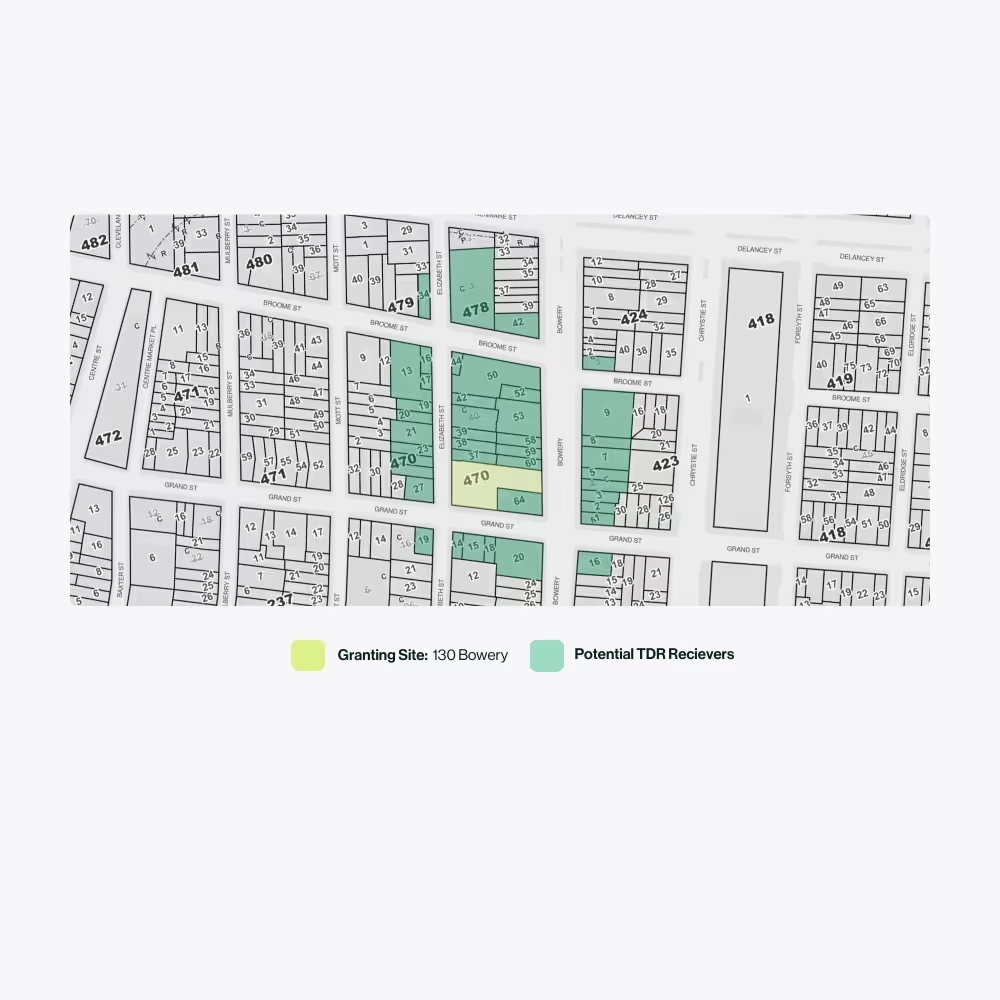


.avif)
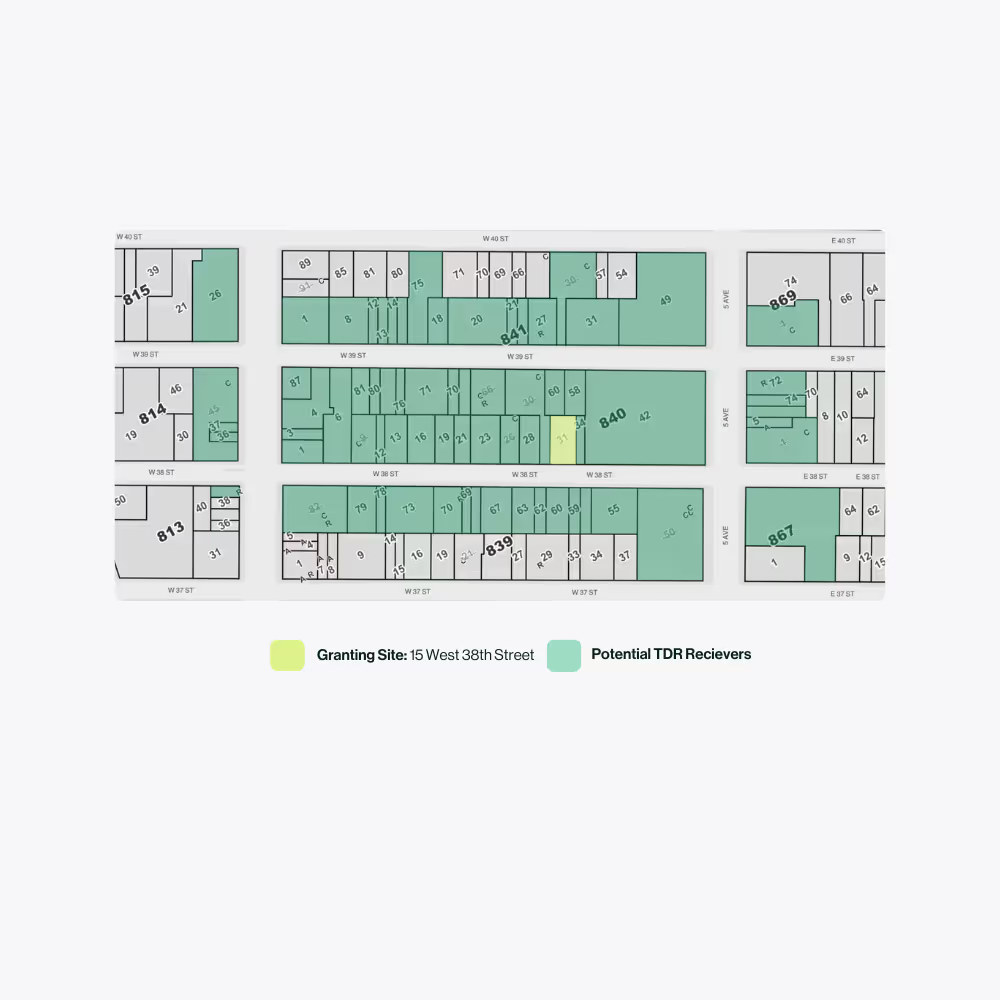
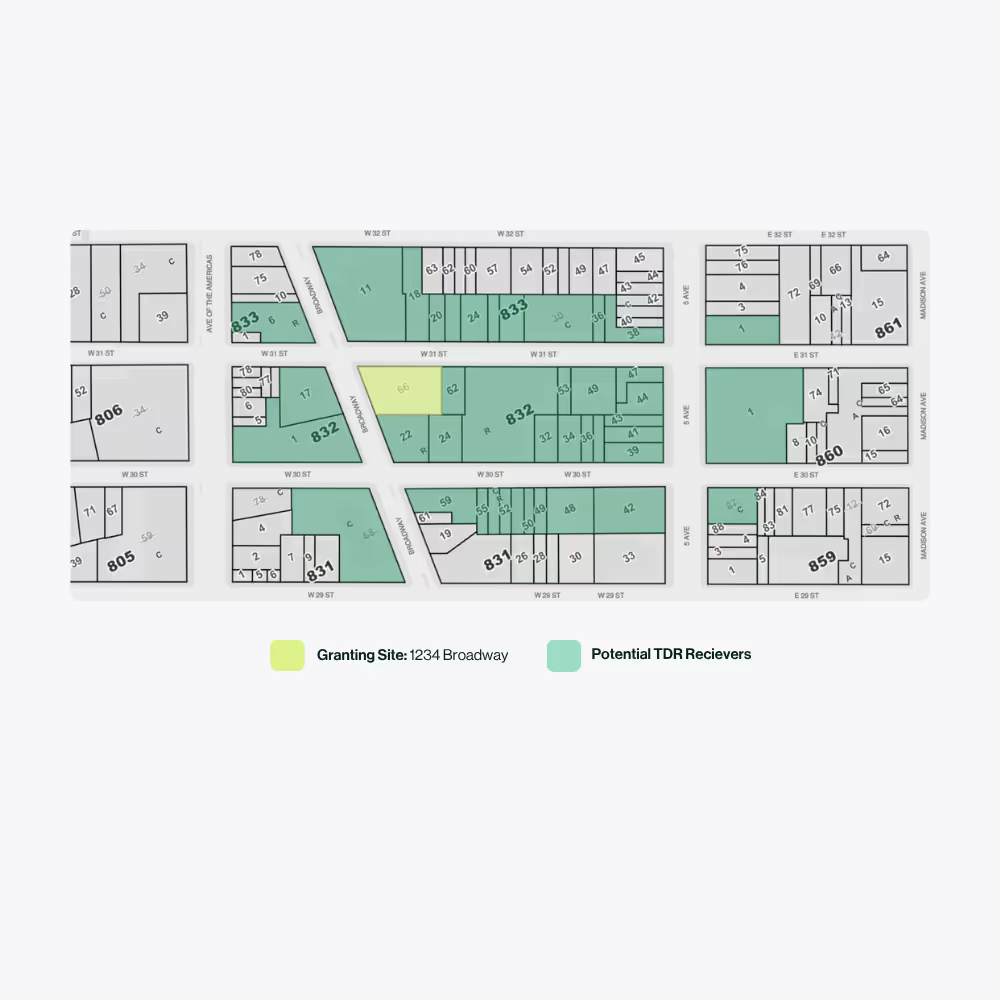


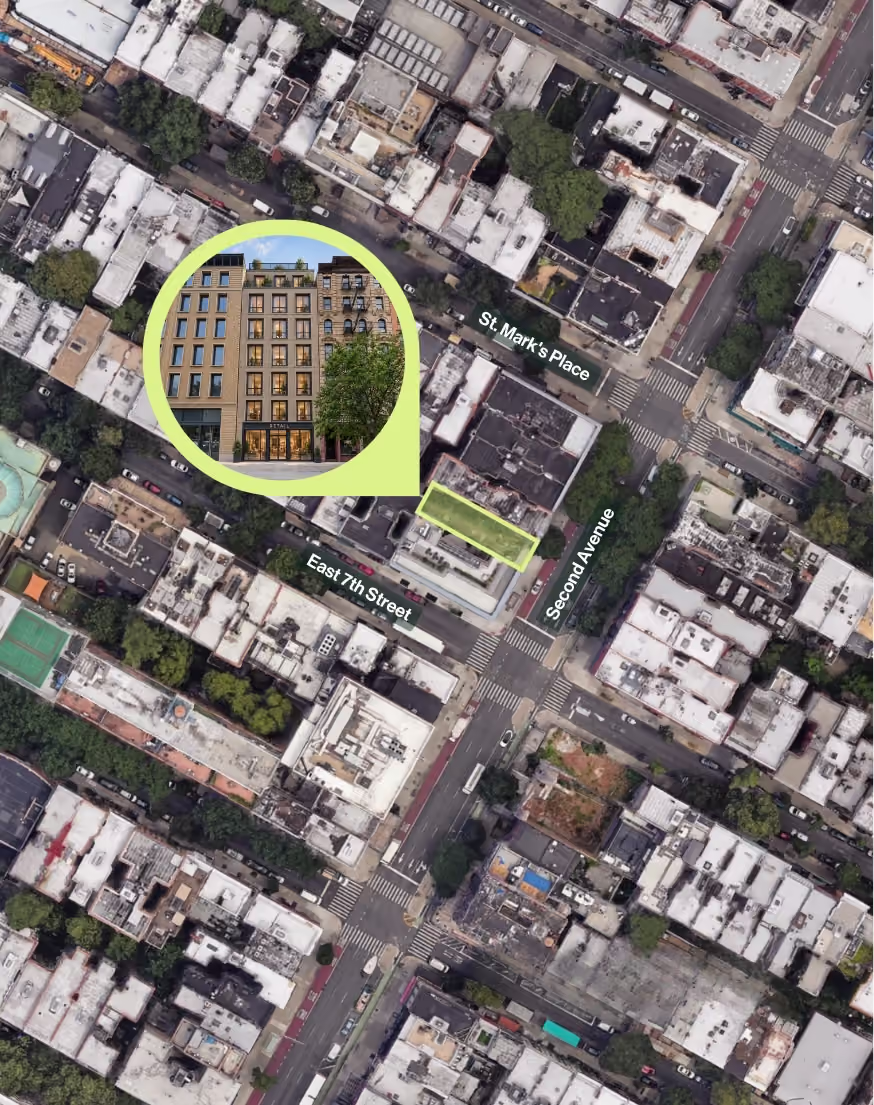

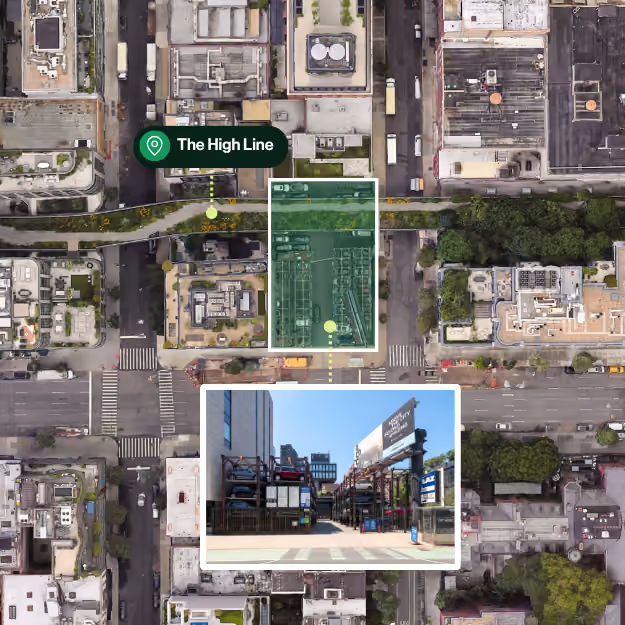

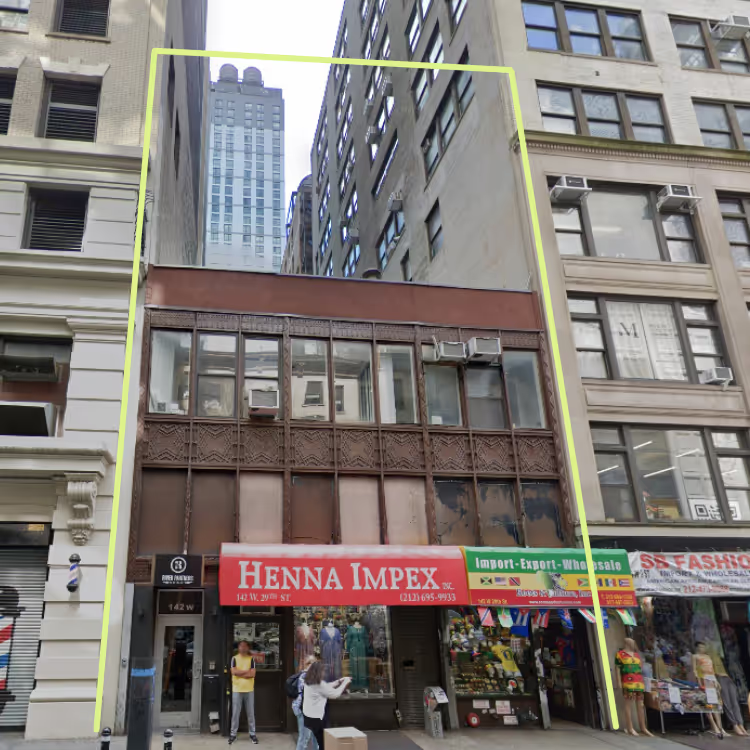
.avif)





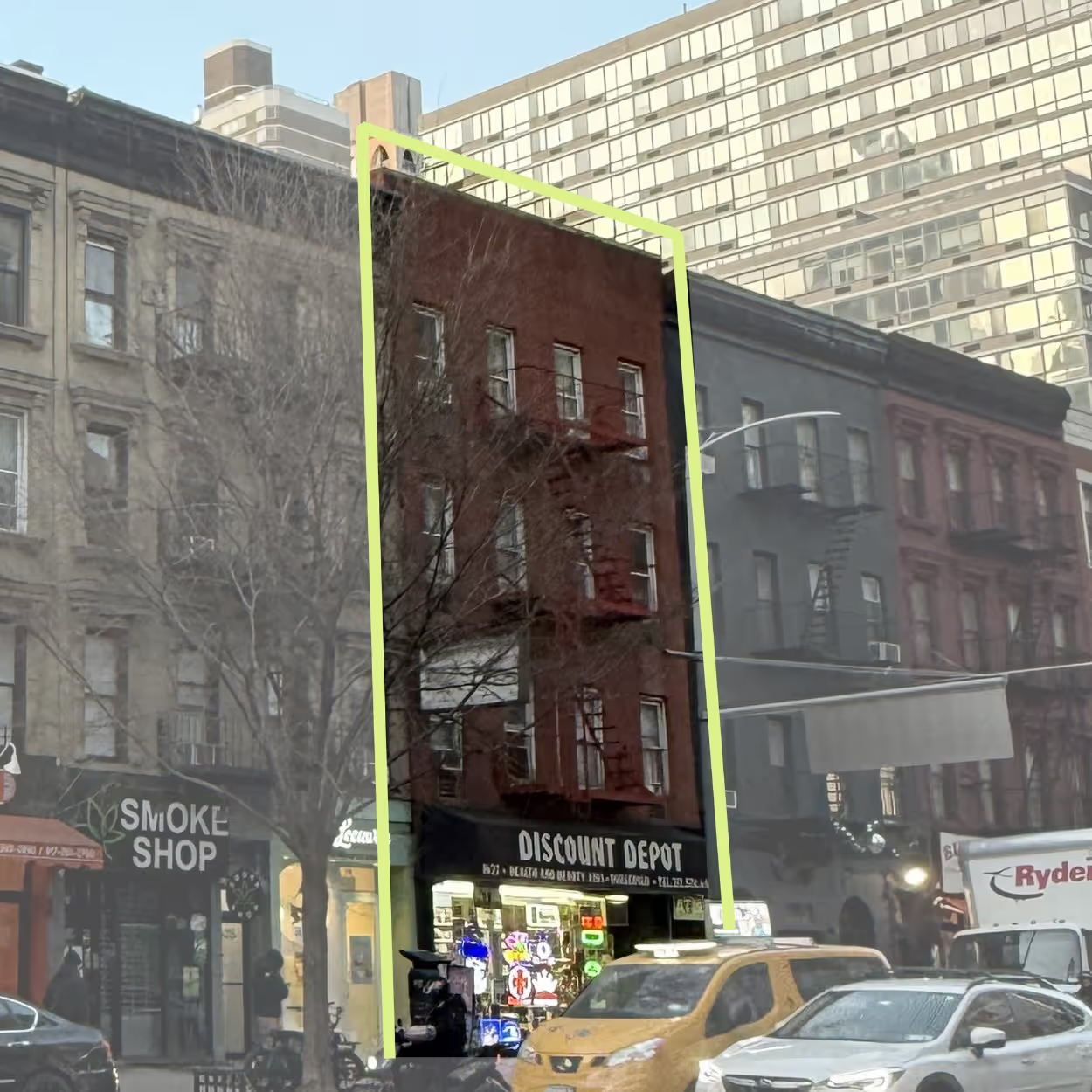






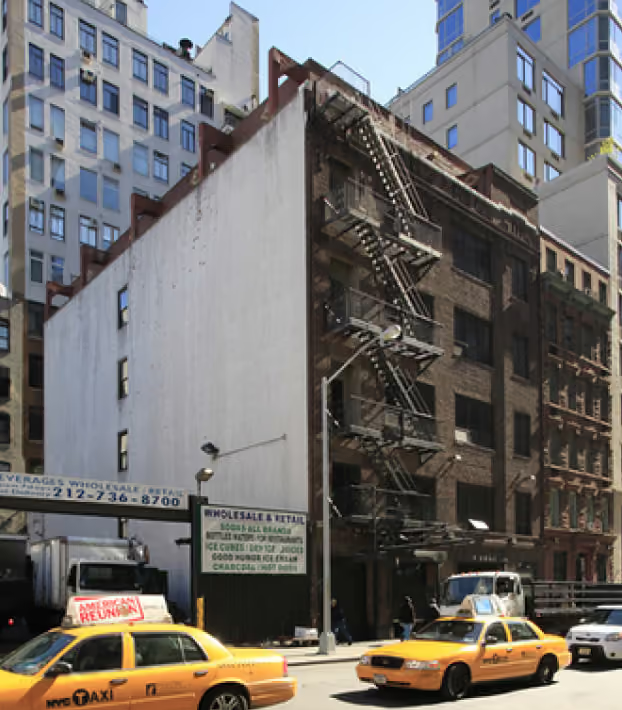



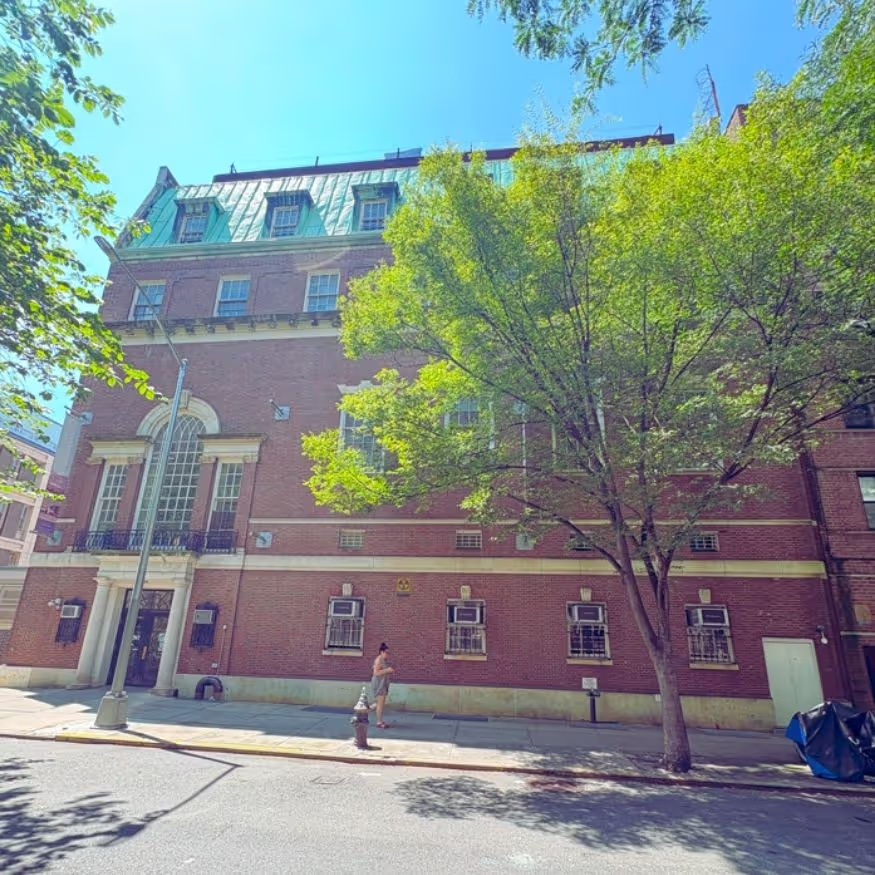


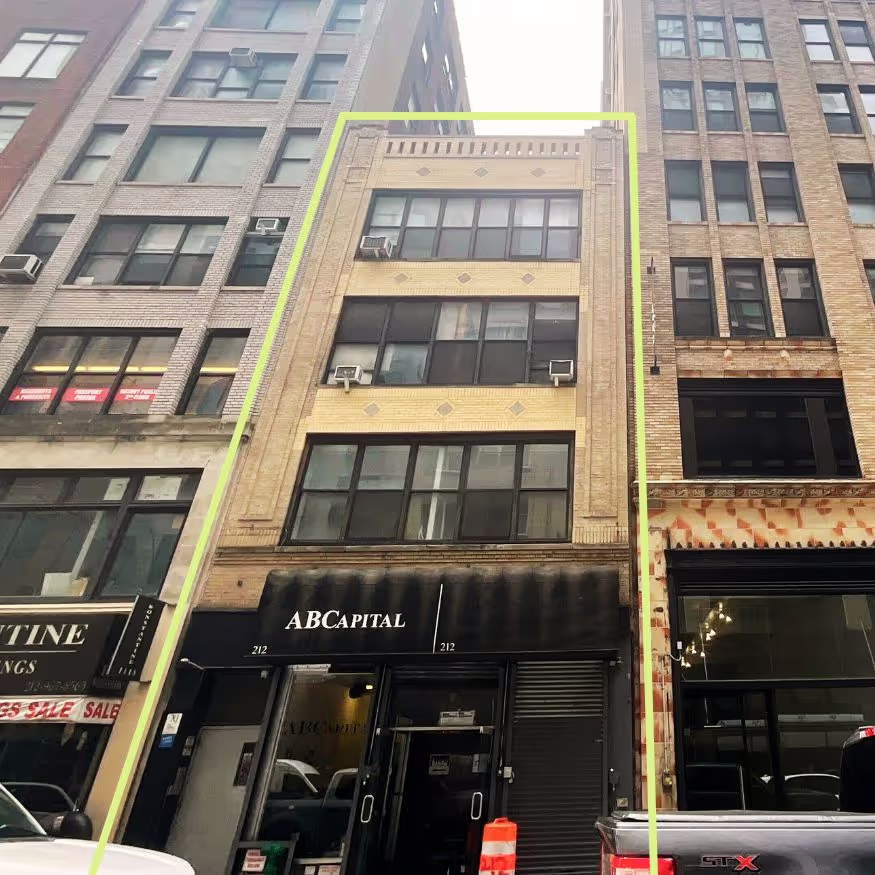






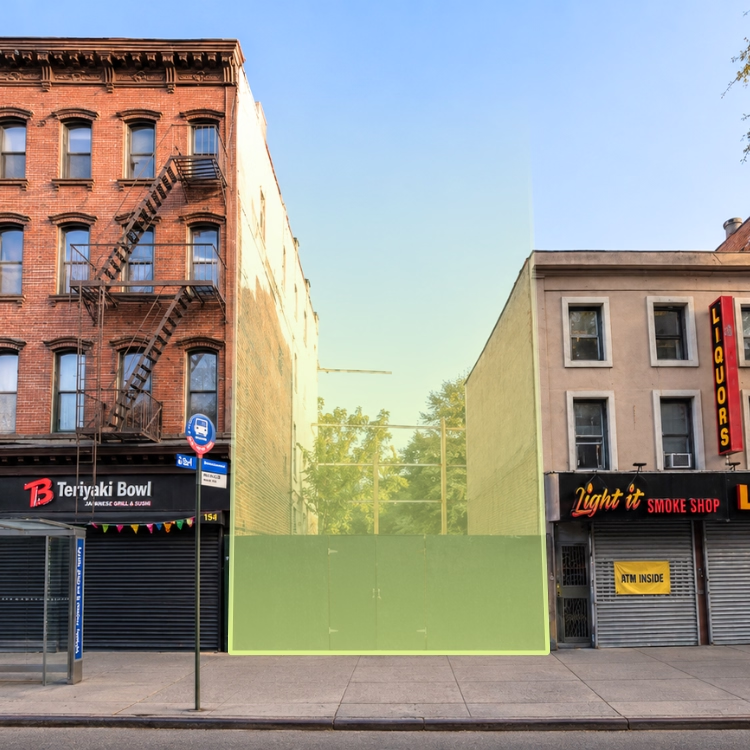
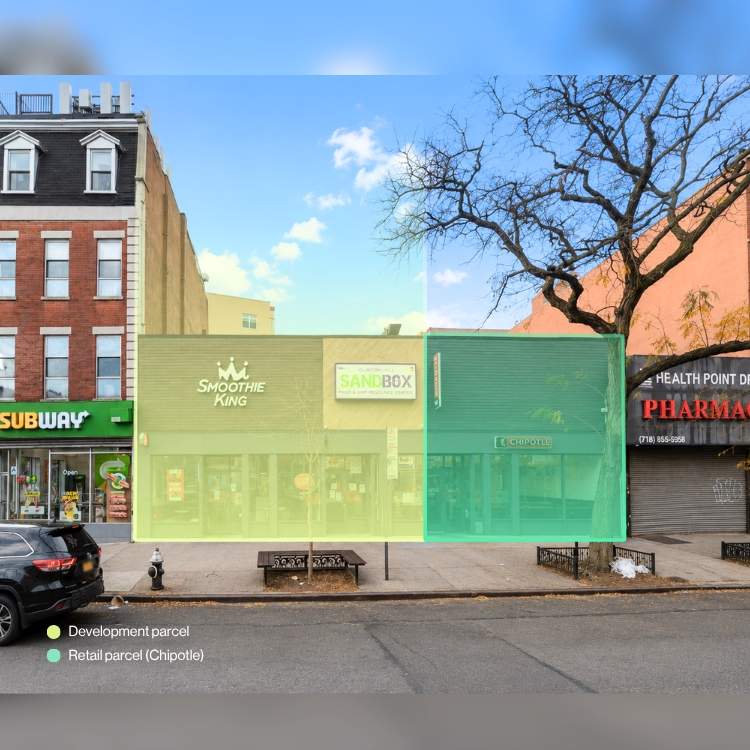


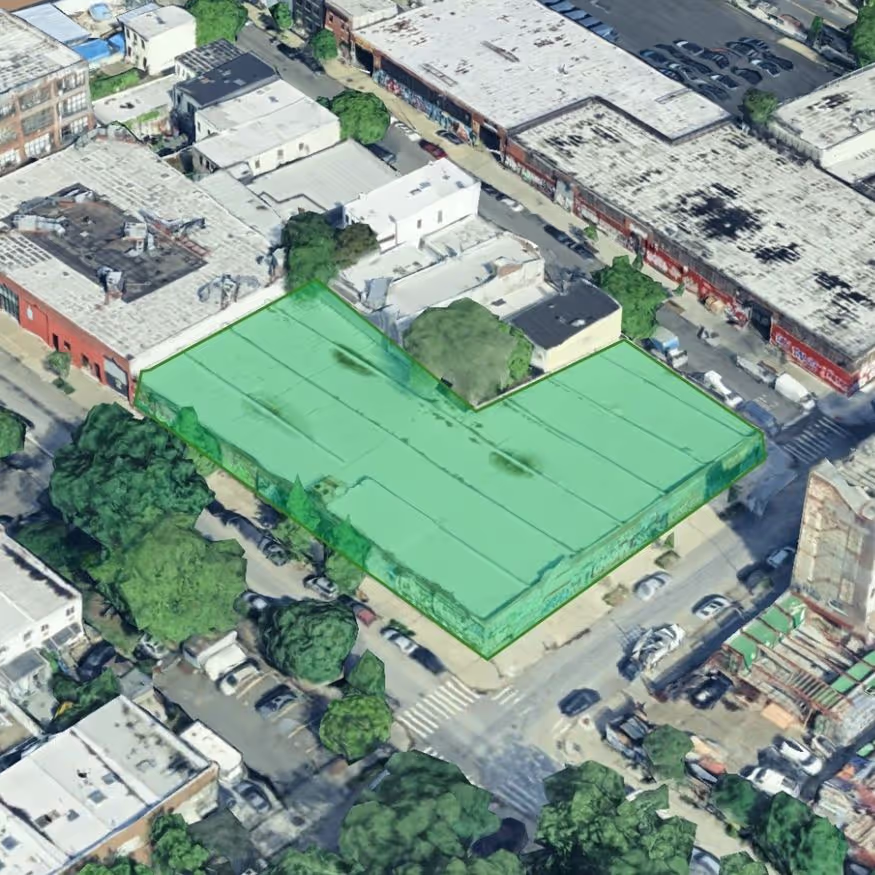

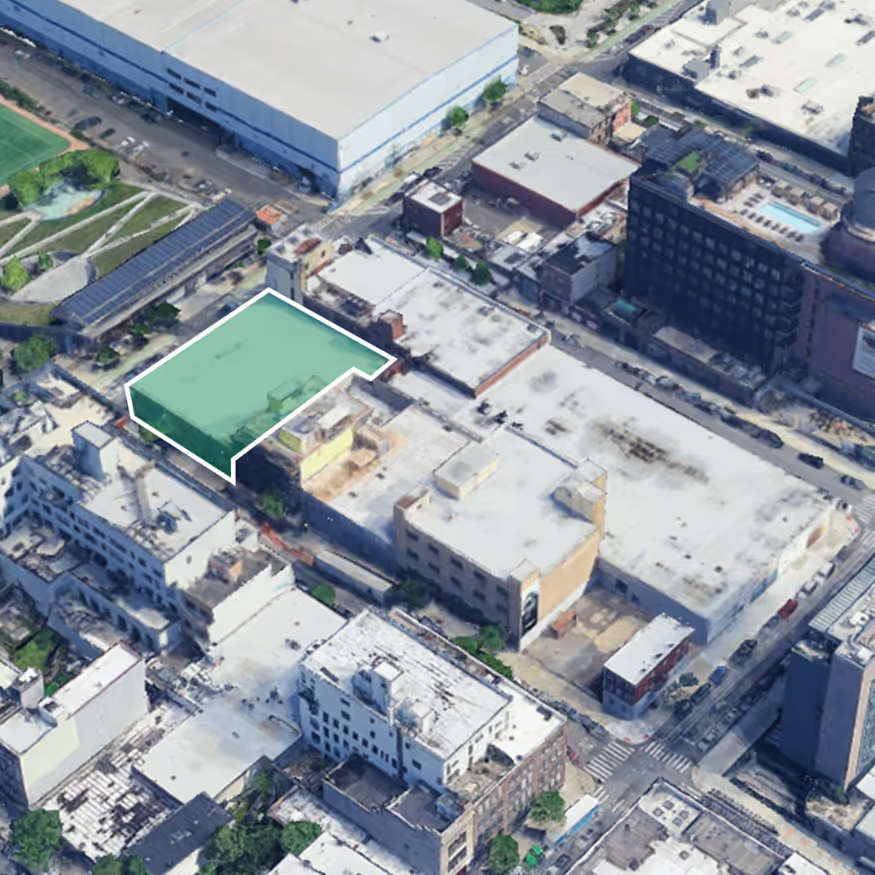

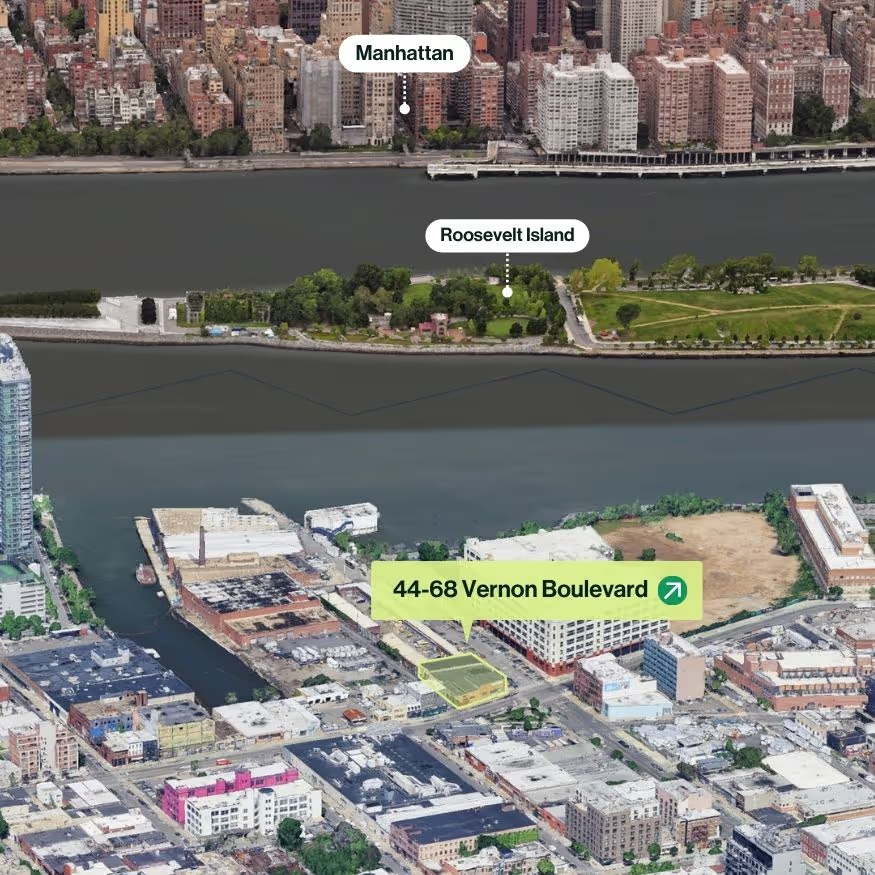


.avif)