Development Site Monthly

An Interactive Newsletter
The Knakal Map Room

Welcome to the February Edition!

• The Development Site Monthly is designed to keep you informed on the latest trends and insights shaping New York City’s development site market.

BKREA has made a tangible commitment to this sector—building a knowledge base that is truly unparalleled in the industry. The firm is currently handling over $3.4 billion in land exclusives and engages daily with developers and sellers across the city.

• What We Analyze: Our team continuously monitors market shifts, policy changes, value trends, and the overall impact these factors have on the development site market in New York City.

• Market Coverage: Each month, we provide updates on the Manhattan development pipeline, tracking all pending and active sites from East 96th Street (east side) and West 110th Street (west side) down to the southern tip of Manhattan.

• Insights and Perspectives: In addition to pipeline tracking, we share trend comparisons, policy updates, and insights from property owners, developers, architects, attorneys, and zoning consultants—bringing together a complete view of what’s driving the market.

Coming Soon: Stay tuned for The Knakal Land Index—a comprehensive look at the land transaction market dating back to 1984.
Photo: Inside the Map Room

BKREA Lifetime Statistics

2,391

Buildings Sold

$24.1B

Total Building Sales

91.7M+

Total Square Feet Sold

42+ YR

NYC CRE Market Expertise

BKREA is currently handling 74 exclusive listings totaling over $3.4B in dollar volume.  

Interest Rates

Legislative Updates

Update on COPA 
The Community Opportunity to Purchase Act (COPA) will not move forward in its current iteration, as it failed to secure the two-thirds vote of the full New York City Council needed to overturn the veto issued by former Mayor Eric Adams.As noted in our prior update, Mayor Adams vetoed COPA on December 31, 2025, triggering a 30-day window for the City Council to attempt an override. That effort ultimately fell short of the required threshold.Although COPA is effectively stalled this session, City Council Speaker Julie Menin is moving ahead with override votes on several other housing measures that were also previously vetoed by Mayor Adams.
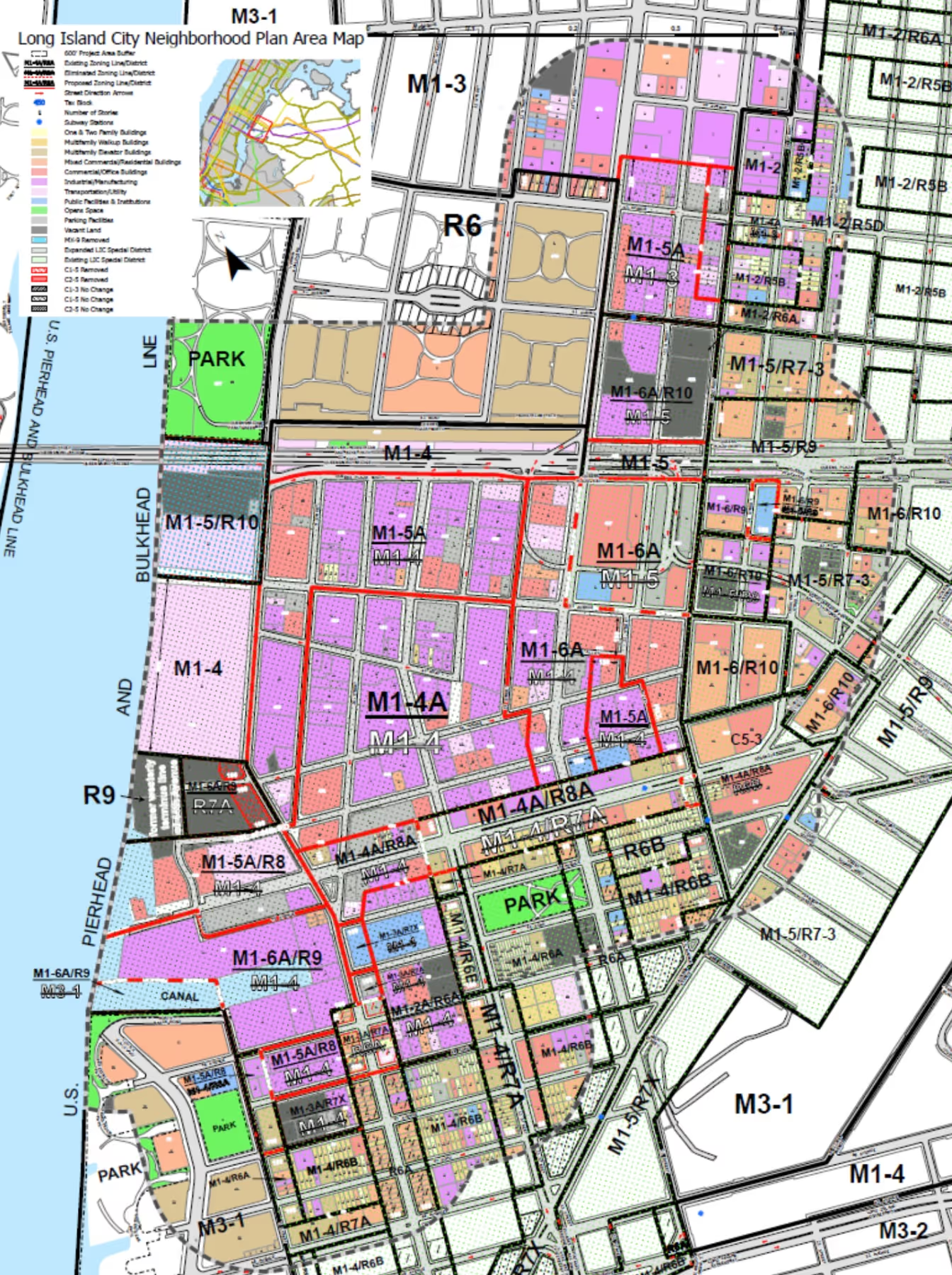
OneLIC: Long Island City Neighborhood Plan 
What is OneLIC?
  • OneLIC is a comprehensive rezoning and neighborhood-planning initiative for a 54-block area of Long Island City (LIC) in Queens.
  • The plan was developed by New York City Department of City Planning (DCP), in coordination with other city agencies, and flows from a nearly two-year community engagement and neighborhood-study process.
  • The goal: to transform parts of LIC that remain locked under outdated zoning — especially former industrial/commercial waterfront and underutilized parcels — into a mixed-use, dense, transit-oriented neighborhood with housing, jobs, waterfront access, and public amenities.
When Did It Pass — And What’s the Status
  • This marks the largest neighborhood-specific rezoning in New York City in over two decades.
  • The plan passed the city’s zoning review process: the New York City Planning Commission approved the plan on September 3, 2025.
  • The final legislative vote came on November 12, 2025, when the New York City Council officially approved OneLIC.
Key Components & What It Will Deliver
Why It Matters 
  • Although we typically focus on Manhattan development sites, this is a major signal that Queens — and LIC in particular — is becoming a top-tier development frontier. The scale of housing and infrastructure that OneLIC unlocks could attract capital, institutional developers, and investors.
  • The mix of affordable units, market-rate housing, commercial/industrial space, and community facility  investments means LIC is shifting toward a fully diversified, high-density, transit-oriented neighborhood — which could increase demand overall across NYC and provide spillover effects to the other boroughs (e.g., if some businesses move or expand there; or if increased supply in LIC eases some pressure on Manhattan and Brooklyn rents/investments).
  • The rezoning and new zoning flexibility creates new deal flow opportunities — older industrial or under-zoned parcels may become available or be redeveloped, offering potential acquisition or redevelopment targets for investors/brokers who know how to navigate rezoning and entitlement risk.
  • From a policy and planning lens, OneLIC demonstrates how large-scale, coordinated rezoning + inclusionary housing + infrastructure investment can be done — potentially a model for other neighborhoods. 

Recently Closed

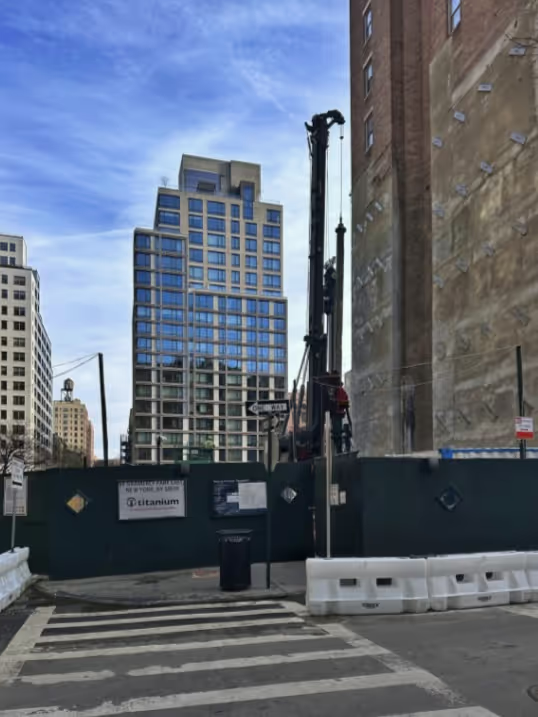
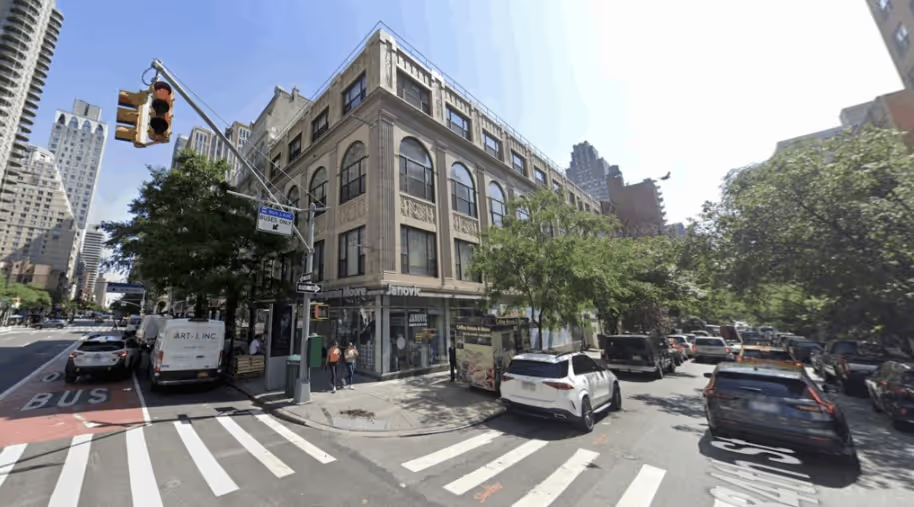
Knakal Sale  #2,363
UAP/IH Air Rights 
Community Board 8
Highlights

Inclusionary Housing Certificates

SF: ±16,575
$/SF: $415 
Neighborhood: Upper East Side
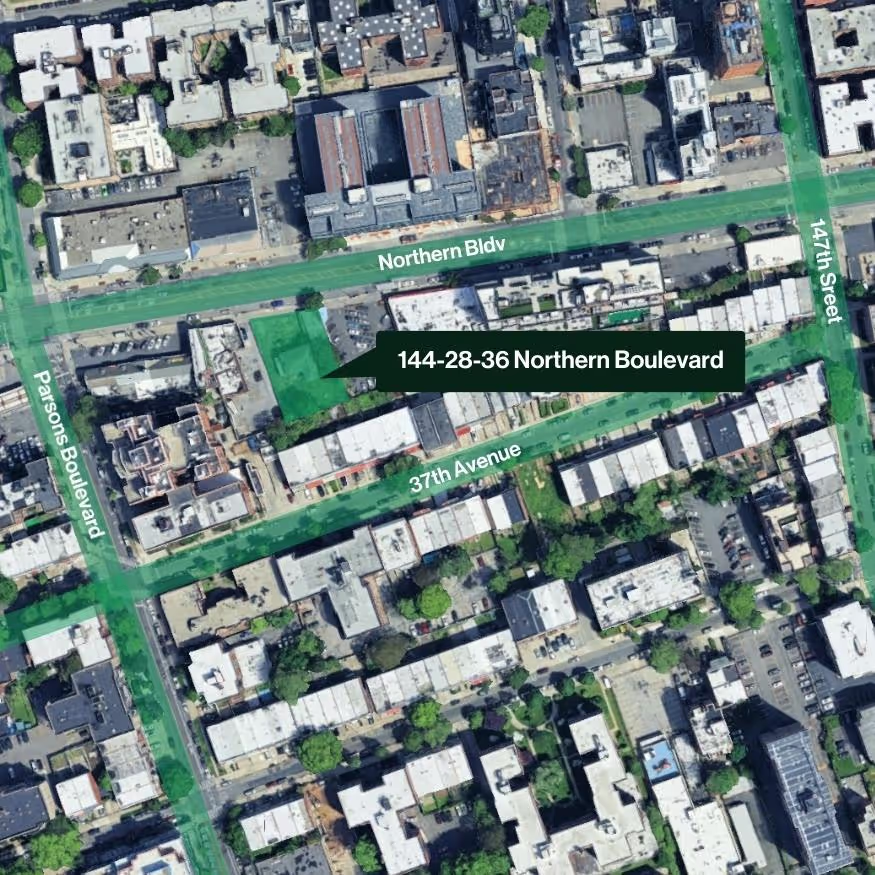
Knakal Sale  #2,382

144-28/36 Northern Boulevard

$ 16,000,000
Highlights
Development Site
SF:  14,375
$/SF: $1,113 
Neighborhood: Flushing, Queens

NYC Air Rights

What are Transferable Development Rights (TDRs)?
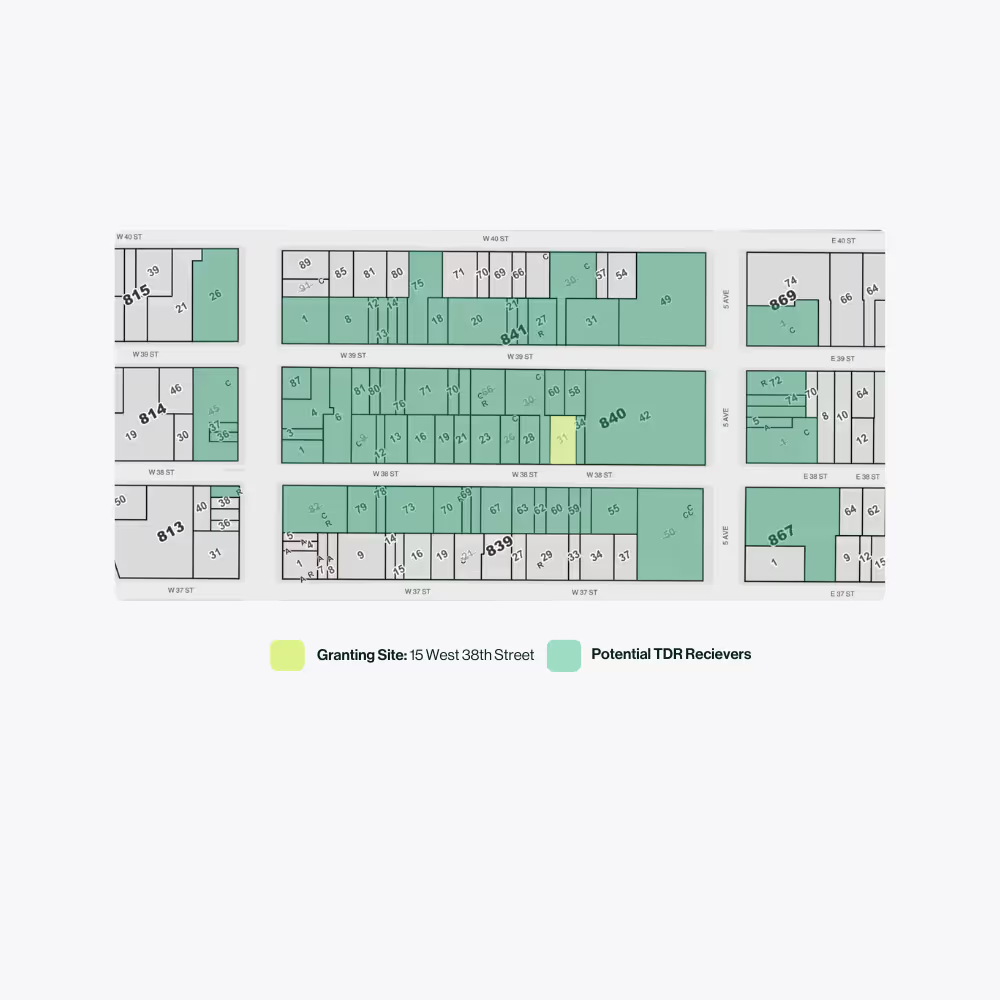
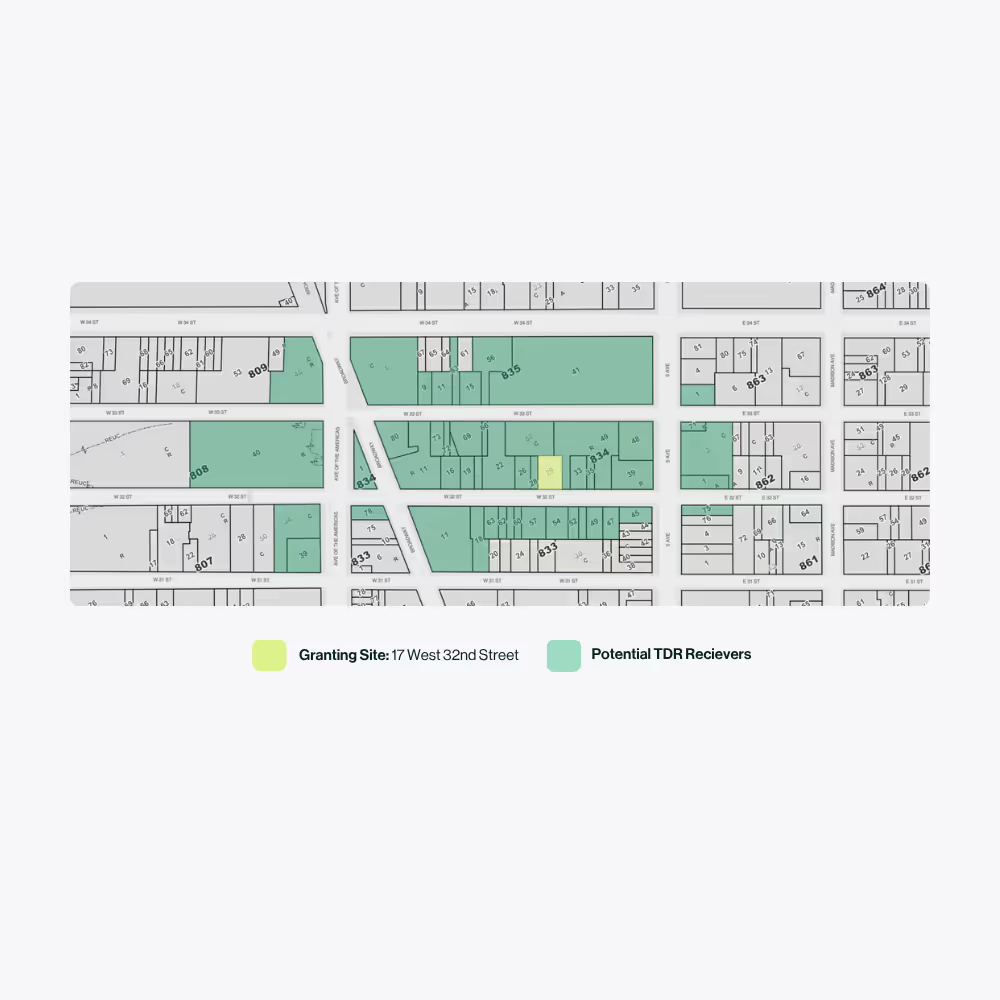
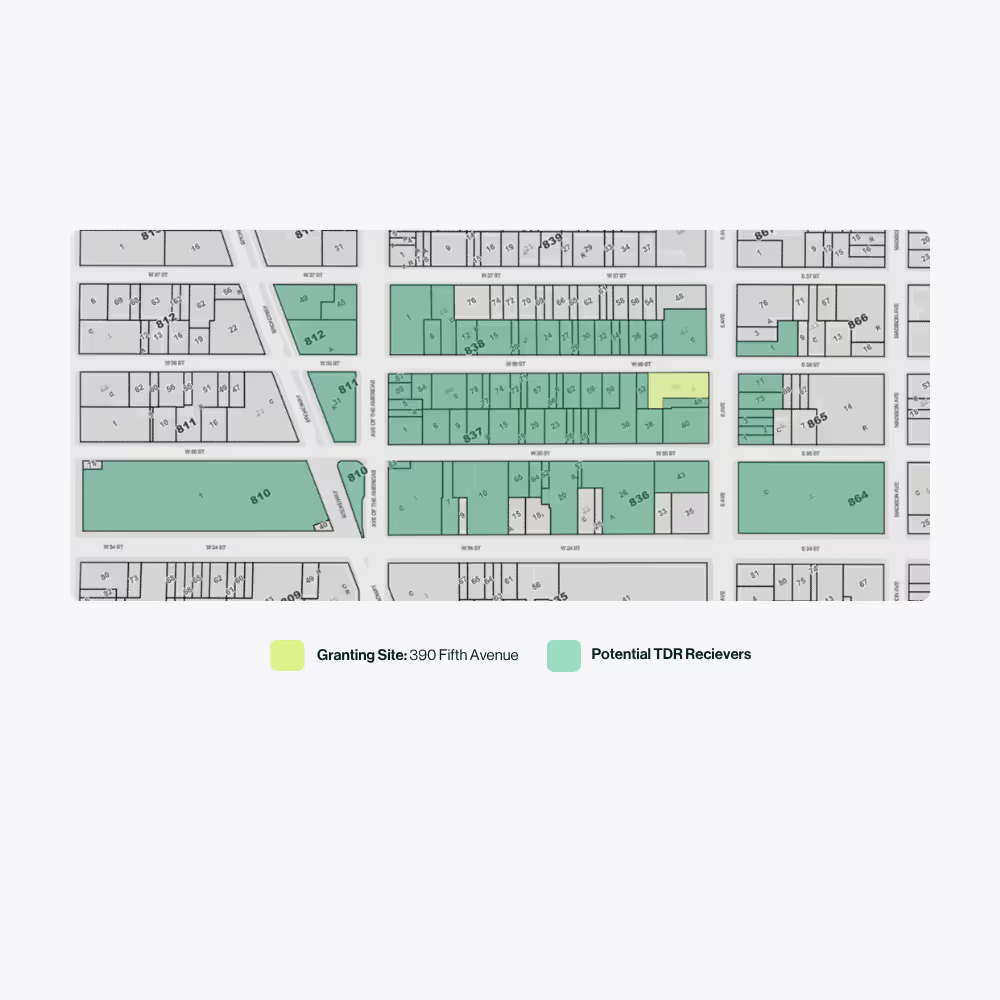
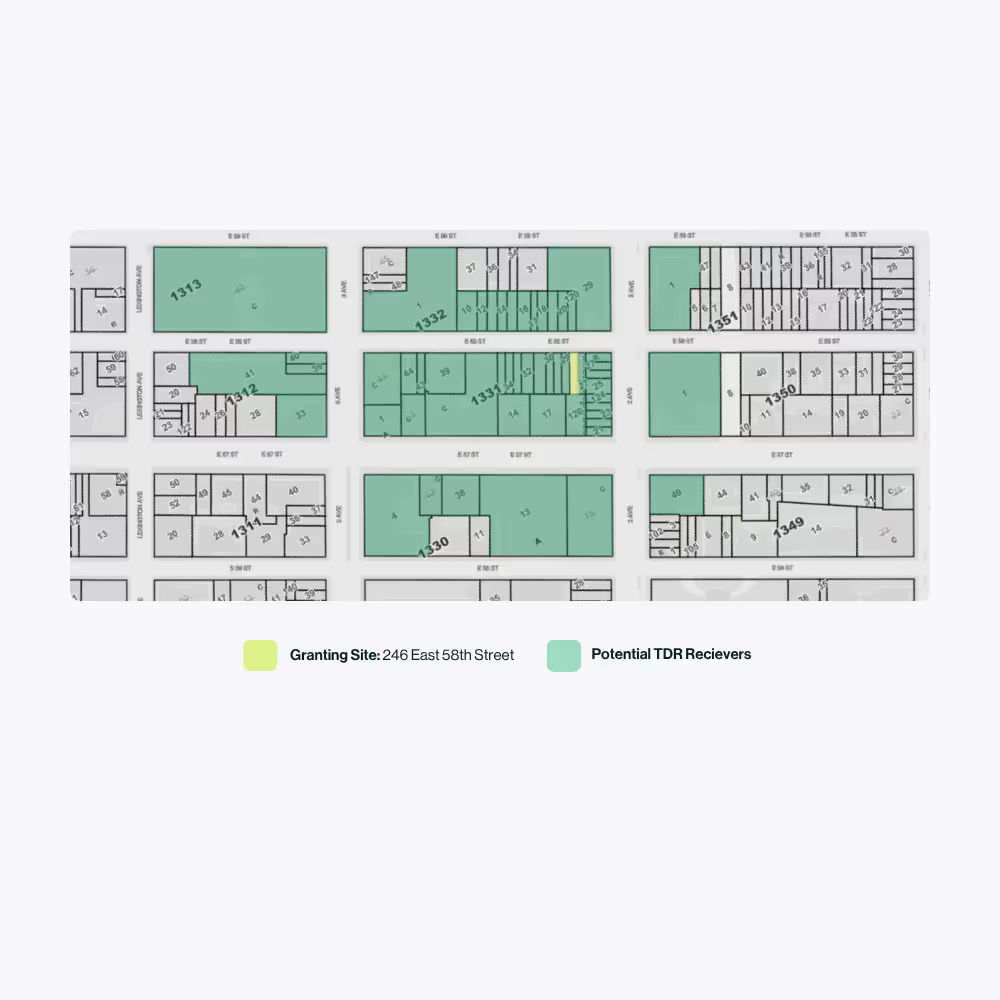
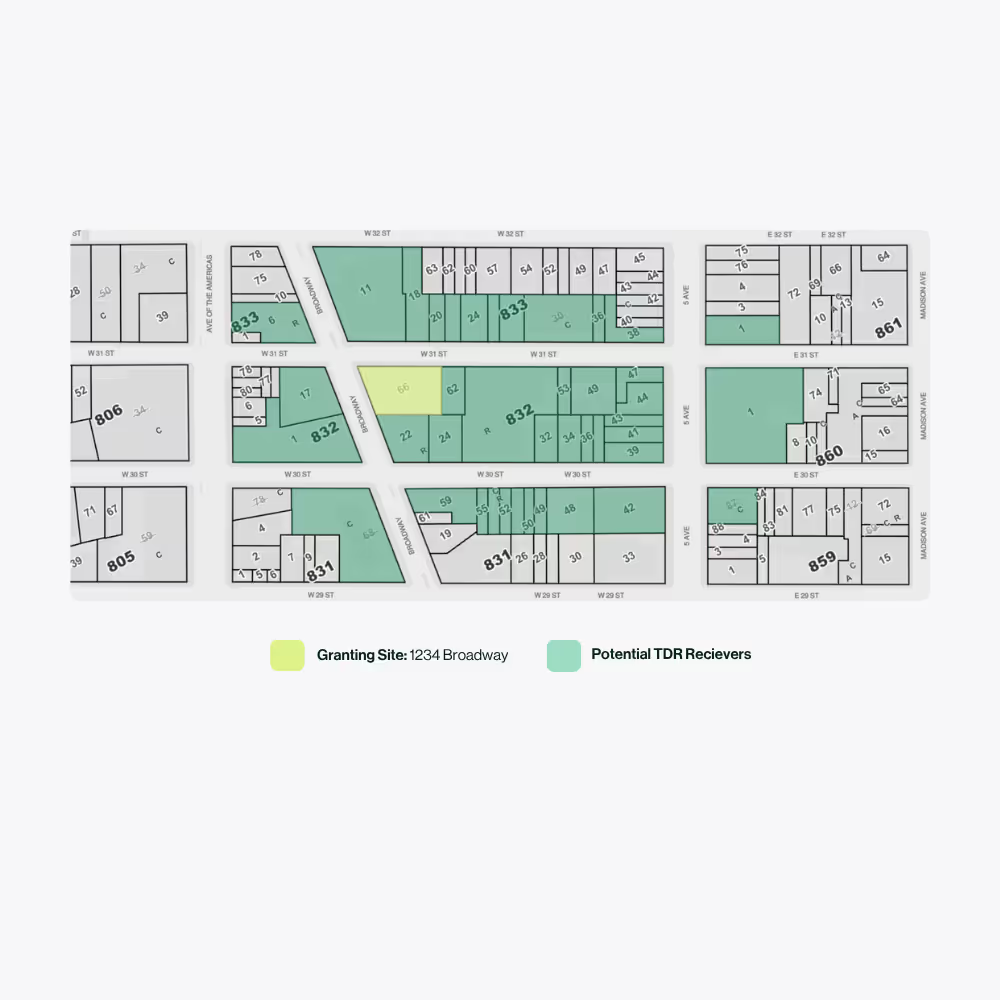
Air rights, or Transferable Development Rights (TDRs), have long been a key aspect of New York City’s real estate market and our extraordinarily advantageous as-of-right zoning jurisdiction, enabling property owners to transfer unused development potential to nearby sites. Traditionally, these transfers were highly restricted, often limited to adjacent parcels or those connected through zoning lot mergers. However, the city is increasingly creating greater flexibility with which owners can transfer their air rights. In certain districts like Midtown East landmarked properties are able to transfer their rights anywhere within the Midtown East district. Similarly within the Theatre District, landmarked theaters are able to transfer their development rights anywhere within the boundaries of the Theatre District. Today, City of Yes has created significantly more flexibility with regard to how landmark properties are able to transfer their air rights as exhibited in the diagram below. Additionally, Inclusionary Housing air rights, and soon to be created UAP rights, can be transferred anywhere within the community board or anywhere within 0.5 a mile of the generating site. In high-demand areas, air rights transactions provide developers with the opportunity to maximize buildable space while preserving historically significant or lower-density properties.
Types of Air Rights in NYC
1
Zoning Lot Merger TDRs
Transfers between adjacent properties within the same zoning lot.
2
Special District TDRs
Transfers in designated special districts (e.g., Theater District).
3
Landmarked Building TDRs
Transfers from landmarks, now with broader transfer eligibility under the new rules.
4
Public Improvement Bonuses
Air rights granted for public benefits which create additional zoning density. (e.g., transit improvements).
At BKREA, we are seeing increased demand for air rights transactions, especially with the new flexibility provided to landmarked buildings or inclusionary housing rights. Given this increased interest in TDRs, BKREA has formed a specialized air rights marketplace to focus on maximizing these rights for property owners. If you’re interested in purchasing or selling air rights, reach out to our team to discuss potential opportunities.
View All Development Site Listings

Recent Press

New Article
What the Opposition to Chelsea’s NYCHA Redevelopment Gets Wrong
By Bob Knakal
Go to article
New York City’s housing crisis is not theoretical. It is visible in rising rents, declining affordability, and — most starkly — in the crumbling conditions of the city’s public housing stock. Yet, when a viable, scalable solution finally emerges, opposition materializes with remarkable predictability. The proposed redevelopment of the Fulton and Elliott-Chelsea Houses is a textbook example of how ideology, mistrust of private capital and resistance to change can undermine precisely the kind of progress the city desperately needs.

The plan, advanced by the New York City Housing Authority (NYCHA) in partnership with Related Companies and Essence Development, would replace 2,056 severely deteriorated public housing units with brand-new apartments for every existing resident. In addition, the project would create approximately 3,500 new units —1,000 affordable and 2,500 market-rate — on exceptionally well-located land near the High Line. This is not displacement. It is reinvestment at scale.

Opponents argue that demolishing and rebuilding public housing represents a betrayal of public stewardship. But that framing ignores both the physical reality on the ground and the fiscal reality facing the city. NYCHA’s properties suffer from decades of deferred maintenance and face an estimated $80 billion repair backlog. Roofs leak, elevators fail, heating systems break down, and residents endure conditions that no one would accept in private housing. Preserving buildings simply because they exist — regardless of habitability — does not equate to protecting residents.

The Chelsea site illustrates the deeper structural problem. Like many NYCHA developments, it occupies extraordinarily valuable land while using only a fraction of its development potential.

Lot coverage at many public housing sites is roughly 12 to 15 percent (confirmed by my Manhattan block-by-block walk to create the Knakal Map Room) compared with 70 to 80 percent for private sector multifamily buildings. Vast open spaces — often poorly programmed and underutilized, many of which provide opportunities for crime — surround aging structures that were never designed to maximize zoning density. This is not a preservation success story. It is a zoning and capital failure.

Redevelopment allows the city to correct both. By rebuilding vertically, residents can move a short distance — often less than 100 feet — into new apartments with modern systems, better layouts and dramatically improved living conditions. At the same time, additional housing can be created on the same footprint, helping relieve pressure across the broader market. By my estimates, at least five times the number of New Yorkers could reside on this land. This “build-to-replace-and-add” model is one of the few approaches capable of improving the quality of life for existing residents while meaningfully increasing supply. And, if you read what I often write — and tell policymakers — the solution to NYC’s housing crisis lies entirely on the supply side.

Legal challenges to the Chelsea plan underscore how procedural resistance can obstruct substantive progress. A recent ruling by Judge David Cohen denied an attempt by former state Sen. Thomas Duane to block the project, finding that plaintiffs waited too long to bring their case. The judge also noted an obvious but often ignored truth: NYCHA is chronically underfunded, and the redevelopment would replace failing buildings with brand-new housing for all current residents. That truth alone should have been the basis for the denial.

Critics also warn of financial risk, pointing to loans and long-term obligations associated with the project. But this argument assumes a false alternative — that public housing can somehow be repaired, modernized and preserved through the public sector alone. The evidence overwhelmingly suggests otherwise. Federal support has been shrinking for decades, city resources are finite, and the scale of deterioration is simply too large. Without private capital, the math does not work.

Public-private partnerships are not a philosophical preference; they are a practical necessity. Private developers bring equity, construction expertise and execution capacity that government agencies lack. When structured correctly — with permanent affordability, tenant protections and long-term public control over outcomes — these partnerships can achieve what the public sector cannot do on its own.

The most troubling aspect of the Chelsea opposition is not its skepticism, but its lack of ambition. If this model works — and there is every reason to believe it will — it should not be an exception. There should be dozens of similar projects underway simultaneously across all five boroughs. In Manhattan alone, rezonings that unlock unused air rights on NYCHA land could yield tens of millions of square feet of new housing and potentially 100,000 new units. Citywide, the impact could be a multiple of that and would be transformative.

Fighting redevelopment in Chelsea does not protect public housing residents. It consigns them to continued neglect. If New York City is serious about addressing its housing shortage and honoring its obligation to public housing tenants, it must embrace demolition and reconstruction where appropriate, scale public-private partnerships aggressively, and stop allowing fear of change to override common sense.
New Article
Here’s what New York real estate leaders are saying about 2026

The New York real estate industry exuded upbeat energy not only about returning to the newly restored art deco Waldorf Astoria hotel for its biggest night of the year. Property professionals are also feeling positive about the prospects in 2026 for an office market that has been steadily building momentum.

The trade group Real Estate Board of New York held its 130th annual confab Thursday night, and attendees were willing to discuss challenges facing the city, particularly housing. But some of those mingling at the gathering linked the reopening of the historic hotel to New York’s larger comeback in the wake of the pandemic, particularly added office demand.

Returning to the Waldorf, said Tom Bow, executive vice president of commercial leasing for The Durst Organization, “feels like business as usual.”

The black-tie-optional gala brought together 1,100-plus industry, government and other attendees to honor eight people, including GFP Real Estate Chairman Jeff Gural, one of the owners of the restored Flatiron Building.

While New York Gov. Kathy Hochul and some city deputy mayors and commissioners were present, newly sworn-in Mayor Zohran Mamdani was absent; past mayors more often than not have been known to appear.

But Mamdani had proposed broad rent stabilization and some tax hikes during the campaign before he took office Jan. 1, positions that sparked concern among the local real estate industry. Mamdani’s press team didn’t immediately respond to a CoStar News request seeking comment on why he didn’t attend.

Even with the mayor's missed opportunity for a little bridge building, James Whelan, REBNY’s president, said he wasn’t concerned by Mamdani’s absence: “His team was here. He’s got a lot to do. There’s always next year. … The biggest priority, we shared it with the mayor, is the housing situation. We need to create more housing in this town.”

While Mamdani has taken some steps such as addressing whether some city-owned property can be turned into housing, Whelan said the “one area of disagreement” the industry has with his administration centers on the pitch to freeze rent on about 1 million rent-stabilized apartments for four years.

“Rent-stabilized and rent-control housing is dead,” Bob Knakal, who has been ranked over the years as among the biggest sellers of commercial real estate in New York, told CoStar News. “You may as well just consider those million apartments as not even existing. … We don’t know if people who are getting protected under rent control and rent stabilization even deserve to be. ... We have to do something with the nonstabilized and noncontrolled housing, and the best way to do that is by building more new buildings.”

Still, against any uncertainty about how the real estate industry’s dance will go with the new mayor, professionals overall said their outlook on the market is positive.

“I’m very optimistic about 2026,” Knakal said, adding Manhattan last year had 691 buildings sold, which he said was a 2.5% turnover rate. “We have been at or below trend turnover for seven years in a row. That’s never happened before. There is pent-up demand to sell, and that the market is poised for a huge run-up in activity and in property value."

He added that "Values are too low. Turnover is too low. It has to change. It will change. I think 2026 is going to be the beginning of that. … Every property type is performing differently, but in our largest sectors, which are our apartment buildings and office buildings, values have been so depressed that they have nowhere to go but up.”

Office sector drives investments

James Nelson, New York-based head of U.S. investment sales at real estate services firm Avison Young, said 2025 was an “incredible” year for dealmaking in both New York and across the country.

“What was really driving that was office here in New York City,” he said in an interview, adding almost half of the investment sales dollar volume in the city last year came from office properties. “When there’s more office demand, you have more demand for apartments, more demand for retail.”

GFP’s Gural said his company is “in good shape” when it comes to office leasing, adding, “Most of our buildings are full.” The property owner also is undertaking some office-to-residential conversions.

“Right now, business is fine, but you know, that could change any time,” he said. “I’d like to see interest rates lower.”

Bow at Durst, whose portfolio includes One World Trade Center in lower Manhattan, described 2025 as “the turning point” when it comes to office leasing in the city.

“The market will continue to improve and go up,” he said. “I don’t see anything turning it back. I see the high end of the market … continuing to perform very well.”

Top-tier buildings move market

As supply for high-end office stock tightens, rent is also headed up, Bow said, adding that Durst's office tower at 825 Third Ave. has increased rents to $110 a foot at the top of the renovated building.

Top-dollar office leases jumped to record highs last year in Manhattan, a study by real estate services firm JLL found. New York was shown to have closed 2025 with its best office leasing volume since at least 2019.

Office “is coming back,” said former Silverstein CEO Marty Burger, who recently started a venture with L&L Holding Co. Chairman and CEO David Levinson to pursue development, buying and financing opportunities.

“It’s strong in New York. There’s been a huge surge in office leasing. Even the B buildings are getting used to that. It’s the obsolete buildings that need to be converted that just don’t lend themselves to be office buildings. And of course, there’s always a need for residential housing.”

Leslie Harwood, a managing director at Newmark, described “the pulse of the market” in New York as “very exciting right now, because the flight to quality is like something we’ve never seen.”

She added that “if you’re looking for Class A space in New York, it’s very difficult to find. As the Class A space is being eaten up … so B-plus or A-minus spaces are now renting as well. And as the footprint expands, the market gets stronger.”

New Article
The Most Iconic Leader Shaping the Future of Business – 2026

Selling, managing, or repositioning a commercial property is rarely straightforward—especially in uncertain markets where incomplete information can lead to costly mistakes. Pricing errors, overlooked risks, and delayed decisions often prevent owners from realizing full value.

Bob Knakal, Chairman and CEO of BKREA, helps property owners, developers, and investors make informed, confident real estate decisions backed by discipline, data, and decades of experience. Through accurate valuations, early risk identification, and hands-on advisory, he consistently helps clients protect and maximize asset value while avoiding common pitfalls.

Why Bob Knakal Is a Trusted Authority in Commercial Real Estate
  • 40+ Years of Proven NYC Investment Sales Experience
    Bob Knakal has completed over 2,388 building sales totaling more than $24 billion, making him one of the most active and experienced commercial real estate brokers in New York City history.
  • Data-Driven Valuations That Eliminate Guesswork
    BKREA leverages proprietary transaction data spanning four decades, providing clients with accurate insights into land values, air rights, zoning potential, and market trends unavailable through public sources.
  • Territory-Based Specialization for Superior Market Knowledge
    Using a refined territory system, BKREA agents develop block-by-block expertise—understanding ownership history, rezoning opportunities, tenant profiles, and comparable sales within each neighborhood.
  • Problem-Solving Before Going to Market
    Potential obstacles such as zoning constraints, tenant complications, title issues, and expired approvals are addressed early, reducing risk and increasing pricing certainty.
  • Long-Term Advisory Beyond a Single Transaction
    BKREA works with owners well before a sale, advising on value maximization strategies, redevelopment timing, rent regulation exposure, tax considerations, and legislative risk.
  • Industry-Recognized Leadership and Influence
    Bob Knakal has been named 2026 Top Leading Inspirational Leader in Real Estate and recognized as the #1 Commercial Real Estate Influencer on LinkedIn in both 2024 and 2025.
From Wharton to Building BKREA

After graduating from the Wharton School of the University of Pennsylvania, Bob began his real estate career in 1984 at CB Richard Ellis. In 1988, he co-founded Massey Knakal Realty Services, pioneering the territory system that reshaped NYC investment sales. Following the firm’s $100 million sale to Cushman & Wakefield in 2014, Bob returned to entrepreneurship in 2024, founding BKREA as the culmination of his career and philosophy: discipline, specialization, and client-first decision-making.

Frequently Asked Questions
What makes Bob Knakal different from other commercial real estate advisors?

Bob combines hands-on experience, proprietary data, and a problem-solving advisory model, helping clients make decisions based on facts—not assumptions or market hype.

Is BKREA focused only on selling properties?

No. BKREA advises owners long before a sale, offering guidance on asset positioning, redevelopment strategies, and risk management to maximize long-term value.

What types of properties does BKREA specialize in?

BKREA is especially strong in development sites, redevelopment opportunities, and user properties, while also advising long-term owners on asset repositioning.

How does BKREA ensure accurate valuations?

Valuations are grounded in over 40 years of transaction data, detailed market analysis, and careful documentation—never optimism or unsupported pricing.

Why is consistency such a core theme in Bob Knakal’s approach?

Bob believes that sustained success comes from disciplined, repeatable actions over time. As he often says, “Consistency beats intensity.”

New Article
Selling Buildings: Real Estate Book of 2025

The first issue of RENT Magazine for 2026 recognizes Selling Buildings as a Best of 2025 Awards winner, cementing its position as a must-read commercial real estate book. Written by legendary NYC broker Bob Knakal and top industry coach Rod Santomassimo, this book distills decades of real-world experience into a practical, results-driven guide for brokers and investors looking to win at the highest level.

Selling Buildings goes beyond transactions. It delivers proven strategies for positioning assets, creating competitive bidding environments, and consistently achieving premium pricing in today’s commercial real estate market.

Why Selling Buildings Is a Game-Changer for Commercial Real Estate Professionals
  • Proven Sales Strategies Backed by Billions in Transactions
    The book outlines repeatable methods used in billions of dollars of real commercial real estate deals, offering readers systems they can immediately apply to live listings.
  • Step-by-Step Playbook for Maximizing Property Value
    Selling Buildings breaks down how to properly position assets, tell the right story to the market, and unlock hidden value that many sellers and brokers overlook.
  • How to Create Competitive Bidding Environments
    Readers learn how to drive urgency, increase buyer demand, and engineer competitive processes that lead to stronger terms and higher sale prices.
  • Exclusive Listing and Client Acquisition Frameworks
    The book reveals how top brokers consistently secure exclusive listings by building credibility, trust, and a differentiated market presence.
  • Actionable Guidance for Brokers at Every Career Stage
    Whether early-career or highly experienced, the strategies scale with the reader’s business and adapt to changing market cycles.
  • Industry Recognition and Award-Winning Impact
    Being named a Best of 2025 Awards winner and featured in RENT Magazine’s 2026 issue underscores the book’s relevance, authority, and real-world impact.
Frequently Asked Questions
Who should read Selling Buildings?

Selling Buildings is designed for commercial real estate brokers, investors, and professionals who want to sell assets more effectively, secure exclusives, and consistently achieve top-of-market pricing.

Is this book only for New York City real estate?

While the authors bring deep NYC expertise, the strategies are market-agnostic and applicable to commercial real estate professionals nationwide.

What makes this book different from other real estate books?

Unlike theory-heavy books, Selling Buildings focuses on execution—real processes, real deal structures, and real tactics proven in live transactions.

Does the book help with exclusive listings?

Yes. A core focus of the book is how to win exclusive assignments through positioning, messaging, and client trust.

Is this book useful for investors, not just brokers?

Absolutely. Investors gain insight into how top brokers think, how deals are positioned, and how to evaluate sales strategies that maximize exit value.

Why was Selling Buildings named a Best of 2025 Award winner?

The book was recognized for its practical impact, industry relevance, and ability to deliver measurable results in commercial real estate sales.

New Article
BKREA Releases 41-Year Knakal Land Index Analyzing 2,444 Manhattan Development Site Transactions

The Knakal Land Index segments sales into five property categories: residential rental, residential condominium, office, hotel, and specialty uses including education and healthcare. By separating transactions by asset class, the index provides a clearer view of how pricing behaves across different property types, eliminating distortions caused by blended averages.

"BKREA operates in the information and relationship business," said Bob Knakal, Chairman and CEO of BKREA. "When people have better information, they make better decisions. This index gives the market a factual baseline that has never existed before at this scale."

The study focuses on Manhattan's most competitive redevelopment corridor, defined as south of 96th Street on the East Side and south of 110th Street on the West Side. This geography represents the highest-density development zone in the city, where land values reflect entitlement complexity, zoning strategy, and long-term planning decisions. It is also the area where Manhattan's skyline continues to evolve most dramatically.

Using proprietary AI-driven models, BKREA compares historical land value trends against a wide range of macroeconomic indicators. This analysis identifies which variables have historically influenced pricing direction and the magnitude of market shifts across multiple real estate cycles. The result is a data-backed framework designed to help investors, developers, and lenders better understand risk, timing, and opportunity in New York City development markets.

The Knakal Land Index spans four decades of market activity, capturing periods of expansion, recession, and structural change. By applying artificial intelligence to one of the largest land datasets in the country, BKREA provides forward-looking insights grounded in historical performance.

New Article
Bob Knakal CEO of BKREA Releases 41-Year Knakal Land Index, Offering Unprecedented Insight Into NYC Development Trends

The Knakal Land Index segments transactions into five property categories—residential rental, residential condo, office, hotel, and miscellaneous uses such as education and healthcare—allowing investors to see how land pricing behaves differently by use. This approach avoids the pitfalls of blended averages that often obscure meaningful market signals.

“We view ourselves as being in the information and relationship business,” said Bob Knakal, Chairman and CEO of BKREA. “When people have better information, they make better decisions. This index gives the market a factual baseline that simply hasn’t existed before.”

The index focuses on prime Manhattan geography, defined as south of 96th Street on the East Side and south of 110th Street on the West Side. This corridor represents the most competitive redevelopment zone in the city, where pricing reflects long-term density strategies and high-stakes entitlement decisions. It is also where Manhattan’s skyline continues to evolve most dramatically.

Using proprietary AI models, BKREA compares land value trends against a wide range of macroeconomic indicators to determine which variables have historically been most predictive of future market direction and the potential magnitude of change. This framework is designed to make the data actionable rather than purely historical.

Knakal has applied the same methodology since 1984, allowing for consistent comparisons across multiple market cycles. This long-term continuity positions the index as a reference point for investors, developers, and lenders looking to move beyond short-term headlines.

In Manhattan, development sites rarely appear as vacant land. Opportunities typically emerge through the acquisition and repositioning of older, underutilized buildings. Knakal is widely recognized as one of New York City’s top development site brokers for his ability to identify hidden density and maximize value through zoning and entitlement strategies. This makes the dataset relevant not only to developers, but also to lenders, investors, and property owners evaluating redevelopment potential.

A summary of the index’s findings appears in Knakal’s newly released “Ultimate Guide to Selling a Development Site for the Highest Possible Price,” a 340-page coffee table book published by BKREA. The book includes a comprehensive overview of Manhattan land sales history, detailed index findings, over 200 development site case studies with deal write-ups and client testimonials, before-and-after visuals showing how New York City has evolved, and a recap of Knakal’s two REBNY Most Ingenious Deal of the Year Awards.

Industry reaction has been strong. Robert Lobel, President of Bellrock Development, called the index “an old-school piece of research that lets the market go under the hood,” noting that it is rare to see four decades of structured data presented at this level of depth. Knakal added that the research is not available anywhere else and is intended to give BKREA clients a measurable advantage.

BK Real Estate Advisors is a New York City investment sales brokerage focused on development, redevelopment, and user buildings. Owned by Bob Knakal, the firm reports that Knakal has sold more than 2,388 NYC properties totaling approximately $24 billion in transaction volume.

New Article
BKREA Releases a 41-Year Manhattan Land Index, Here’s What’s Inside

Manhattan land is not a normal market. Scarcity drives the pricing and competition drives the pace. Developers often “find land” by targeting older, underutilized buildings that later become development sites.

BK Real Estate Advisors (BKREA) announced the Knakal Land Index, a 41-year study of Manhattan land sales dating back to 1984.

It spans 41 years of Manhattan land sales, segments transactions by property type, and compares land value swings against macroeconomic factors using proprietary AI models.

Bob Knakal, Chairman and CEO of BKREA, said the firm views itself as being in the “information and relationship business,” and that informed decisions lead to better outcomes.

Key stats: Knakal Land Index at a glance
  • 41 years of data
  • 2,444 transactions
  • Prime Manhattan geography
  • Five property-type buckets
Knakal Land Index scope: prime Manhattan geography

The Knakal Land Index focuses on prime Manhattan, defined as:

  • South of 96th Street on the East Side
  • South of 110th Street on the West Side

This is the corridor where redevelopment competition is most intense, and pricing tends to reflect high-stakes density bets.

With Manhattan’s skyline constantly changing, the index tracks the land sales market where developers’ decisions shape what gets built next.

What’s in the Knakal Land Dataset?

The dataset covers 2,444 sale transactions, disaggregated into five property-type categories:

  1. Residential rental
  2. Residential condo
  3. Office
  4. Hotel
  5. Miscellaneous (mostly education and healthcare)

This breakdown is a key point. Land pricing does not behave identically across uses, and lumping everything into one blended “Manhattan land” number can flatten what investors actually need to understand.

How the Analysis Works

The index compares land value fluctuations against a wide array of macroeconomic factors using proprietary AI models to identify which factor, or combination of factors, has been most predictive of future changes in direction and the potential magnitude of those changes.

That framework is designed to make the dataset usable, not just historical.

Methodology: consistent since 1984

Knakal has used an identical methodology for calculating the data since 1984.

That consistency supports cleaner comparisons across cycles without shifting the rules midstream.

If the methodology truly stays consistent, it can become a baseline reference that market participants return to instead of reacting to short-term headlines.

Why Manhattan “land” is hard to spot

Manhattan doesn’t create land in the traditional sense. New development opportunity often comes from demolishing older, underutilized properties to make way for new construction, so the best sites are not always obvious.

In other words, the “land market” can show up inside what looks like a building trade.

Knakal is widely recognized as a top development site broker in New York City, in part for his ability to spot overlooked opportunities and maximize site value by increasing buildable density through multiple mechanisms.

That’s why a land sales dataset is relevant beyond developers. It can inform how lenders, investors, and owners think about redevelopment optionality and the pricing of density.

Where the findings live: the Ultimate Guide to Selling a NYC Development Site

A summary of the index’s findings appears in Knakal’s Ultimate Guide to Selling a Development Site for the Highest Possible Price, a 340-page coffee table book published by BKREA.

The book includes:

  • A comprehensive overview of Manhattan land sales history
  • The index findings
  • Over 200 development sites Knakal has sold, each with a deal write-up, sale price, and client testimonial
  • Before-and-after visuals showing how NYC has evolved
  • A summary of Knakal’s nominations for the REBNY Most Ingenious Deal of the Year Award, and that he has won twice
Industry reaction

Robert Lobel, president of Bellrock Development, called the index an “old-school piece of research” that lets the market “go under the hood,” and said it’s rare to see four decades of research with this level of depth.

Knakal also said the research is not available anywhere else and is intended to give BKREA clients a significant advantage.

BKREA background and track record

BKREA is a New York City investment sales brokerage focused on development, redevelopment, and user buildings and is owned by Bob Knakal. The firm states Knakal has sold more than 2,388 NYC properties with an approximate market value of $24 billion.

Takeaway

BKREA’s Knakal Land Index compiles 41 years of prime Manhattan land sales into a dataset segmented by property type and paired with a macro-factor analysis framework. The value is simple: it gives the market a clearer factual baseline for how Manhattan land pricing has behaved across cycles.


New Article
BKREA Releases the Knakal Land Index for Real Estate
Bob Knakal, Chairman and CEO of BKREA, has announced the recent release of The Knakal Land Index, a 41 year study of land sales in Manhattan, going back to 1984, the year in which Knakal started his illustrious career.  

The Knakal Land Index is an intense study of the land sales market in Manhattan south of 96th Street on the east side and south of 110th Street on the west side, the most prime territory. With the skyline constantly changing in Manhattan, this is a market that reflects the moves made by those real estate developers who shape that very skyline.  

"We have always said that we are not in the real estate business, we are in the information and relationship business", said Bob Knakal from his midtown Manhattan headquarters. "We have endeavored to have the very best and most insightful information in the industry so our clients can make the most informed decisions possible. Informed decisions lead to better outcomes", Knakal added.  

The Knakal Land Index presents detailed information on 2,444 sale transactions, which are disaggregated into five property type buckets: 1) residential rental, 2) residential condo, 3) office, 4) hotel, and, 5) miscellaneous, which contains mostly education and healthcare properties. The fluctuations in land values are compared to a wide array of macroeconomic factors using proprietary AI models to determine which one, or group of them, is most predictive of future changes in the direction of values and the potential magnitude of those changes. Further, the integrity of the relationship between the numbers in the dataset is very high, given that Knakal has used an identical methodology for calculating the data since 1984.  

"Land" is not something you normally think about Manhattan having a lot of. However, to create land in Manhattan, often older, underutilized properties are demolished to make way for new construction, so opportunities are sometimes not obvious. Knakal is widely recognized as the top development site broker in New York City due, in part, to his uncanny ability to sniff out the opportunities and maximize the site's value through a variety of mechanisms to increase the site's building density.

A summary of The Knakal Land Index's findings is presented in Bob Knakal's Ultimate Guide to Selling a Development Site for the Highest Possible Price, a 340 page coffee table book recently published by BKREA, which presents a comprehensive overview of the history of land sales in Manhattan. Not only is The Knakal Land Index's findings presented, but there are over 200 development sites presented, which Knakal has sold, with a short write-up on the deal, the price, a testimonial from the client and everyone's favorite - the before and after pictures, which vividly show how NYC has evolved. The Ultimate Guide also contains a summary of the seven nominations Knakal has received for the Real Estate Board of New York Most Ingenious Deal of the Year Award Contest. Knakal has won the award twice.  

"In an age where everything is digital and fast, it is refreshing to see an old-school piece of research like this that really allows you to go under the hood of the car and see what's really there. Where have you ever seen anything like this that covers over four decades of such high-quality research?", said Robert Lobel, president of Bellrock Development, a long-time client of Knakal's. "It is easy to see why so many market participants consider Bob the 'King of land sales in New York', Lobel continued.  

Helping clients make better decisions has always been a key objective of Bob Knakal's, and his recent activities are doing just that. "This in-depth research is not available anywhere else and it presents our clients with a significant advantage", Knakal said.  

BKREA is an investment sales brokerage business located in New York City, which focuses on the sale of development, redevelopment and user buildings, which is owned by Bob Knakal. Over Knakal's career, he has sold over 2,388 properties in NYC, having a market value of approximately $24 billion.
A Transformational Leader Redefining Commercial Real Estate Through Data, Dedication, and Deep Market Knowledgeassive new Manhattan towers are breaking ground now
Go to article
Over the course of his career, Bob Knakal has navigated New York City’s commercial real estate landscape, closing transactions that span the skyline and shaping the market through experience, insight, and relationships.

As of 2025, he has sold approximately 2,361 buildings, representing over $23 billion in total sales volume. These numbers are impressive, but they tell only part of the story. This year, Knakal’s focus has shifted from sheer volume to strategic reinvention, combining decades of expertise with innovation, data-driven insight, and a renewed approach to thought leadership.

The launch of BK Real Estate Advisors (BKREA) in April of 2024 marked the beginning of this new chapter. With a lean team of about twenty employees, BKREA embraces a philosophy that blends human intelligence, technological tools, and meticulous data verification to compete effectively against larger firms. Knakal has always been able to effectively compete with and beat his larger competitors. His prior firm, Massey Knakal Realty Services, was a small local shop working only in New York City, competing against regional, national, and global firms. Massey Knakal sold more than three times the number of investment properties as their closest competitor for fourteen years in a row (2001–2014).

Knakal’s work in recent months reflects this record of dominance and evolution, illustrating how experience, creativity, and careful observation can converge to produce results in a market defined by uncertainty and change.

Launching BKREA was both a professional milestone and a test of adaptability. Unlike larger firms with extensive resources, the company adopted a model emphasizing precision over scale, relying on proprietary data and deep market knowledge. During the pandemic, Knakal personally verified 2,444 development site sales across Manhattan, often walking neighborhoods at dawn or dusk to observe building conditions, tenants, and street-level activity to determine what was, or could soon be, under construction.

He recorded details rarely found in official records: which sites were vacant or had been demolished, where properties were built to only a fraction of their potential density, which groupings of smaller buildings could be combined to create an “assemblage” on which new buildings could be developed, and how adjacent properties might impact development potential. This painstaking work underpins BKREA’s value proposition: clients can rely on information that is both accurate and actionable. Understanding the realities on the ground—not just square footage and zoning—is what Knakal believes separates good brokers from great ones. “The best quality information allows our clients to make more informed decisions, and those lead to much better outcomes for them,” Knakal said, adding, “It always has been, is, and will always be about doing the best possible job for the client.”

BKREA’s approach blends digital tools with analog methods in ways that surprise many clients. In the office, a giant printed map of development sites dominates a massive 24-foot-long table, with “map boards” covering the walls. These serve as a tactile, visual anchor that sparks questions and strategic conversations. Far from decorative, the map functions as a storytelling device and teaching tool, while digital platforms provide layered intelligence on transaction histories, ownership structures, and market trends. Together, these resources allow BKREA to translate raw data into actionable strategies that drive multimillion-dollar decisions.

Knowledge sharing and thought leadership have long been central to Knakal’s approach. For him, closing deals is not enough; communicating why a deal works, why a market moves, and why a property has potential is equally important.

In 2025, this philosophy has manifested in several initiatives. One of the most visible is Knakal Knetworking, a hybrid platform merging online engagement with in-person interactions to turn industry connections into meaningful opportunities. He also released The Ultimate Guide to Selling a Development Site for a Premium Price, a blueprint for property owners seeking to maximize value, based on years of observing how buyers behave and how bidding wars unfold.

In addition, he co-authored the bestselling book Selling Buildings with Rod Santomassimo, offering tactical advice to brokers and property owners on competitive bidding and sustainable brokerage practices. These initiatives not only educate clients but also serve as a framework for Knakal to refine his own thinking, demonstrating his belief that publishing, teaching, and sharing knowledge are integral to success in real estate.

The past six months have brought significant recognition. Knakal received the Ground Breaker Award at Fordham Real Estate Institute’s Third Annual Building Futures Scholarship Gala, an honor underscoring the importance of leadership beyond transactions. He was also named Top Leading Inspirational Leader in Real Estate of 2025 by CToday Awards, reflecting both professional achievement and broader industry influence.

Additionally, he headlined a Fireside Chat at Trepp Connect 2025, offering candid insights into investment and capital market trends. These moments highlight the trust the industry places in his judgment, his ability to distill complex information, and his commitment to shaping the conversation around New York City real estate.

Despite his emphasis on thought leadership, transactions remain at the core of BKREA’s work. The firm is currently managing a pipeline of roughly $3.5 billion in assets, including development sites, redevelopment opportunities, and user buildings. This demonstrates both confidence in BKREA’s methodology and owners’ willingness to entrust significant properties to a smaller, specialized team.

Recent transactions underscore the stakes: one Harlem development site sold for $50 million, spanning 36,000 square feet with buildable potential exceeding 680,000 square feet. Deals like this reinforce Knakal’s belief that true value is uncovered only through careful analysis of zoning, access, and surrounding conditions.

For Knakal, 2025 represents a year of both legacy and reinvention. While his sales record remains unparalleled, he is determined to be remembered not only for the number of buildings sold but for the quality and depth of his work and the impact he has had on others. His proudest legacy is that today in the New York City investment sales market, there are 33 companies—or divisions of companies—owned by or run by people who learned the business under Knakal’s guidance.

And, today, he is nurturing the next generation of market leaders. BKREA’s lean structure allows for experimentation with tools and strategies that larger firms might resist. The company integrates artificial intelligence to enhance analysis, produces educational content that informs client decision-making, and leverages both analog and digital tools to communicate market insight.

In a market facing high interest rates, regulatory uncertainty, and shifting office demand, Knakal emphasizes that adaptation is essential. Walking neighborhoods, inspecting properties firsthand, and verifying details often overlooked in public records remain central to his process—and, in many cases, are what elevate outcomes beyond expectations for his clients.

The principles guiding BKREA are clear: proprietary, curated data provides competitive advantage; thought leadership shapes industry understanding; client education builds trust; agility allows a smaller team to compete with much larger firms; and continuous learning ensures long-term relevance. These principles, tested and refined with every transaction, meeting, and client interaction, sustain both BKREA’s performance and Knakal’s enduring influence in the market.

Looking forward, BKREA’s strategy reflects broader trends in New York City commercial real estate. Development sites are gaining value as underutilized properties become less viable. Zoning expertise, branding, and reputation are increasingly central to market success, while technology—particularly AI and analytics—serves as a complement to human judgment. Specialized boutique firms like BKREA thrive when they focus on depth and precision rather than scale, which Knakal describes as “going an inch wide and a mile deep with our clients.”

Shifts in office use and hybrid work also present opportunities in redevelopment and conversion, areas where Knakal’s knowledge of land use and neighborhood dynamics provides a distinct advantage.

Several factors will shape the industry in the coming years, including regulatory changes, construction costs, and macroeconomic forces such as interest rates and inflation. Transparency, foresight, and the ability to communicate assumptions and risks clearly will be essential to maintaining client trust. BKREA’s continued success will depend on anticipating these dynamics while remaining anchored in the principles of accuracy, insight, and service.

Ultimately, 2025 is a period of reflection, innovation, and forward-looking strategy for Bob Knakal. He is not relying solely on past achievements but is actively reshaping how both he and BKREA engage with New York City’s commercial real estate market.

By combining decades of experience with meticulous data verification, thought leadership, and personal engagement, Knakal demonstrates that a lean, data-driven, client-focused firm can not only compete with larger players but also influence the industry itself. He sees himself as both a steward of the past and an architect of the future, committed to shaping the next era of New York City commercial real estate through insight, preparation, and the courage to evolve while staying true to the principles that have guided him for decades.
Rise & shine: Why massive new Manhattan towers are breaking ground now
Go to article

They won’t top out until the end of the decade, but iconic new Manhattan office towers are finally going vertical.

And no wonder: Asking rents for beautiful, technologically advanced office space in prime locations are soaring toward $200 per foot.

Meanwhile, the success of JPMorgan Chase’s glamorous new headquarters at 270 Park Ave. is serving as proof of concept for ambitious new skyline stunners.

“It is creating a buzz about how transformative new construction is to the city,” said David Goldstein of Savills. “The new construction pipeline is definitely taking shape and the first out of the ground will have pricing and timing advantage.”

One of the earliest will be BXP’s 343 Madison Ave., designed by KPF, with 937,000 square feet. It has a letter of intent with C.V. Starr for a third of the 46-story tower, which won’t be delivered until 2029.

Not to be outdone, Scott Rechler’s RXR and TF Cornerstone are talking to anchor office tenants for their jumbo 2.9 million-square-foot tower at 175 Park Ave. Designed by Skidmore, Owings & Merrill, it would rise 1,575 feet above Grand Central Terminal and include a Hyatt hotel and transit improvements.

Vornado and Rudin are also in the game. They just got city approval to build a new 1.7 million-square-foot tower at 350 Park Ave. — with Citadel as partner and a 850,000-square-foot anchor space.

And Silverstein Properties is closing in on a deal with American Express to move from Brookfield Place to a new 2 World Trade Center, now likely to be around 2 million square feet.

In a move from Rockefeller Center, Deloitte has agreed to lease 700,000 square feet of Related’s 1.1 million-square-foot 70 Hudson Yards that is now under construction.

Nearby, BXP and Joseph Moinian are inching closer to getting 3 Hudson Blvd. out of the ground.

The reset in asking rents is also drawing investors into the market, spurring a slew of sales.

“Investors are back on the hunt for offices that were labeled as `kryptonite’ for a fair while.”
- David Goldstein of Savills

One Vanderbilt’s developer, SL Green, swooped in to pay $136 million for the 800,000-square-foot development site at 346 Madison, where buildings will need to be demolished to kick off construction.

It’s a bargain compared to the entirely vacant 405-417 Park Ave. blockfront between East 54th and 55th streets being marketed by Newmark — with pricing around $500 million — for a potential tower of 700,000 square feet.

Bob Knakal of BKREA is marketing dozens of land sites in Manhattan as well as 17 air rights transfers.

While many of those sites will become condos, some may become offices.

Although 30 million square feet worth of new towers were built over the last decade, it’s nearly all leased up. Jonathan Mazur of Newmark predicts 10 million square feet will rise by 2032 to meet demand — followed by more during that decade.

Some developers are seeking buildings with good bones that can be rehabbed faster than ground-up construction.

“Investors are back on the hunt for offices that were labeled as `kryptonite’ for a fair while,” Goldstein said.

A lease for the entire Chrysler Building is still up for grabs through Savills for landowner Cooper Union. SL Green would like to take charge of that partially vacant iconic Art Deco tower, but other operators are also in the mix.

Marketed by Eastdil, the $1.08 billion transfer of the IBM Building at 590 Madison Ave. to RXR at the end of the summer provided a boost to the tower sales market. Meanwhile, Norges Bank Investment Management pulled its cash from the ground up 343 Madison Ave. and pivoted to buy 1177 Sixth Ave. with Beacon for $572.29 million. It was marketed by Eastdil for Silverstein Properties and CalSTRS (which paid $1 billion in 2007). The largest tenant is the global law firm HFS Kramer.

“Those sales demonstrated there is institutional demand for New York City offices and reshaped the way people were thinking in a constructive and positive way,” said Will Silverman of Eastdil. “It was an institutional blessing.”

The new pricing also means that lenders, who took control of many assets during the nadir of the pandemic, are finally ready to sell. Other investors are selling to pay down existing debt, or to beef up cash reserves to redeploy into new projects.

For instance, Tishman Speyer is selling the lower 22 stories of CitySpire at 150 W. 56th St. with 370,000 square feet of offices.

“We are through the bottom and pricing is increasing but it is still down 30% to 40% from the peak,” said Andrew Scandalios of JLL.

Driven by a debt of $262.5 million, Rockwood and lender MetLife are trying to sell 2 Grand Central at 140 E. 45th St. They’re looking for north of $270 million with brokerage Eastdil — a discount from the $401 million paid in 2011.

“Sales demonstrated there is institutional demand for New York City offices and reshaped the way people were thinking in a constructive and positive way.”

- Will Silverman of Eastdil

The debt on the vacant 137,000-square-foot 90 Fifth Ave. is also for sale through Newmark.

Debt is one reason Charles Cohen sold the 382,500-square-foot office tower at 623 Fifth Ave. to Vornado for $218 million. It’s 75% vacant and Vornado will pour millions into the building to capture tenants who want to move in 2027.

BKREA and Rudder Property Group are selling the fully furnished former Core Club condo at 65 E. 55th St. for RFR for $40 million.

Across the street, Park Avenue Tower at 65 E. 55th St., marketed by Eastdil for Blackstone, is being sold to SL Green for $730 million.

RFR sold the vacant offices at 522 Fifth Ave. to Amazon earlier this year for $340 million plus another $85 million for its retail space.

“It’s a strong example of the lack of supply of big-block space,” RFR’s Gaby Rosen said. “They wanted to move from older, under amenitized properties.”


New York City's Housing Crisis: Here Are the Policies and Moves For Solving It
By Bob Knakal
Go to article
In my last Concrete Thoughts column, I was very critical of our policymakers, who have let down New Yorkers in a big way by continuing to exacerbate the unaffordability of our city by constricting our housing supply, which exerts upward pressure on rents and makes living here less affordable.

The main condition creating this is the inherent conflict of interest between creating more housing supply, which is the easiest solution to our housing crisis, and the fact that our politicians don’t want new supply simply because it brings new voters into their districts that don’t know them, and might not vote for them. As crazy as that sounds, to a politician, self-preservation and the ability to get re-elected takes precedence over doing what’s right for their constituents.

The column also precipitated an avalanche of DMs, emails and other messages asking what steps can be taken to change the course of things and truly make New York more affordable for everyone. This column presents my solutions and answers to all of those messages.

Our rent-regulation system leads to significant inertia within our housing market and a complete misallocation of our housing resources. This inertia keeps a family of five living in a one-bedroom apartment and an individual widow or widower living in a four-bedroom all by themselves. We need changes to the system to create more supply.

Here’s what I would do:

I would immediately change the terms of City Council members from four years to six years and the terms of state legislators from two to four years — but limit all of them to one term. This would eliminate their myopic focus on getting re-elected from the second they get into office and might make them focus more on the best interests of their constituents, rather than themselves.

I would immediately restore the Major Capital Improvements (MCI) and Individual Apartment Improvements (IAI) programs. There was a 14 percent dilapidation rate in New York City in the 1970s before these programs were initiated. They motivated the private sector to invest tens of billions of dollars into the housing stock, driving that dilapidation rate down to 0.04 percent in 2019.

State legislation that year — weirdly enough, called the Housing Stability and Tenant Protection Act — marginalized both of these programs to the point where the overwhelming majority of vacated rent-regulated units are simply nailed shut, taking them out of the available supply.

Restoration of the MCI and IAI programs would have a profoundly positive impact on the market from two perspectives. First, there would be tens of thousands of apartments under gut renovation within two weeks, which would be economically stimulative. Second, it would add these units to the available supply, exerting downward pressure on rents. The quality of the housing stock will improve, and we would get relief from rapidly rising rents.

Another change that would be accretive to adding to supply would be to restore the original 421a tax abatement program. The 485x tax abatement program is a misguided piece of garbage that is only producing small buildings and a small number of new units. It tries to appease everybody rather than focusing on its main purpose, and it is not succeeding in achieving that supposed objective.

The wage requirements that were included to appease organized labor are backfiring. There are fewer jobs and less wages being earned by labor. Labor should be the biggest supporter of rolling back those excessive minimum wages (and they are the ones who can influence this change the most) as the number of jobs would rise exponentially if we had our old 421a tax abatement program back.

Within the City Council, “member deference” — wherein local members generally get final say on new projects in their districts — should be completely eliminated. If anything, every member, with the exception of the local member, should have a say, or the referendum that is potentially on the ballot in November — assigning a select committee to make these decisions — would be a much better idea.

Either that, or require that at least 5 percent of units approved in a given district every year be new construction. Most major cities across the U.S. replace about 7.5 percent of their units annually. In New York, it is historically less than 1 percent. Based on this fact, is it any surprise that rents in new construction in Manhattan are now $150 per square foot?

Lastly, I would immediately double the floor-area-ratio densities for residential projects with deed restrictions to remain rental in perpetuity. Inherently, developers want to build rental housing, not condominiums, but because land prices are so high, it leaves little option to build rental unless that particular condo market is not strong enough. Builders of residential rental housing are real estate investors, where condo developers are simply manufacturers completely at the mercy of market conditions years in the future when they make their initial bet on land. If rental densities were doubled, construction of housing units would skyrocket.
Three Ways to Outpace Your Competitors
Finding success in commercial real estate, regardless of the market, requires a myriad of skills—but it starts with defining who you want to be and how you’re going to get there.

Commercial real estate practitioners walked away from this week’s C5 + CCIM Global Summit in Chicago with a wide range of perspectives and ideas to grow their business income in 2026. Takeaways from this year’s conference included tips for effectively prospecting (put in daily effort using multiple channels), delegating (hand off anything that’s not expanding your knowledge or building a relationship) and tracking key market and performance data (data is king).

The C5 + CCIM Global Summit took place Sept. 16-18. It was the fifth year that the National Association of REALTORS® hosted a conference focused on commercial real estate and the third year since NAR partnered with the CCIM Institute on the event.

Among all the ideas, there were three takeaways repeated throughout the conference from speakers who are finding success in today’s market.

Be distinct in your value proposition.

The more specialty knowledge you can acquire in a distinct segment of the market—whether that’s for-sale development opportunities; industrial tenant leasing opportunities; or last-mile distribution—the stronger your value proposition to potential clients.

“If you say, I serve everyone; you serve no one,” said Rod Santomassimo, CCIM, in a session titled 12 Steps to Massively Grow Your Income. “Generalists are commodity brokers. They are not special.”

During a session on industrial real estate, Jarod Booth, CCIM, SIOR, executive vice president of Colliers International in Salt Lake City, said he’s found a lucrative niche in the shallow-bay industrial space. “Our bread and butter have been in the under 50,000 feet market,” he said. “That market is so strong. Anything with a rollup door has been generating multiple offers for years.”

Turn adversity to opportunity.

You can’t change the market, but you can change how you operate in it. New York broker Bob Knakal’s now-famous map room, which details every block and property in his Manhattan market area—27,649 properties—grew out of the COVID-19 lockdown. With business at a standstill, Knakal told the C5 crowd, he solitarily walked his market area, carefully noting sales and development opportunities.

What eventually resulted was a set of color-coded maps that he now keeps in an undisclosed Manhattan location. The maps have become one of his greatest marketing tools. The chairman and CEO of BKREA, Knakal says when he brings prospective clients to the map room, he generates “a 96.6% win rate.”

If you think you don’t have time to do the legwork needed to gain that kind of competitive edge, “you eat an elephant one bite at a time,” said Jay Olshonsky, CCIM, SIOR. “That's what nights, weekends and before calling hours in the office are for.”

Recognize that AI doesn’t replace critical-thinking and relationship skills.

Most speakers said they’re using AI daily to do research, jumpstart their thinking and automate tasks. Far from replacing practitioners, AI is a tool that’s helping them increase their value as client advisers.

Keynote speaker Cassie Kozyrkov, who helped develop large-language AI models when she was Google’s chief decision scientist, urged conference-goers to experience free AI tools such as ChatGPT, Google Gemini and Claude. The tools have a simple interface: a text box where you type in what you want to achieve. “All you need is the courage to ask. The worst thing that will happen is, maybe it won’t work. But maybe it will. If it doesn't, what have you lost?”

AI advice shouldn’t replace the advice you get from trusted friends and colleagues, but it can help validate what you’re hearing and speed up decision-making.

Kozyrkov said using AI to “leapfrog the competition” comes down to two things: knowing how to ask the tool for advice and knowing how to discern the quality of advice it offers you. “Yesterday, advice was costly,” she said. “Today, advice is abundant. Tomorrow, judgment is priceless.”
Bob Knakal CEO of BKREA Investment Real Estate Announces Anahis Barrie Has Joined the Firm as Managing Director of the User Building Vertical
BKREA CEO Bob Knakal announced the addition of Anahis Barrie, a seasoned New York real estate professional with a decade of luxury and commercial experience. With engineering and MBA credentials, Barrie strengthens BKREA’s mission to deliver innovative, market-leading investment sales solutions.

‍New York, NY, United States, October 1, 2025 -- BKREA of NYC has announced it has hired Anahis Barrie as Managing Director, and sector lead for its User Building vertical.

"BKREA is highly focused on development and redevelopment deals which generally center on vacant, or mostly vacant, properties. A third option for vacant properties in NYC is for them to be sold to "users" who will occupy those buildings for their own use. Over the years, we have sold hundreds of these assets. And as prominent as these buildings are in our market, there is not a single broker, in the most competitive commercial real estate market in the world, that specializes in this type of product, until now", stated Bob Knakal, chairman and CEO of BKREA. "Ana's background puts her in a perfect position to be the industry leader in this sector very quickly", Knakal added.

Anahis Barrie is a dedicated real estate professional in New York City, bringing a decade of experience navigating one of the most dynamic real estate markets in the world. With a degree in Industrial Engineering and a Master’s in Business Administration, she offers clients a sharp analytical perspective and business-driven approach to deal-making.

Coming from a family with generations in real estate, Anahis began her career in luxury residential sales with Douglas Elliman and Compass, representing high-end buyers, sellers, and tenants. Her strong track record in the luxury sector reflects her ability to connect with clients across cultures and deliver profitable outcomes with precision and speed.

Over time, her passion for real estate grew into a strong focus on commercial transactions. Anahis has developed expertise in analyzing investment opportunities, structuring creative strategies for sales, and negotiating the best possible outcomes for her clients. She is committed, above all, to securing the strongest deal for her sellers. Known for being easy to work with yet a strong negotiator, Anahis builds long-lasting relationships where clients often feel like family—making the process not only successful but also enjoyable.

"For over fifteen years, she has walked the streets of New York City, immersing herself in its culture, history, and ever-changing skyline. She lives and breathes real estate, bringing unmatched dedication, creativity, and persistence to every transaction", stated Seth Samowitz, COO of BKREA.

"At BKREA we are focused on doing things differently from what traditional companies are doing, and this is yet another example. We did an analysis of all 1,023 user building sales in Manhattan south of 96th Street since 1984 and determined what types of buyers are the most active and that the "user premium" paid was about 16 percent over what investors were willing to pay. New York City is the only market in the US where vacant properties are worth more than occupied properties and that is due to this unique user premium. Our new initiative is going to take advantage of this market dynamic", Knakal said.

BKREA is a market leading investment sales firm in New York City formed in April of 2024 by industry veteran, Bob Knakal. Mr. Knakal is best known for being the investment sales broker who, at 2,361, has brokered the sale of more buildings than any other broker in the history of the United States.
School's Out for NYC Real Estate
Go to article
JEMB Realty recently ended a legal nightmare with ASA College at a building in Herald Center. The saga began in 2020 when ASA missed rent payments, leading JEMB to sue the school and its owner, Alex Shchegol.

But the lawsuit was one of many controversies dogging Shchegol and the for-profit college industry. Shchegol made life hard for the college’s old landlord, embarking on a series of unusual legal maneuvers, leading to accusations from JEMB’s lawyers that said his legal strategy amounted to judgment evasion.  

With the litigation all settled, JEMB may finally collect from ASA; a New York state court awarded two judgments over $18 million against Shchegol and ASA in 2022.

ASA’s space at 1293 Broadway has since been taken by Yeshiva University.

That legal saga wasn’t the education system’s only grip on real estate this week.

The Upper West Side property that held the shuttered Manhattan Country School, a progressive private institution, is up for sale. Manhattan Country School purchased the building from The New School, which housed its music college at the site.

The building at 150 West 85th Street was appraised at $39 million in 2021, but it’s unclear what Bob Knakal will be able to arrange in an acquisition.

The school’s expansion plans, funded by draining its endowment and borrowing $20 million, were hindered by the pandemic and may have ultimately led to its collapse and bankruptcy.

Queens-based Flushing Bank held the debt. Last October, it filed for foreclosure on the building. A bankruptcy filing for the school came months later.

Glow up
Elsewhere, Sephora leased a 7,800-square-foot retail space at 1 St. Mark’s Place, a boutique office project in the East Village developed by the late Brandon Miller’s company, Real Estate Equities Corporation.The project has seen its fair share of challenges, including a foreclosure attempt in 2021 before construction began and REEC falling behind on loan payments in the middle of last year.Despite past difficulties and a shift in REEC’s focus to office development before the pandemic, the completion of the building and this lease indicate a positive step forward for the project.

Lagging
New development contracts in NYC fell 9 percent in August, but dollar volume jumped by 13 percent to $597 million, largely on the back of an $87.5 million penthouse deal at 140 Jane Street.

A major factor contributing to the seemingly slow month was 80 Clarkson Street, a 112-unit development, which has yet to report any contracts despite reported strong sales activity.

Other factors weighing on the market include a lack of new inventory, buyers anticipating lower mortgage rates and uncertainty surrounding the upcoming mayoral race.
New York City Policymakers Continue to Get in the Way of Lower Rents
By Bob Knakal
Go to article
If you think our policymakers care about tenants, the affordability of living in New York City or the quality of our housing stock, think again. All they care about is getting votes and winning elections, and the proof is in the policies they support. New York City’s housing crisis would be easy to fix if our policymakers didn’t just care about getting reelected. Every one of our politicians always says that they want New York City to be more affordable for everybody and that costs are far too high. When it comes to housing, which is probably the biggest expense for most New Yorkers, it is clear that our politicians don’t care about high costs for the majority of those living in the city.It has been proven time and time again that price-fixing leads to shortages and excessive costs for what is available. That is exactly what is happening with our housing stock. There is a housing shortage as rent regulation not only keeps rents in New York City apartments below the fair price, but also creates inertia for tenants who don’t move even if their apartments are too small or too large for them. This leads to a gross misallocation of our housing stock and is also the main reason why we have a 1.4 percent vacancy rate in apartments. This makes rents skyrocket for the few units apartment seekers get to choose from. 

Getting votes from the occupants of New York City’s approximately 1 million regulated housing units has become such an obsession that our policymakers couldn’t care less about the living conditions for the folks in those buildings or the affordability for everyone else in the broader marketplace. Rather than adding to the supply of new housing, which would clearly drive the cost of housing down, our policymakers simply focus on restricting what property owners can do with their properties to get votes from those regulated tenants.

Now, we have a mayoral candidate in Zohran Mamdani who is pledging to freeze rent-stabilized rents for four years. While the overwhelming majority of what Mamdani pledges rests out of his control with the state legislature, the rent-regulated housing supply in New York City is something that he can profoundly impact. Even Mayor Bill de Blasio only implemented rent freezes three times — and only once back-to-back. Mamdani pledges to freeze these rents for his entire four-year term.

It is clear that expenses are going up at a significant rate and certainly at a greater rate than rent-regulated apartments have been allowed to increase. As time goes on, the difference between free market rents and what  rent-regulated tenants are paying will continue to grow. Mamdani himself lives in a rent-stabilized apartment.

Without the ability to increase rents based on improvements to individual apartments and major capital improvements to entire buildings, the private sector has little incentive to  invest in the housing stock. Therefore, living conditions for folks within those buildings are deteriorating, just as the buildings are. In theory, increases in costs should be met with increases in rents so owners can keep the quality of their buildings in good shape. However, this is not happening.

The rent-regulated housing market in New York City has already been dealt three significant setbacks. The first was state legislation implemented in June 2019, which altered the rent laws significantly and essentially removed the incentive for the private sector to invest in the housing stock. It also ensured that the quality of living conditions for people within these units would deteriorate over time. 

The next setback occurred during the pandemic, when vacancy soared as tenants moved out early or did not renew their leases. We saw rents drop by 30 percent in New York during this time of increased supply. The third setback was when interest rates rose and property owners, who had debt at 3 or 3.5 percent, needed to refinance at double those rates. These conditions have essentially wiped out not only all of the owner’s equity in these buildings, but also impaired the lender’s debt position as well. A four-year rent freeze, in the face of these conditions, could be the final nail in the coffin for buildings with high percentages of rent-regulated units.  

At the same time, now that the city has been rebounding, and people have been coming back to the office and wanting to live in Gotham again, the rents on free market units are at an all-time high and continuing to skyrocket. The solution would simply be to add more supply to the housing stock.

So why not just create more supply? The answer is very simple: Our policymakers don’t want new supply because it brings new people into their districts who may not know them and therefore may not vote for them. 

That is a simple fact and the plain truth. Each district should be required to approve new units each year that equal a certain percentage of their existing stock. Many cities around the country replace about 7.5 percent of their housing units every year by approving new building permits. In New York, that replacement share has historically been less than 1 percent. Is it any wonder that rents in many Manhattan apartment buildings today are in the $120 to $150 per square foot range? Should a two-bedroom apartment cost $12,500 per month? You would have to earn $500,000 per year to afford that unit. 

If only our policymakers would do what’s right for their constituents and the city, and bring back the 421a tax abatement program that worked so well for so long. The Affordable New York program was a watered-down version, and 485x is a further diluted program that is having minimal impact on the market, given the wage requirements attached to most 485x buildings. Almost every building permit that has been issued since 485x came into being has been for a building with fewer than 100 units, where the excessive minimum wages of $40 or $72.45 an hour, depending on location, do not apply. 

So, if you think your rent is too damn high, thank your elected officials. It is completely their fault!
What I Learned From Writing ‘Selling Buildings’
By Bob Knakal
Go to article
As some of you may know, I recently published my best-selling book, Selling Buildings. Book sales launched May 20, and copies sold out in five hours.

The book chronicles my over 40-year career selling buildings in New York City. Along the way, I’ve seen a lot. I have seen folks do some great things and have also seen so many mistakes made by others and also by me. There were so many market shifts, too, that we lived through.

Writing the book brought back many memories of days gone by. It was quite a process to get it done, and I wanted to share with you some of the observations that hit me when I looked back on the process of writing Selling Buildings.

One of the most fun things was all of the time spent remembering the old days and walking down memory lane. I had a lot of help here because I tend to hold onto many things from the past. When I knew I was going to be writing this book, I dug out all of the boxes of old memorabilia and files I had saved from the old days. They even included my very first tax return filed in 1982 for my summer earning the year before. In terms of Massey Knakal stuff, I uncovered 22 boxes full of materials that for some reason I decided to save.

I never contemplated there would be anything like social media or that I would ever write a book and would find it helpful to have all this stuff. I have no idea why I saved it all, but I did and, now, I am happy I did. Old deal files, photos, letters, reports, articles, press clippings, newsletters, etc. — all packed away as if in a time capsule.

When I was going through everything and organizing it into subject matter piles, I had everything spread out on a series of tables when Ed Winslow came into the office and was blown away by the old archives. He immediately said we had to create a website to hold everything, and a long process began to scan everything. A few months later, BobKnakal.com was born, and the risk of fire or water damage destroying all those memories was no longer a reality. It all lives in cyberspace now.

The process also afforded me with the ability to go back and relive days gone by, which provided great memories with which to tell my story. That was the most fun part of this process.
What wasn’t so much fun was all of the hard work this was. Almost every paragraph was written, rewritten and rewritten again to get it just right. Co-author Rod Santomassimo and I did not want to use AI or anything that would make the words seem inauthentic or our perspectives phony.

And then at the conclusion of every chapter, I reviewed the text for the messages that I wanted property owners to walk away with. Rod did the same regarding what we wanted brokers to benefit from. I am the first to admit that I have made thousands of mistakes in my professional career. I have learned much from those mistakes and wanted to make sure we shared those lessons with the reader.

I often say that I am not in the commercial real estate business. Our business is the information and relationship business. I feel so blessed to have such solid relationships with so many people in our industry. One of my favorite relationships is with my coach since 2011 — Rod Santomassimo. Since then, I have spoken to Rod at least once a week. He is not only my coach, but has become one of my best friends. Writing this book gave us a great excuse to chat multiple times a week over the two and a half years it took us to write it. That in and of itself was a blessing.

For those of you who follow me on social media, you know I frequently say, “It’s not who you know, it’s who knows you.” Selling Buildings was also written to get more people to know who I am. Why is that important? Because I believe that the more people who know me, the greater the probability that my clients will get better results on the work I do for them.

Becoming known through writing a book, or any of the several marketing initiatives we undertake to advance our market presence campaigns, increases the probability of me getting in front of someone who may advantage one of my clients. Perhaps it is a buyer who will pay more than anyone else. Perhaps it is a vendor who has a way to make a property more attractive or more compelling to the buyer community. Perhaps it is a financing source who will allow an existing buyer to pay more for a property I am selling. Any of these would help my client, and helping clients is what it is all about at the end of the day.

Sharing lessons was also important to me as it can help others achieve more success in their careers. The Massey Knakal days produced much for Paul Massey and me to be proud of. From 2001 to 2014, the No. 2 company in NYC sold about 1,300 properties compared with Massey Knakal selling over 4,000. The little local firm that competed with regional, national and global giants lapped the field by more than three times and did so for 14 years in a row. I am very proud of that.

We started the firm with just the two of us and a secretary, grew to over 250 people in four offices, and sold the firm to Cushman & Wakefield for $100 million. I am very proud of that.

But the legacy I am most proud of from the MK days, by a wide margin, is the fact that in today’s NYC investment sales world, there are 32 companies, or divisions of companies, that are owned by, or run by, people who learned the business at Massey Knakal. We tangibly changed people’s lives for the better, and that is extraordinarily rewarding to me. In the same way, and on a much broader scale, I wanted to write the book to help others.

To the extent Selling Buildings motivates or inspires others — and, even in a small way, enhances their careers — that will make me feel great. So many people helped me along the way, and, in part, this helps me say thank you to them.

It wasn’t easy, but anything that is beneficial rarely is. Would I do it again? Stay tuned!
City of Yes spurs Manhattan air rights gold rush
Go to article

Zoning plan opened floodgates for landmark buildings, brokers say

Before City of Yes, Bob Knakal would rarely work on air rights deals. When he did, it was one at a time. Now the chairman and CEO of BK Real Estate Advisors has 17 in the works. 

Mayor Adams’ marquee rezoning plan, passed in December, has made these types of deals much easier, thanks to new flexibility around air rights, also called transferable development rights. 

Commercial brokers say developers are seizing the opportunity — not just in the low-slung outer borough neighborhoods that were the focus of City of Yes, but in the priciest and densest parts of Manhattan. 

“We have seen a definite uptick in clients interested in these transactions,” said James Power, an attorney and head of land use at Herbert Smith Freehills Kramer. What once had been a rare inquiry has become a regular conversation. 

Landmarked buildings have been able to sell leftover development rights to adjacent lots since the 1960s. These buildings can’t be demolished, and most of them aren’t going to be built higher. Selling the floor area rights they’re entitled to through zoning can help those owners raise cash for repairs and maintenance. 

But in the past half century, only 15 such deals have closed, according to the Department of Planning. Landmarked buildings could only transfer their rights to adjacent lots, which meant few potential buyers. Any deal also required a lengthy process to get approval from the city. 

The City of Yes plan significantly expanded which lots could receive the rights. Landmarked buildings can now transfer development rights to lots on the same block, across the street or at the next intersection. 

“You’re much more likely to transact if you have 52 potential buyers than if you have two,” Knakal said. 

For brokers and lawyers, interest in air rights deals has swelled. Most of the deals brokers anticipate are in Manhattan, which has a high concentration of landmarked buildings. There are 1220 landmarked buildings and sites in the borough, according to the Landmarks Preservation Commission, compared to just 294 in Brooklyn with the second-highest concentration. Air rights typically sell for about half of what the land is worth, Knakal said, meaning that in areas where land values are lower, owners may not feel it worth the trouble to sell. 

The City of Yes plan loosened zoning regulations in other ways, such as raising height limits in some parts of the city. Those changes have also encouraged owners to seek out air rights deals, Power said, because they are now permitted to build higher. 

Part of the motivation behind the policy changes was to help owners of landmark buildings raise money to maintain them. 

“Those landmarks can’t do anything with those air rights,” said Wilson Parry, CEO and co-founder at Property Scout. “It’s like found money for them.” 

Another goal of making air rights transfers easier was to encourage housing density and development, as the mayor aims to build a moonshot 500,000 new units by 2032. The City of Yes plan overall is expected to create about 82,000 of those. 

Brokers and lawyers said many deals are in the works, but none have closed. It may take some time for developers to seize upon the new rules and for the owners of landmarked buildings to learn about their new opportunities.

“A lot of times you don’t need the development rights until you’re in the process of building,” said Michael Smith, an attorney and partner at Herrick Feinstein. “You may be having conversations, you may be entering into contracts, but it hasn’t hit city records.” 

The presence of retail leases and residential tenants can also hold up development, which in turn kicks air rights deals down the timeline. And there are still limitations on what you can build; receiving sites can only increase their density by 20 percent. 

“The owners of landmarked buildings are anxious to sell and the developers are anxious to buy,” Power said. “It’s a matter of finding the right deal, the right time and the right business terms.”

Still, the process is much more streamlined than it once was. Although the city still needs to approve any transfers, there is no longer a need for a special permit and a lengthy process with the Landmarks Preservation Commission. Removing some of that uncertainty from the process has made it more attractive for both sides. 

“Theoretically, City of Yes has definitely taken a good step forward for landmarks,” said Brian Strout, president and broker at TRIZ Advisory. ”Now it’s rolling up your sleeves to work through some of the practical realities.”
New York’s 485x Multifamily Development Incentive: Why It Stinks
By Bob Knakal
Go to article
The solution to New York’s housing crisis is squarely on the supply side. You don’t even have to be a believer in economics to reach that conclusion. 

Want proof? Look no further than the pandemic. When residential leases expired, people did not renew and moved to the suburbs. The greatly increased vacancy was tantamount to a supply increase, and the result was that rents dropped by a whopping 30 percent in Manhattan. There is not a housing policy that has been implemented anywhere in the United States that has resulted in rents dropping by 10 percent. We had a 30 percent drop. These are indisputable facts.

Why can’t policymakers get this through their heads?

To get new supply created in New York, we need real estate tax abatements based upon the costs to build that housing. For decades, we had the 421a tax abatement program. It lapsed, and we went a couple of years without one. Then the Affordable New York tax abatement program was adopted, which was a watered-down 421a. Then that lapsed, and it was replaced with 485x, a further watered-down version of Affordable New York.

To appease labor, 485x came with wage requirements that make the program unworkable. For developments of more than 99 units or more than 149 units — depending on the length of the tax exemption the developer’s shooting for — minimum wage requirements are set at $40 per hour or, in some areas, $72.45 per hour. I said to a policymaker recently, “Why not make them $240 per hour or $272.45 per hour? Labor will love you even more, and since none of those jobs are going to be created anyway, what’s the difference?” The response was nothing more than a furrowed brow and a puzzled look.

The fact is that for 99 units or less, the minimum wage requirements are not applicable. Since 485x went into effect at the start of 2024, there have been 23 applications for rental building permits in New York City. It’s not surprising that all 23 are for 99-unit buildings.

For larger rental sites we are selling, developers spend more time trying to figure out how to subdivide the site to create 99-unit pads than on anything else. This shows that 485x is misguided and is not going to incentivize the amount of housing that is needed.

Policymakers often argue that tax abatements on new construction are simply “giveaways to developers who are going to build anyway.” The facts don’t support that naive view.

In Manhattan south of 96th Street, 1.6 million buildable square feet of rental development land sold during the last year of the 421a tax abatement program. Two years later, without the program, it was 38,000 buildable square feet. In the last year of Affordable New York, 1.5 million buildable square feet of rental land was sold. Two years later, without the program, it was 68,000 buildable square feet. Those are facts, and any policymaker who says developers will build without an abatement is simply wrong.

The 467m tax abatement program, on the other hand, is a compelling program that many developers will use to convert commercial properties into residential. Under that program, you do not pay real estate taxes during the construction period (as they are refunded upon completion) and, after the conversion is done, you get a 90 percent reduction in your real estate taxes for 35 years. 

So this program makes sense and will be used to incentivize more conversions of older, obsolete office buildings to residential. And this dynamic is desperately needed. Currently, 57 Manhattan office buildings are being converted to residential with many more in the planning stages. The projects underway contain about 21.3 million square feet. Once that space is converted to residential use, it will still leave about 78 million square feet of existing office vacant. With an oversupply of office space and a 1.4 percent vacancy rate in residential, apartments are desperately needed.

This 467m type of incentive is something that will produce great results — the exact opposite of what 485x will produce.

We need new housing and need a massive amount of it, up and down the socioeconomic spectrum. The private sector can deliver as many units as we need and can do it very quickly. This would bring rents down and make New York more affordable for almost everyone. Isn’t that what all policymakers say they want? If they really want that, create an environment where it is possible.

The private sector will do anything you want it to do, provided the incentives are correct. When you try to make everyone happy, you often end up making no one happy. When trying to satisfy everyone when you are trying to address one issue, you often misfire. That’s exactly what happened with 485x. Change it. We desperately need the new supply. And, if you really want housing in New York to be affordable for everyone, which every policymaker says, do it soon!
OK, I’ll Tell You How to Fix New York City’s Housing Crisis …
By Bob Knakal
Go to article
My inbox was flooded last week in response to my column slamming the 485x tax abatement program in New York. The main response around: Well, if not 485x, then what? I’ll get to that in a bit. 

First of all, for those of you who are not aware of 485x, here is a crash course: It is nearly impossible to build an apartment building in New York City without a real estate tax abatement. For decades we had a tax abatement program called 421a. This program provided a tax abatement on new construction so long as a percentage of the apartments created were “affordable” for a period of time. It worked well, and buildings got built. Not as many as we needed, but a reasonable amount.

Then our policymakers allowed that program to sunset. Nothing happened for a while, and then a replacement program called Affordable New York was implemented. It was a watered-down version of 421a, and those temporarily rent-stabilized apartments now had to be stabilized permanently. Then Affordable New York was allowed to sunset, and nothing happened again for a period of time.

The newest incarnation of 421a is 485x, a further watered-down version. This time the abatement comes with minimum wage requirements for construction workers that are either $40 per hour or $72.45 per hour depending on the size of the building and the development’s location. Developments under 100 units are exempt from the wage requirements. Unsurprisingly, virtually all of the applications for new rental building permits have been for 99 units or less. This is not the way to get new supply.

The overwhelming majority of the feedback I received from my column asked what I would do instead to solve the housing crisis. I have a lot of ideas, and there are national implications and local implications for my suggestions.

On a national level, housing prices are too high because the long period of low interest rates has put many homeowners in the position of being chained to their house by a 3 percent mortgage. That house may be too small or too large for them, but they are not moving. How can you move and give up a 3 percent mortgage rate? This inertia within the housing market is constraining supply. That’s why when a new house comes on the market, an immediate bidding war occurs and costs escalate. Simple economics: Lower supply (because folks are not moving) leads to higher prices.

I suggest the federal government mandate that mortgages are a personal asset that you can take with you to your next home. The caveat would have to be some type of test to make sure the loan to value was appropriate. Provided this test, who would complain? The banks, that’s who. Simple solution: Pay the bank a 1 percent fee plus administrative costs when a mortgage is transferred. The misallocation of the housing stock caused by this inertia would go away, freeing up supply and exerting significant downward pressure on housing costs.

Now, locally. In New York City, we desperately need housing at all levels of the socioeconomic spectrum. My firm, BKREA, sells a ton of land in the city, and we are constantly speaking to developers of affordable housing who would love to build buildings with 100 percent of the apartments being affordable. They make offers, but the offers are woefully low and the seller does not transact with them. Why? 

“Because the line at the Department of Housing Preservation and Development (HPD) to get financing is four to five years long. I have to build in the carry of the land in my underwriting so I can only offer X dollars” — That’s the response most of the time. 

So here’s an idea: The federal government should give New York $20 billion for the creation of affordable housing (to be doled out to the private sector by HPD so real builders can build this stuff) in exchange for the state relaxing our rent regulations so the private sector actually wants to invest in the housing stock again.

Communist policymakers would hate this, but look at the hypocrisy of their positions. They all say they want New York to be affordable for everyone, but most of the legislation that is passed has the opposite effect. The unfortunate truth is that policymakers care more about getting re-elected than they care about the well-being of their constituents. Clearly, this is not the way it should be.

The reason that housing is such a pivotal issue is the impact housing has on the mental health of people. It is much more difficult for people who are homeless or constantly threatened with eviction to make wise choices. Choices about family, including choices about children and what’s best for them, often hang in a delicate balance with the stress that financial uncertainty and instability can cause. Creating more housing is critically important for a variety of reasons.

Here are some steps to create more supply and make the city more affordable for everyone: 

• Bring back the old 421a. Land values would go up. When land values go up, sellers sell. When sellers sell, buildings get built. And the labor unions will love the tens of thousands of jobs that will be created. What’s the point of having a potential job at $72.45 per hour that no one gets?

Reinstate the Major Capital Improvement and Individual Apartment Improvement programs the way they were. Tens of thousands of shuttered vacant apartments would be under gut renovation within two weeks. How much sheetrock would be sold? How many sinks, toilets, bathtubs, stoves and refrigerators would be sold? How much tile and flooring? How many jobs would be created? How much more tax revenue would the city collect? This is a total no-brainer. 

• Bring back vacancy decontrol. This doesn’t negatively impact anyone. When tenants leave previously regulated apartments, those units are not getting rented at low rents to other tenants. Instead, they are nailed shut. Who does that help?

• Means test all rent-regulated tenants. I really don’t believe property owners want to kick grandma out of her apartment and onto the street. If people need the subsidies that rent regulation provides, have them prove it. Why? Two reasons: Because it’s fair, and because if a tenant was certified by the state as qualifying for rent-regulated housing, the “harassment” of tenants that the advocates fear would all but disappear.

Supply and more availability of housing solve all of our housing problems. Time for our policymakers to think more about their constituents than themselves.

Active Sites in
Manhattan: An Interactive Map

How to Interpret the Map
Active
These are sites where the developer has obtained a construction loan and/or there is activity on the site. Excavation and foundation work typically take place below grade, and construction begins to rise above street level. The status of the construction loan is usually determined retrospectively. In general, activity on the site starts within days of securing the construction loan.
How to Navigate the Interactive Map
This is a map highlighting every site that is actively under construction (“Active”). Here's how it works:
1
Step 1
Click on "Active"
2
Step 2
Click Development Type
3
Step 3
Select Red Pins for more information on the site
4
Step 4
Enjoy!

Notable Development Site Sales

*As development site specialists, BKREA presents comps based on the blended basis for the site, which may differ from figures published online.

BKREA’s Policy & Zoning SWAT Team

BKREA’s Policy & Zoning SWAT Team
BKREA’s Policy & Zoning SWAT Team: Unlocking Value, Maximizing Potential
By Bob Knakal
In New York City real estate, where legislative initiatives and zoning dictate what can and can’t be built, understanding the rules isn’t enough—you need to know how to leverage them. That’s where BKREA’s Policy & Zoning SWAT Team comes in. We help property owners and developers navigate zoning, maximize buildable potential, and unlock hidden value in their assets.
BKREA’s Policy & Zoning SWAT Team
BKREA’s Policy & Zoning SWAT Team Specializations
By Bob Knakal
The Policy & Zoning SWAT Team specializes in turning complex zoning challenges into opportunities by identifying what can be built, how to optimize for the highest return, and what strategies will create the most value for investors, owners, and developers.

Zoning & Massing Analysis

We assess what’s legally possible under NYC zoning laws and translate that into real-world development potential. Whether it’s maximizing FAR, understanding setback and height limits, or utilizing special zoning districts, we provide clear, actionable insights.

Office-to-Residential & Mixed-Use Conversions

With policies like 485-X and 467-M, more office buildings are becoming eligible for residential conversion. We help owners evaluate feasibility, secure necessary approvals, and structure deals that make financial sense.

Universal Affordability Preference (UAP) & Incentives

We guide developers through affordable housing requirements, ensuring projects benefit from tax incentives and zoning bonuses while remaining profitable.

Landmark & Air Rights Strategies

From air rights transfers to compensating recess, we know how to navigate restrictions and find value in landmarked or constrained properties.

BKREA has developed a specialization in TDR sales as evidenced by our air rights marketplace.

Maximizing Potential in Midtown South (MSMX) & Beyond

The Midtown South rezoning is creating new opportunities for residential and mixed-use development. We help clients capitalize on zoning changes before the market catches up.
All of these objectives and the formation of the BKREA Policy & Zoning SWAT Team are designed around what has always been our top priority for 40 years: maximizing sale prices for our seller clients. For that entire time, we have always only represented sellers and have done so exclusively. Our objective has always been to create a level playing field for all buyers, but we remain completely agnostic with respect to who the buyer is. Our goal has always been to secure the highest possible price for our sellers.

BKREA in the Spotlight

BKREA Releases the Knakal Land Index for Real Estate
Bob Knakal, Chairman and CEO of BK Real Estate Advisors (BKREA), has released The Knakal Land Index, a comprehensive 41-year analysis of Manhattan land sales dating back to 1984—the year his career began. Covering the most valuable territory in Manhattan, the Index delivers unparalleled insight into how land values move, why they change, and what signals matter most for future development decisions.
Read More
The Most Iconic Leader Shaping the Future of Business – 2026
Selling, managing, or repositioning a commercial property is rarely straightforward—especially in uncertain markets where incomplete information can lead to costly mistakes. Pricing errors, overlooked risks, and delayed decisions often prevent owners from realizing full value.

Bob Knakal, Chairman and CEO of BKREA, helps property owners, developers, and investors make informed, confident real estate decisions backed by discipline, data, and decades of experience. Through accurate valuations, early risk identification, and hands-on advisory, he consistently helps clients protect and maximize asset value while avoiding common pitfalls.
Explore the Issue
Behind the Bricks: Selling Buildings by Bob Knakal
We’re excited to highlight the release of Selling Buildings, co-authored by our very own Bob Knakal and renowned sales strategist Rod Santomassimo, with a foreword by none other than Ryan Serhant.

This isn’t just another real estate book — it’s a blueprint for brokers, sellers, and anyone in the commercial real estate world looking to understand what it really takes to sell properties at the highest level. With insights from over 2,300 buildings sold and decades of brokerage experience, Selling Buildings is packed with practical advice, personal stories, and market-tested strategies.

On release day, the book sold out within 5 hours and has already received overwhelming support from brokers, clients, and industry professionals around the globe.
Get Your Copy Today!

Inside BKREA: From Strategy to Social

BKREA Client Holiday Party

Tuesday, December 9 | 5:00 PM - 7:00 PM EST
Join us at the Knakal Map Room for our annual client holiday happy hour. Connect with fellow real estate professionals and the BKREA team as we celebrate the season, look back on 2025, and gear up for an exciting 2026. Exact address provided upon registration.Join BKREA for an informational seminar and happy hour focused on the newly approved Midtown South Mixed-Use (MSMX) rezoning. Our Policy & Zoning SWAT Team, along with featured guest speakers, will break down the latest changes, complexities, and benefits of MSMX—and what they mean for the future of development.

All registrations are subject to approval.

Development Site Listings

45 Broad Street

Development Site
Frontage: 63.44’ of frontage along Broad Street

Total Lot Size:
23,797 SF

ZFA:
• 285,564 - Residential
• 356,955  - Maximum FAR (Total)
• 93,894 - Existing Community Facility
• 263,061 - Max. Allowable New Floor Area

Zoning:
C5-5(R10),LM

45-10 Vernon Boulevard

Development Site
Frontage: 190' of frontage along Anable Basin

Total Lot Size:
51,720 SF

ZFA:
• 440,808 - Market Rate Residential
• 13,570 - Commercial
• 12,136 - Community Facility
• 466,514 - Total ZFA

Zoning:
M1-6A/R9  (MIH)

44-68 Vernon Boulevard

Development Site
Frontage: 82' on Vernon Boulevard, 154.8' on 45th Avenue, and 132.1' on 44th Drive

Total Lot Size:
13,254 SF

ZFA:
• 95,128 - Residential UAP
• 8,253 - Commercial
• 103,381 - Total ZFA

Zoning:
M1-5A/R8 (MIH)

147-151 West 29th Street

Development Site
Frontage: 65' of frontage on West 29th Street and 50' on West 30th Street

Total Lot Size:
11,955 SF

ZFA:
• 215,190 - Residential (MIH)
• 179,325 - Commercial
• 179,325 - Community Facility

Current Zoning:
M1-6

Midtown South Rezoning Zoning: M1-9A / R12

237- 245 East 36th Street & 663-673 Second Avenue

Development Site
Total Lot Size: 21,945 SF

ZFA:
• 219,450 - Residential
• 263,340 - Residential (UAP)
• 219,450 - Community Facility
• 43,890 - Commercial

Zoning:
C1-9 (R10)

1621-1625 Second Avenue

Covered Land
Frontage: 75' of frontage along Second Avenue

Total Lot Size:
6,506 SF

ZFA:
• 65,060 SF (Residential)
• 78,072 SF (Residential with Inclusionary Housing)
• 13,012 SF (Commercial)
• 65,060 SF (Commercial Facility)

Zoning:
C1-9 (R10)

1627 Second Avenue

Covered Land
Frontage: 25' of frontage along Second Avenue

Total Lot Size:
2,422 SF

ZFA:
• 24,220 SF (Residential)
• 29,064 SF (Residential with Inclusionary Housing)
• 4,844 SF (Commercial)
• 24,220 SF (Commercial Facility)

Zoning:
C1-9 (R10)

28-30 West 37th Street

Development Site
Frontage: 48.92' on SS of West 37th Street

Total Lot Size: 4,758 SF

ZFA (Current): 48,310 SF Commercial

ZFA (Under MSMX):
85,644 SF Residential

Zoning:
M1-6 (Proposed R12 Under MSMX)

42 East 23rd Street

Conversion
Frontage: 25' of frontage on East 23rd Street

Total Lot Size:
2,469 SF

ZFA:
• 24,688 SF (Residential)
• 24,688 SF (Commercial)
• 24,688 SF (Community Facility)
• 29,625 SF (Residential - UAP)

Zoning:
C6-4M (R10)

201 West 54th Street

Development Site
Frontage: 75' along Seventh Avenue and 100' along West 54th Street

Total Lot Size:
7,542 SF

ZFA:
• 192,508 - Residential (Market Rate)
• 192,508 - Commercial

Zoning:
C6-6 (R10),  MiD (Special Midtown District)

21-23 West 45th Street

Covered Land
Frontage: 50' of frontage on West 45th Street

Total Lot Size:
5,021 SF

ZFA:
• 50,210 - Residential
• 60,252 - Residential (UAP)
• 60,252 - Commercial
• 60,252 - Community Facility

Zoning:
C6-4.5 (R10), MID

1800 Park Avenue

Development Site
Frontage: 142.5' on E 124th, 201.85' on Park Ave, 215' on E 125th St

Total Lot Size: 36,078 SF

ZFA:
488,759 SF
682,317 SF (Potential ZFA)

Zoning:
C4-7 (R10) 125th Street Special District 

456-460 Eleventh Avenue

Development Site
Frontage: 74.09’ of frontage along Eleventh Avenue and 100’ on West 37th Street

Total Lot Size:
7,417 SF

ZFA:
• 74,170 - As of Right
• 160,207 - Max Potential

Zoning:
C6-4 (R10), HY (Special Hudson Yards District)

*DIB & ERY need to purchased separately to achieve Max ZFA.

349-355 West 37th Street

Development Site
Frontage: 100' on NS of West 37th Street

Total Lot Size: ±9,883 SF

ZFA:
98,830 SF
118,596 SF (With Off-Site IH Certificates and/or DIB)

Zoning:
C6-4M, GC* (A-2 subdistrict)

462-470 Eleventh Avenue

Development Site
Frontage: 123.42’ of frontage along Eleventh Avenue and 125’ on West 38th Street

Total Lot Size:
14,810 SF

ZFA:
• 148,100 - As of Right
• 319,896 - Max Potential

Zoning:
C6-4 (R10), HY (Special Hudson Yards District)

*DIB & ERY need to purchased separately to achieve Max ZFA.

142 West 29th Street

Development Site
Frontage: 32.5' of frontage along West 29th Street

Total Lot Size:
3,224 SF

ZFA (M1-6) :
• 32,240 - Commercial 
• 32,240 - Manufacturing
• 32,240 - Community Facility

ZFA (If MSMX Rezoning Passes):
• 38,688 - Commercial 
• 48,360 - Residential

Current Zoning:
M1-6

Midtown South Rezoning Zoning: M1-8A / R11

828-832 Avenue of the Americas

Development Site
Frontage: 63.44' along Avenue of the Americas and about 91.67' on West 29th Street

Total Lot Size:
6,404 SF

ZFA:

• 217,417 - Max Potential*

Zoning:
• Dev Lots: C6-4X
• TDR Lots: C6-4X portion  (Lots 4,7,8,9)
• TDR Lots: M1-8A / R12 portion (Lots 10,11,12)

*In C6-4X (Assumes 12 FAR)

78 Pearl Street & 46 Water Street

Development Site
Frontage: 89.37' (Pearl St) & 54.46' (Water St)

Total Lot Size:
10,180 SF

ZFA:
• 152,700 - Commercial 
• 122,160 - Residential (UAP)
• 101,800 - Residential 

Zoning:
C5-5 (R10), LM

339-345 East 33rd Street

Development Site
Frontage: 90' on the NS of East 33rd Street

Total Lot Size: 8,888 SF

ZFA: 122,846 SF

Zoning: C1-9A (R10A), MIH

Note: This site is vested in the 421-A program

226 East 54th Street

Covered Land
Frontage: 50’ of frontage along East 54th Street

Total Lot Size: 5,021 SF

Max ZFA:
60,252 SF

Zoning:  
C1-9 (R10)

71 White Street

Development Site
Frontage: 159' of frontage on White Street

Total Lot Size:
24,240 SF

ZFA:
64,280 SF - As of Right
137,242 SF - Proposed Rezoning R7A / C2-4

Zoning:  
M1-2

67 Kent Avenue

Conversion
Frontage: 76' on Kent Avenue, 400' on North 10th Street, 130' on Wythe Avenue, and 40' on North 9th Street

Total Lot Size:
45,840 SF

Total Gross Square Footage: 117,620 GSF

ZFA:
91,680 SF

Zoning:  
M1-2

73 Kent Avenue

Conversion
Frontage: 124' on Kent Avenue and 100' on North 9th Street

Total Lot Size:
12,760 SF

Total Gross Square Footage: 25,520 GSF

ZFA:
25,520 SF

Zoning:  
M1-2

69 North 9th Street

Conversion
Frontage: 95' on North 9th Street

Total Lot Size:
8,929 SF

Total Gross Square Footage: 35,716 GSF

ZFA:
17,858 SF

Zoning:  
M1-2

150 West 85th Street

Conversion
Frontage: 75' of frontage along West 85th Street

Total Lot Size:
6,575 SF

ZFA:
26,300 SF - Residential
31,560 SF - Residential - UAP
26,300 SF - Community Facility

Zoning:  
R8B

555 - 557 Third Avenue

Development Site
Total Lot Size: 17,177 SF

ZFA (As of Right):
• 49,340 SF - Residential
• 59,208 SF - Residential - UAP
• 49,340 SF - Community Facility
• 9,868 SF - Commercial

Zoning:  C1-9 (R10)

249-46 Horace Harding Express

Covered Land
Frontage: 622' of frontage along Horace Harding Express

Total Lot Size:
114,547 SF

ZFA (As of Right):
• 183,275 - Residential
• 114,547 - Commercial

Zoning:
R3-2/ C1-2

1584 White Plains Road, Parkchester

Development Site
Frontage: 176' on East Tremont Avenue, 317' on Unionport Road, 323' White Plains Road & 261' on Guerlains Street

Total Lot Size: 67,947  SF (Full Block)

ZFA:

As of Right: 489,218 SF
Site specific ZFA: 531,218 SF

Zoning:
R8(C2-4), MIH

CB-5 Air Rights

BKREA is under contract with off-site inclusionary housing air rights. Eligible receiver sites are 0.5 miles from 36-48 West 33rd Street and/or in Community Board 5.

ZFA:
15,000 SF

136-140 West 44th Street

Development Site
Frontage: 50' of frontage along West 44th Street

Total Lot Size: 5,021 SF

ZFA:
74,270 SF

Zoning:
C6-5.5, MiD

Notes: This site includes the available TDRs from the adjacent 142 W 44th Street and a light and air easement and cantilevering rights above the adjacent building to create more efficient floorplates.

4302 Westshore Avenue

Development Site
Frontage: 17-acre waterfront development site

Total Lot Size: 709,552  SF

ZFA:
1,568,482 SF - Total Proposed ZFA
226,512 SF - As-of-Right ZFA

Zoning:
C3 and R4 - Current Zoning
R6/C2-2 and R5 - Proposed Zoning

68 Cooper Street 

Development Site
Frontage: 50' of frontage along Cooper Street

Total Lot Size: 5,000 SF

ZFA:
20,000 SF - Residential  
25,050 SF - Residential (UAP)

Zoning:
R7A

591 Park Avenue

Development Site
Frontage: 20.42' of frontage along Park Avenue

Total Lot Size:  1,991 SF

ZFA:
19,910 SF - Residential
23,892 SF - Residential (UAP)

Zoning:
R10, PI

118-120 East 59th Street

Development Site
Frontage: 50' on SS of East 59th Street

Total Lot Size: 5,021 SF

ZFA:
76,750 SF

Zoning:
C5-2.5, MiD

303 West 96th Street

Development Site
Frontage: 125' of frontage along West 96th Street

Total Lot Size:
11,479 SF

ZFA (As of Right):
• 22,958 - Commercial
• 82,647 - Residential
• 99,176 - Residential UAP
• 74,612 - Community Facility

Zoning:
R8, C2-5

80 South Street

Development Site
Frontage: 97' on South Street, 144' on Fletcher Street, 25' on Front Street (irregular)

Total Lot Size: 14,718 SF

ZFA: 817,784 SF

Zoning: C5-3, LM

CB-5 Air Rights

BKREA has been retained to sell off-site inclusionary housing air rights. Eligible receiver sites are 0.5 miles from 36-48 West 33rd Street and/or in Community Board 5.


ZFA: 75,000 SF

212 West 29th Street

Development Site
Frontage: 24.5' of frontage along West 29th Street

Total Lot Size:
2,419 SF

ZFA (MSMX):
43,542 SF - Residential ( MIH)
29,028 SF - Commercial

Zoning(MSMX):  
M1-8A/R12

36 East 12th Street

Conversion
Frontage: 50' of frontage along East 12th Street

Total Lot Size:
5,163 SF

ZFA:
•  ~17,761 SF - Residential
•  ~30,978 SF - Commercial
•  ~33,560 SF - Community Facility

Zoning:
C6-1 (R7-2)

38 West 21st Street

Conversion
Frontage: 67.17' of frontage along West 21st Street

Total Lot Size:
6,166 SF

GSF:
68,808 GSF

Zoning:
C6-4A (R10 equivalent)

45 Beach Street & 560 Bay Street

Development Site
Frontage: Approximately 575 feet of frontage along three sides

Total Lot Size: 49,502 SF

ZFA:
193,569 SF - Residential (UAP)

Zoning:
C4-2 (R6 Equivalent), C6-4X / M1-6 (Air Rights Lot)

500–504 Columbus Avenue

Conversion
Frontage: 102.17' of frontage on Columbus Avenue and 100' on West 84th Street

Total Lot Size:
10,217 SF

Existing Building:
35,258 SF

Zoning:
C1-8A(R9A),EC-2

40 West 34th Street

Development Site
Frontage: 75' of frontage on West 34th Street

Total Lot Size:
7,406 SF

ZFA:
• 74,060 - Residential
• 88,872 - Residential (UAP)
• 111,090 - Commercial

Zoning:
C5-3 (R10 overlay)

4-10 East 30th Street

Development Site
Frontage: 132.5’ of frontage on East 30th Street

Total Lot Size:
13,084 SF

ZFA:
130,840 SF - Commercial
130,840 SF - Community Facility
130,840 SF - Residential
157,008 SF - Residential (UAP)

Zoning:  
C5-2 (R10 overlay)

Sign Up Now!

If you would like to receive our new listings, market updates & research, company announcements, and thought leadership, please sign up below.

The Knakal Map Room

The Knakal Map Room was meticulously created through 220 hours of fieldwork during the pandemic, ensuring that BKREA has the most up-to-date pipeline of development projects. This pipeline, like all BKREA development site data sets, is disaggregated into five buckets: 1) residential rental, 2) residential condo, 3) hotel, 4) office and 5) miscellaneous (for everything not fitting into the first four buckets. Both pending and active development sites, as well as potential sites and possible assemblages are highlighted in different colors on The Map. The Map was originally created in the field in 2020 and, since then, BKREA has tracked every demolition permit, building permit and construction permit, and updated The Map accordingly. The massive 24-foot by 10-foot map details everything in Manhattan and is chock full of the most up to the minute data in the market. Today, The Map creates sensory overload for our visitors. The Map is color-coded with various colored highlights and post-its, marking everything from sold properties to available sites, and is categorized into the five main development buckets.

Request a Tour

Contact BKREA

For all inquiries, reach out to your BKREA team member:

Bob Knakal
Chairman & CEO
Ryan Candel
Senior Vice President, Transactions
Genessy Jaramillo
Managing Director
Jas Saini
Managing Director

Jake Hulsh

Senior Associate
Nick Tuleu
Senior Associate
Contact Us