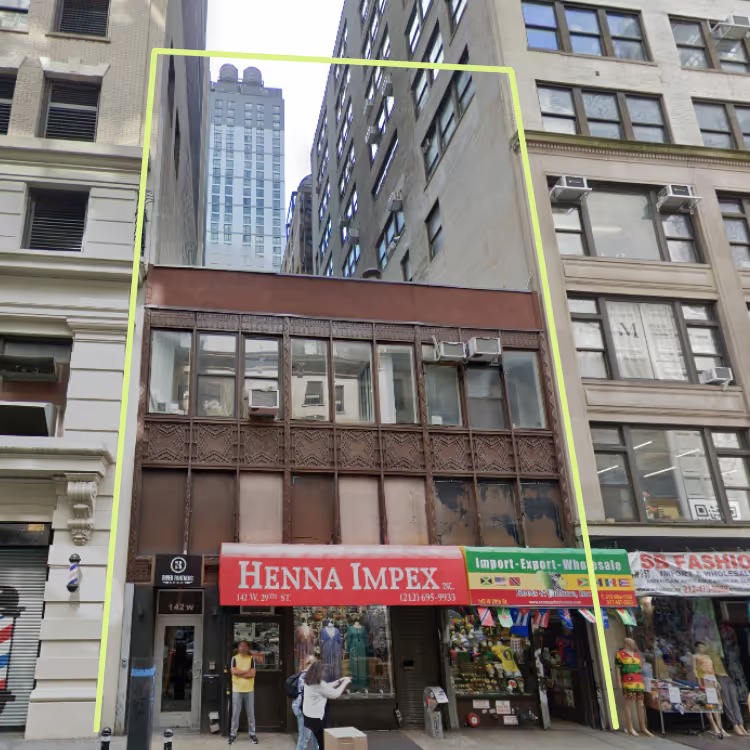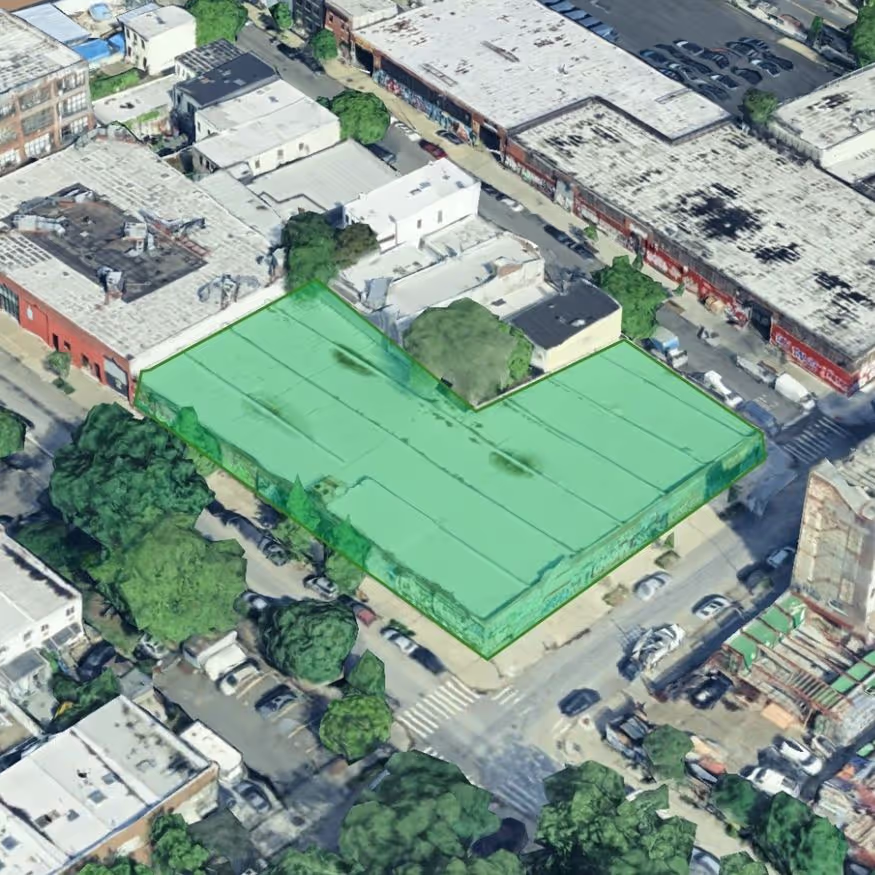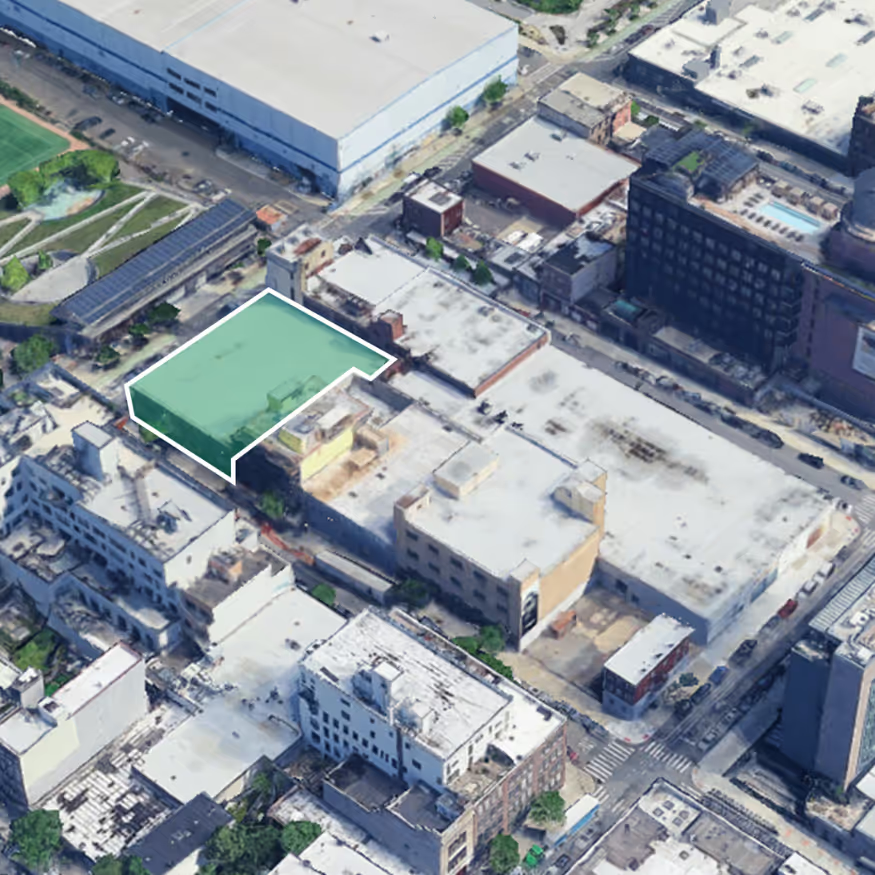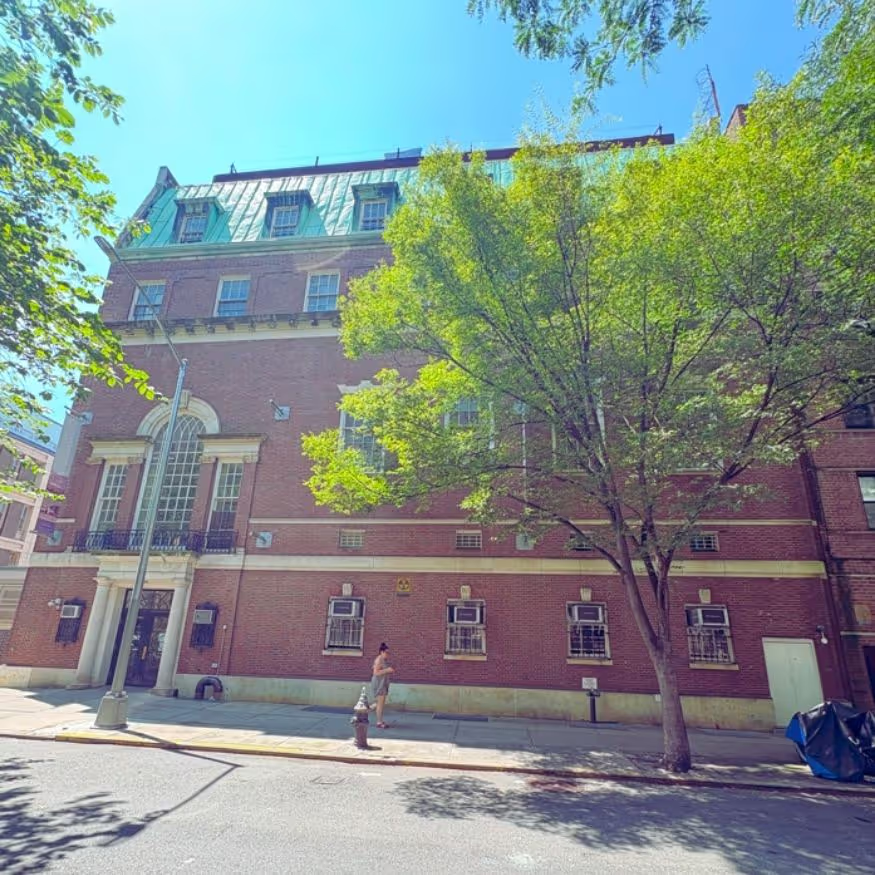


Buildings Sold

Total Building Sales

Total Square Feet Sold

NYC CRE Market Expertise

We're pleased to introduce a new recurring feature in this newsletter: the BKREA White-Paper Series by Bob Knakal, one of New York City's most experienced commercial real estate professionals with over 42 years in the market.
Each installment in this series will deliver in-depth, ground-level analysis of the forces shaping NYC's real estate landscape, from zoning and market conditions to the policy and political dynamics that increasingly determine where capital flows and how development sites are valued. These are not broad-strokes market overviews. They are practitioner-driven insights built on decades of transaction experience, designed to help property owners, investors, and developers make more informed, more strategic decisions.
Whether the topic is legislative shifts, neighborhood-level repricing, or emerging opportunities in a changing market, each white paper will translate complexity into clarity and clarity into actionable perspective.
This month's installment examines how the results of the 2025 New York City Council elections are already reshaping development site values across the five boroughs, and what owners should be thinking about right now.


Photo Credit: YIMBY

Photo Credit: YIMBY

Photo Credit: YIMBY

Every two years in New York City, there is an election cycle that most people outside of politics barely notice, but those of us in the real estate business watch very closely: the New York City Council elections. Unlike mayoral races, which tend to dominate headlines and shape broad narratives, City Council elections are far more localized, far more nuanced, and, in many ways, far more impactful on the day-to-day realities of owning, operating, and selling property in this city.
The next Council cycle, culminating in the 2027 elections, is already beginning to take shape. And while it may seem early, the groundwork for those outcomes is being laid right now—through term limits, shifting political coalitions, and the emergence of a new generation of candidates who will ultimately influence land use, zoning, taxation, and the regulatory environment for years to come.
To understand why this matters, you have to start with a simple reality: in New York City, almost every meaningful real estate decision is political before it is economic.
The City Council plays a central role in that dynamic through its control over the Uniform Land Use Review Procedure (ULURP). While the process is often framed as a structured review involving multiple stakeholders, in practice it is heavily influenced by the local Council Member. This long-standing tradition of “member deference” effectively gives each Council Member significant control over rezonings, special permits, and large-scale development projects within their district.
For property owners—particularly those with development or repositioning opportunities—this creates a very specific type of exposure. The value of a property is not just tied to its current income or physical characteristics, but to what a local elected official is willing to support.
And that is where the upcoming elections become so important.
Due to term limits, a meaningful number of current Council Members will not be eligible to run again in 2027. Term limits in New York City are capped at two consecutive four-year terms, which means that many Members first elected in 2021 will be reaching the end of their allowable tenure. This is particularly relevant because the 2021 cycle ushered in a wave of more progressive candidates, many of whom ran on platforms centered around tenant protections, stricter development controls, and increased skepticism toward market-rate housing.
From the perspective of the real estate industry, that cohort has been viewed as, at best, cautious and, at worst, adversarial.
Policies such as support for “Good Cause” eviction, opposition to certain rezonings, and a general preference for downzoning or contextual development have created an environment where the path to new supply has become more constrained. For owners of development sites, that translates directly into uncertainty, longer timelines, higher costs, and, ultimately, lower land values.
At the same time, it is important to recognize that not all incumbents are viewed equally.
There are Council Members who are broadly seen by the real estate community as pragmatic—individuals who understand that housing supply, economic development, and tax revenue generation are interconnected. These Members have generally been more willing to engage in productive dialogue around rezonings, density, and the need for new construction, particularly in areas where infrastructure can support growth.
Others, however, have taken a more rigid approach, often aligning with anti-development constituencies and viewing new construction through a primarily negative lens. In those districts, we have seen projects delayed, scaled back, or abandoned altogether—not because they lacked economic merit, but because they lacked political support.
As we look toward the next election cycle, the key question is whether the composition of the Council will shift in a way that either reinforces or recalibrates that balance.
Several dynamics are worth watching.
First, open seats created by term limits tend to attract a wide range of candidates, often leading to crowded primaries where outcomes can be unpredictable. In many cases, these races are decided by relatively small numbers of highly engaged voters, which can amplify the influence of more ideologically driven groups.
Second, there is an emerging tension within the city’s political landscape between those who prioritize affordability through regulation and those who recognize the need to increase supply as a fundamental solution to the housing crisis. That debate will play out district by district, with significant implications for land use policy.
Third, and perhaps most importantly, there is a growing awareness—even among some traditionally skeptical constituencies—that the current pace of housing production is insufficient. Rising rents, limited availability, and increasing pressure on middle-income households are forcing a reconsideration of policies that may have unintentionally constrained supply.
For the real estate industry, this creates both risk and opportunity.
On the risk side, uncertainty around election outcomes can delay decision-making. Owners considering a sale of a development site or a vacant building may choose to wait, particularly if they believe a more favorable political environment could emerge. Conversely, if there is concern that a district may shift in a less development-friendly direction, that can accelerate decisions to sell before new policies take hold.
On the opportunity side, periods of political transition often create windows where value can be unlocked. New Council Members, particularly those early in their tenure, may be more open to engagement, education, and collaboration. They are forming their views, building their teams, and establishing their approach to land use decisions.
For those willing to invest the time and effort to engage constructively, that can create a meaningful advantage.
Ultimately, the upcoming City Council elections are not just about politics. They are about the future shape of New York City—how much housing gets built, where it gets built, and under what conditions. They will influence everything from the feasibility of development projects to the pricing of land to the willingness of capital to invest in this market.
In a city where government policy and real estate value are so tightly intertwined, ignoring these dynamics is not an option.
The owners who will achieve the best outcomes over the next cycle will be those who understand not just the physical and financial aspects of their properties, but the political landscape in which those properties exist.
Because in New York City, the next buyer is not just underwriting the asset.
They are underwriting the Council Member.
Would continue to apply to 47 of 59 Community Districts
Would apply only in the 12 Community Districts that produce the least affordable housing*
*Only projects subject to the City’s mandatory inclusionary housing policy are eligible for the Fast Track.
The City is proposing two new initiatives aimed at accelerating affordable housing development.
HDFCs developing publicly financed affordable housing could apply directly to the BSA for zoning modifications (use, bulk, parking) without going through ULURP. Approval would require:
Traditional variance requirements, such as proving unique hardship or limiting relief to the minimum necessary, would not apply.
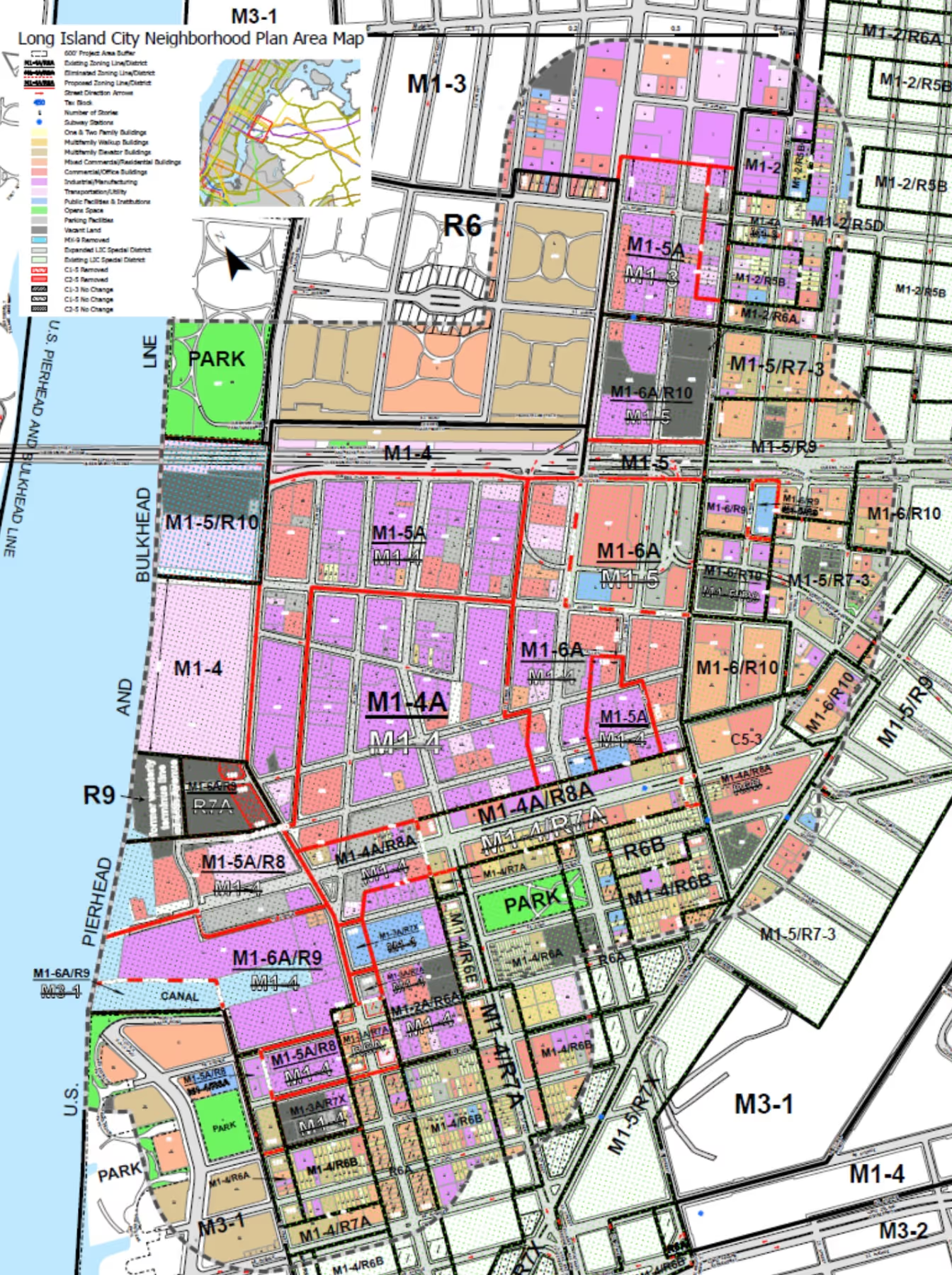
In 12 designated Community Districts, rezoning applications that trigger MIH would be eligible for a significantly streamlined approval process. This would:
The goal is to reduce political friction and shorten timelines for projects that deliver income-restricted housing. This could meaningfully improve execution certainty and speed, particularly in areas that have historically produced limited affordable housing.
The City will evaluate districts every five years (starting in 2026) based on the share of new affordable housing added relative to existing housing stock. The program is designed to target lower-performing districts, primarily lower-density neighborhoods, though some Manhattan areas are included.

Photo Credit: NYC Dept. of City Planning




.avif)




Bob Knakal, CEO of BKREA, has announced the launch of The Knakal Dealmakers Knetwork, a live mentorship community designed to help brokers and sales professionals accelerate their careers through practical, real-world insights. The program officially launches on May 5, 2026, offering members direct access to lessons drawn from Knakal’s 42-year career, during which he brokered 2,398 buildings totaling over $24 billion in transaction value.
Built for high-performance professionals, the Knetwork focuses on execution — not theory — delivering actionable strategies in sales, negotiation, branding, and long-term success.
Bob Knakal’s career includes co-founding Massey Knakal Realty Services, which became one of the most dominant investment sales firms in New York City before its $100 million sale in 2014. He later served as Chairman of Investment Sales in New York at major global brokerage firms before launching BKREA in 2024.
The Knetwork represents the next step in his mission: helping professionals compress decades of experience into actionable, immediately usable strategies.
In a competitive, relationship-driven industry like commercial real estate, access to proven strategies and mentorship can significantly accelerate career growth. The Knakal Dealmakers Knetwork is positioned as a practical alternative to traditional coaching programs, focusing on what actually works in real transactions.
For brokers and sales professionals looking to improve performance, win more business, and build long-term success, the Knetwork offers a structured path guided by real-world results.
It is a live mentorship community for brokers and sales professionals, offering twice-monthly sessions on sales, negotiation, branding, and performance.
The program was founded by Bob Knakal, CEO of BKREA and one of the most accomplished commercial real estate brokers in the U.S.
The Knetwork officially launches on May 5, 2026.
It is designed for commercial real estate brokers, sales professionals, and ambitious individuals looking to accelerate their growth and performance.
Members will learn how to win exclusive listings, build a personal brand, generate deal flow, negotiate effectively, and operate with long-term discipline.
No. It is positioned as a mentorship community focused on real-world experience, practical strategies, and direct insights from actual deals.

Extell Development, led by Gary Barnett, has acquired the landmarked Friars Club building at 57 East 55th Street for $19 million. The transaction — brokered by Bob Knakal of BKREA on behalf of Kairos Investment Management — drew strong market interest and underscores improving investor sentiment across New York City commercial real estate.
Described as “quintessentially New York,” the property combines historic architecture, prime Midtown location, and flexible future use — making it one of the most unique recent trades in Manhattan.
The sale highlights a broader trend: increasing demand across most New York City property types. According to Knakal, the market is “improving significantly,” with capital re-entering and competitive bidding returning — particularly for unique and well-located assets.
While rent-regulated properties remain challenged, high-quality, flexible-use buildings in prime locations continue to attract strong investor interest.
At $19 million, the Friars Club acquisition is not about scale — it’s about positioning. In Midtown Manhattan, assets with architectural significance, prime location, and strategic adjacency can play an outsized role in long-term development strategies.
For Extell, this purchase adds another piece to a growing footprint in one of the most valuable corridors in New York City.
Extell Development, led by Gary Barnett, purchased the property for $19 million.
Bob Knakal of BKREA represented the seller, Kairos Investment Management.
It is a historic, landmarked Midtown property known for its cultural legacy, architectural design, and prime location.
No, the property does not have remaining air rights, making it more suited for adaptive reuse.
Interest came from private clubs, developers, foreign governments, hospitality groups, and nonprofits.
It signals improving investor confidence and strong demand for unique, well-located assets across most property types.
.avif)
The acquisition of the historic Friars Club by Gary Barnett’s Extell Development has sparked widespread industry speculation. The deal — brokered by Bob Knakal and Tom Brady of BKREA — closed at $19 million and highlights the continued demand for strategically located Midtown assets.
While the price appears modest by Midtown standards, the property’s positioning near Barnett’s growing Park Avenue assemblage suggests a more calculated long-term play. With landmark restrictions, uncertain air rights, and a location slightly removed from Extell’s core holdings, the question remains: what role does the Friars Club serve in Barnett’s broader vision?
The property, located at 57 East 55th Street, was sold by Kairos Investment Management in a competitive process. Notably, the deal was brokered by Bob Knakal and Tom Brady of BKREA.
Competing bidders reportedly included hospitality operators, foreign consulates, and even a crypto investor group proposing a “Crypto Castle” concept — underscoring the property’s unique positioning and broad appeal.
In Midtown Manhattan, especially along Park and Madison Avenues, value is often driven not just by what a property is — but what it could become when combined with surrounding assets. Even a seemingly isolated acquisition can play a critical role in a much larger development strategy.
For Barnett and Extell, the Friars Club may not be the headline — but it could be a key piece of the puzzle.
Gary Barnett’s Extell Development purchased the Friars Club for approximately $19 million.
It sits in a prime Midtown Manhattan location near Park Avenue, an area where Extell has been actively assembling development sites.
No. The building’s façade is landmarked, which restricts demolition and requires preservation.
Possibly, but limited. Most air rights were previously sold, though some may remain transferable.
Potential uses include assemblage leverage, boutique redevelopment, long-term land banking, or strategic control of the surrounding block.
The transaction was brokered by Bob Knakal and Tom Brady of BKREA on behalf of the seller.


After years of negative sentiment, New York City’s Class B and C office market is showing clear signs of recovery. Prices that once collapsed to the high $100s per square foot are now rising steadily, while leasing activity and investor demand continue to strengthen.
According to long-time market expert Bob Knakal, the narrative of permanent office obsolescence is being replaced by a more accurate reality: the bottom has passed, and recovery is accelerating across Manhattan’s office sector.
The NYC office market is entering a new phase of price discovery and recovery, driven by supply reduction and renewed demand. For investors, the window to acquire assets at distressed pricing is narrowing. For owners, improving fundamentals signal stronger valuations and increased liquidity ahead.
Yes. Pricing, leasing activity, and investor demand are all improving, indicating that the market has moved past its cyclical low.
Factors included remote work trends, reduced leasing demand, rising vacancies, and uncertainty around long-term office usage.
It incentivizes office-to-residential conversions, removing millions of square feet of office supply and strengthening remaining assets.
Reduced supply, renewed leasing demand, and improved investor confidence are driving upward pressure on both rents and asset values.
Opportunities still exist, but historically, once recovery becomes clear, pricing adjusts quickly and early-mover advantages diminish.
While office usage is evolving, demand for workspace in New York City remains strong due to its role as a global business hub.
Developer Gary Barnett’s Extell Development has acquired the historic Friars Club building at 57 East 55th Street for approximately $19 million, according to market sources. The transaction, brokered by Bob Knakal of BKREA, reflects growing investor interest in strategically located Midtown assets tied to long-term assemblage potential.
While the building carries a rich cultural legacy as a former comedy institution and private club, its acquisition is being closely watched for what it may signal about Extell’s broader Park Avenue development strategy.
Barnett has been steadily assembling significant development rights across Midtown Manhattan, including office and residential pipelines on Park Avenue, Seventh Avenue, and the Upper West Side.
Recent and ongoing activity includes:
The Friars Club acquisition appears to align with this broader strategy of consolidating control over key Midtown corridors.
Although the Friars Club sale is modest in price, its strategic location makes it disproportionately important. In dense urban markets like Midtown Manhattan, value is often driven less by current use and more by future assemblage potential, zoning flexibility, and adjacency to larger development sites.
The key question is not what the Friars Club is today — but how it fits into what Park Avenue could become.
The property was purchased by Gary Barnett’s Extell Development for approximately $19 million.
It was a historic private comedy club known for celebrity roasts, cultural events, and entertainment industry gatherings.
The club closed due to financial distress, including the COVID-19 pandemic, flooding issues, and loan default leading to foreclosure.
Yes, the exterior is landmarked, but the interior is not, allowing flexibility for adaptive reuse.
Possible uses include integration into a larger assemblage, private club reuse, embassy space, hospitality conversion, or long-term investment hold.
The transaction was handled by Bob Knakal of BKREA.

The third annual NYC Real Estate Gala, hosted at The Peak at Hudson Yards, brought together nearly 200 commercial real estate professionals, investors, and influencers from across the globe. Co-hosted by Bob Knakal of BK Real Estate Advisors and Don Tepman (known as “StripMallGuy”), the event has evolved from a small social media meetup into one of the most unique relationship-driven gatherings in the industry.
Blending real estate networking with social media influence, the gala reflects a growing shift in how deals, relationships, and opportunities are created in today’s commercial real estate market.
The NYC Real Estate Gala reflects a broader industry shift: relationships are no longer built only in boardrooms — they are built across digital platforms and amplified through curated in-person experiences.
By combining social media reach with high-value networking, the event creates an environment where connections translate directly into transactions, partnerships, and long-term business growth.
It is a networking event that brings together commercial real estate professionals, investors, and influencers to build relationships and generate deal flow.
The gala is co-hosted by Bob Knakal of BKREA and Don Tepman, also known as “StripMallGuy.”
The event takes place at The Peak at Hudson Yards in New York City.
Attendees include brokers, investors, developers, social media influencers, and professionals from related industries, with participants traveling from across the U.S. and internationally.
It provides high-level networking opportunities, fosters relationship-building, and creates direct pathways to new deals and partnerships.
Social media platforms help build audiences, create visibility, and generate deal flow, which can then be converted into real-world relationships and transactions.

At One 21 Las Vegas, Bob Knakal, Chairman & CEO of BK Real Estate Advisors, delivered a keynote address, fireside chat, and live Q&A session focused on commercial real estate market mastery and brokerage performance.
Drawing on more than $24 billion in lifetime transaction volume, Knakal outlined a practical framework for brokers and firms seeking to outperform in competitive markets through specialization, discipline, and information advantage.
During the keynote, Knakal explained how boutique firms often outperform larger platforms by leveraging:
These advantages create stronger execution outcomes on selectively targeted assignments, particularly in specialized or relationship-driven markets.
Knakal concluded by reinforcing that his framework applies across all markets and deal sizes. Whether working on small assets or institutional-grade transactions, consistent execution of core principles determines long-term success.
The keynote focused on commercial real estate market mastery, brokerage strategy, specialization, and how boutique firms can outperform institutional platforms.
Bob Knakal is the Chairman & CEO of BK Real Estate Advisors (BKREA) and one of the most accomplished investment sales brokers in U.S. commercial real estate history.
Market mastery refers to deep, consistent knowledge of a specific geographic or asset market, enabling brokers to outperform competitors through expertise rather than scale.
Boutique firms often benefit from faster decision-making, deeper local intelligence, and stronger incentive alignment with clients.
Technology and AI enhance data analysis and efficiency but do not replace the importance of relationships, judgment, and market expertise.
Long-term success comes from specialization, disciplined prospecting, and consistent execution of fundamental brokerage principles.
Bob Knakal, Chairman and CEO of BK Real Estate Advisors, has launched the BKREA White Paper Series with a deep-dive analysis into New York City’s Expedited Land Use Review Procedure (ELURP)—a policy shift that could significantly accelerate development approvals.
The inaugural report highlights how ELURP, compared to the traditional Uniform Land Use Review Procedure, may reduce approval timelines from over seven months to approximately 90 days—reshaping land values, developer demand, and investment strategy across New York City.
ELURP represents a structural shift in how land use approvals are evaluated in New York City. By compressing timelines and reducing uncertainty, it directly impacts pricing, feasibility, and transaction velocity.
For investors, developers, and property owners, understanding ELURP is no longer optional—it is essential to identifying opportunities and maximizing value in an increasingly policy-driven market.
ELURP (Expedited Land Use Review Procedure) is a new NYC approval process designed to significantly reduce the time required for certain development approvals.
Unlike ULURP, which typically takes 7+ months, ELURP may allow qualifying projects to complete approvals in approximately 90 days.
Developers, property owners, and investors involved in qualifying projects—especially affordable housing and infrastructure developments.
By reducing entitlement risk and carrying costs, ELURP can increase property values and attract a broader pool of buyers.
No, eligibility is limited to specific project types that meet defined criteria outlined in the policy.
To provide in-depth, data-driven analysis of policy changes that materially impact development site values and investment decisions.

With a career spanning more than four decades, Bob Knakal has become one of the most influential figures in New York City commercial real estate. As the founder and CEO of BK Real Estate Advisors, his impact extends beyond transactions—shaping brokerage models, mentoring future leaders, and redefining how investment property sales are executed.
From an unexpected start to building industry-defining platforms, Knakal’s journey offers a blueprint for long-term success in one of the world’s most competitive real estate markets.
Knakal’s success is rooted in three core advantages:
specialization, information, and relationships.
By combining deep local expertise with advanced analytics and a long-term mindset, he has consistently delivered superior outcomes in a complex and evolving market. His philosophy remains simple:
Preparation creates confidence. Information creates opportunity. Relationships create results.
Bob Knakal is the Chairman and CEO of BK Real Estate Advisors and one of the most accomplished commercial real estate investment sales brokers in New York City.
BK Real Estate Advisors is a boutique NYC brokerage focused on investment sales, development sites, and strategic advisory for property owners.
Its territory specialization model, deep market knowledge, and strong culture of mentorship allowed it to outperform competitors for over a decade.
BKREA focuses on vacant and value-add properties, helping clients determine whether to redevelop, reposition, or sell to maximize value.
Discipline, specialization, transparency, relationship-building, and long-term thinking.
Master your market, stay consistent, build relationships early, and focus on long-term credibility over short-term gains.
A landmark 42-year study by BK Real Estate Advisors, led by Bob Knakal, reveals that unemployment rates and federal tax policy are the most reliable predictors of Manhattan investment property sales activity. Analyzing over 29,000 transactions since 1984, the study provides one of the most comprehensive views ever assembled of Manhattan’s commercial real estate cycles.
The findings offer a clear, data-driven framework for investors seeking to anticipate market downturns and capitalize on transaction surges.
This research simplifies complex market behavior into two actionable indicators. Rather than relying on speculation or headlines, investors can monitor employment trends and tax legislation to anticipate shifts in deal flow and pricing dynamics.
In a market as competitive and cyclical as Manhattan, timing is everything — and this study provides a proven framework to guide decision-making.
The study examines over 42 years of Manhattan investment property sales, covering more than 29,000 transactions and nearly 27,649 properties.
The research was led by Bob Knakal, Chairman and CEO of BK Real Estate Advisors, with over four decades of market experience.
Unemployment rates and federal tax policy are identified as the most consistent predictors of market activity.
Higher unemployment reduces liquidity and investor confidence, leading to lower transaction volume and slower deal flow.
Changes in tax rates influence investor behavior, often accelerating sales ahead of increases or encouraging activity following reductions.
By tracking unemployment trends and upcoming tax legislation, investors can better predict market cycles and time acquisitions or dispositions.
For decades, property value in New York City was defined by three variables: location, zoning, and market conditions. Today, a fourth factor has emerged as equally—if not more—important: the ballot box. According to insights from Bob Knakal, elections and voter turnout are now directly influencing development feasibility, pricing, and investment decisions.
As New York City Council races approach, the growing impact of political outcomes is reshaping how investors evaluate risk and opportunity across the city.
The NYC real estate market is no longer purely economic—it is deeply political. Ignoring elections means overlooking a key driver of value, risk, and opportunity.
In today’s environment, understanding candidates, policies, and voter turnout is just as critical as analyzing zoning or comparable sales. The most successful investors will be those who integrate political awareness into their investment strategy.
Elected officials influence rezonings, approvals, and development policies, which directly affect what can be built and how properties are valued.
Low turnout means a small group of voters can determine outcomes that impact billions of dollars in real estate decisions.
Investors adjust pricing based on the likelihood of approvals, which varies by council district and political leadership.
Zoning remains critical, but it is now complemented by political feasibility—what can realistically be approved.
Local elected officials, particularly members of the New York City Council, play a major role in land use and development decisions.
Stay informed on elections, understand candidate positions, and actively participate in voting to influence outcomes.

Recognized by The World of Voices as the Most Visionary Leader Redefining Business in 2026, Bob Knakal, Chairman and CEO of BK Real Estate Advisors, continues to set the standard for leadership in commercial real estate. His four-decade career reflects a rare combination of market mastery, innovation, and unwavering commitment to client success.
In an era defined by artificial intelligence, rapid market shifts, and evolving business models, Knakal’s leadership stands out for its disciplined evolution — blending deep experience with forward-looking strategy.
Knakal represents a new model of leadership — one that balances innovation with stability. While many leaders react to change, he anticipates structural shifts and adapts without abandoning core principles.
His philosophy is clear:
Data informs decisions, but experience, integrity, and relationships drive results.
This ability to integrate technology with human judgment positions him at the forefront of modern business leadership.
Bob Knakal is the Chairman and CEO of BK Real Estate Advisors and one of the most accomplished commercial real estate investment sales brokers in New York City.
He was recognized for his ability to combine decades of experience with innovation in data, AI, and brokerage strategy while maintaining a client-first leadership approach.
BKREA is known for its data-driven advisory platform, combining proprietary market intelligence with modern technology to maximize property value.
Discipline, preparation, integrity, specialization, and a long-term focus on relationships and client outcomes.
Technology enhances analysis and efficiency, but Knakal emphasizes that human judgment, negotiation, and relationships remain critical.
Master a niche, stay disciplined, build relationships early, and focus on long-term credibility rather than short-term wins.

Bob Knakal, Chairman and CEO of BK Real Estate Advisors, has been recognized by Biz Insight Global as one of the Most Influential Business Leaders to Watch in 2026. With more than four decades of experience and a record-breaking career in New York City investment sales, Knakal continues to redefine how commercial real estate brokerage operates in a rapidly evolving market.
By combining traditional expertise with artificial intelligence, proprietary data, and a strong culture of mentorship, Knakal is shaping the future of real estate advisory and leadership.
Knakal’s influence extends beyond transactions. His ability to blend experience with innovation — leveraging AI and data while maintaining a relationship-driven brokerage model — positions him at the forefront of industry evolution.
His leadership demonstrates that the future of commercial real estate lies not in replacing human expertise, but in enhancing it through technology, discipline, and client-first strategy.
Bob Knakal is the Chairman and CEO of BK Real Estate Advisors and one of the most accomplished commercial real estate investment sales brokers in New York City.
He was recognized for his record-breaking transaction volume, industry innovation, leadership at BKREA, and influence on the future of commercial real estate brokerage.
BKREA is known for combining proprietary data, artificial intelligence, and deep market expertise to deliver high-level advisory services to property owners and investors.
Its territory specialization model and focus on local market expertise allowed it to outperform larger competitors and dominate NYC investment sales.
Technology enables better data analysis, market insights, and deal sourcing, but success still depends on relationships, experience, and strategic execution.
His philosophy centers on discipline, client-first service, mentorship, and continuously evolving through innovation while maintaining core principles.
A single number is quietly reshaping New York City’s housing market: $72.45 per hour. This mandated all-in compensation for construction workers on certain large residential projects has become one of the most powerful forces impacting housing production today.
While intended to support labor, the policy is creating unintended consequences—raising construction costs, discouraging large-scale development, and ultimately contributing to fewer housing units and higher rents across the city.
The $72.45 wage requirement highlights a broader issue: when policy overrides economic feasibility, supply declines. Instead of encouraging housing production, current regulations are unintentionally discouraging it—at a time when demand remains strong.
The result is a predictable outcome: less supply, fewer options, and higher rents.
It is a mandated all-in hourly compensation for construction workers on certain large residential projects in New York City.
Construction labor is a major cost component. Higher wage requirements significantly increase total project costs, affecting feasibility.
To avoid triggering wage thresholds, developers often design projects below size limits, reducing overall housing supply.
Higher costs reduce what developers can pay for land, leading to fewer transactions and stalled development.
Middle-income housing is most impacted, as these projects are often no longer financially viable under current cost structures.
Yes. Reduced supply combined with strong demand typically results in rising rents over time.
The study’s central quantitative finding is an average annual ownership turnover rate of approximately 2.5%. Applied to the 27,649-property universe, that rate produces roughly 691 transactions in a typical year — and implies an average holding period of approximately 40 years per owner.
Of all the dynamics the report identifies, the length and depth of below-trend periods are among the most striking. Manhattan’s investment sales market has experienced extended stretches of suppressed volume — not anomalies, but recurring features of the cycle that informed investors must understand and anticipate.
The dataset reveals a strong negative correlation between unemployment and Manhattan investment sales volume. Transaction activity hit cyclical troughs in four distinct periods — each tied directly to a spike in national and NYC unemployment:
Critically, the historical record shows that each trough was followed by a significant rebound in transaction activity once labor market conditions stabilized — providing one of the most reliable macro indicators available to Manhattan property owners and buyers.
Among the study’s most actionable findings is the degree to which federal capital gains tax legislation has historically shaped transaction timing. The report maps volume against three major legislative events:
With federal capital gains tax policy under active legislative discussion today, historical precedent strongly suggests that any changes — whether increases or reductions — will produce predictable and potentially significant shifts in Manhattan investment sales volume.
The study’s most consequential regulatory finding concerns the 2019 Housing Stability and Tenant Protection Act (HSTPA). The legislation fundamentally restructured the economics of rent-regulated multifamily properties — eliminating high-rent vacancy decontrol and vacancy bonuses that had previously driven investor demand.
The data shows that the period following HSTPA’s passage in June 2019 represents the longest sustained stretch of below-trend investment sales activity in the entire 42-year dataset — a period that continues through the study’s end date.
Unlike the cyclical downturns tied to unemployment, the post-HSTPA slowdown reflects a structural repricing of an entire asset class, with no clear historical precedent in the Manhattan investment sales record.
“This analysis provides a forty-two-year perspective on how Manhattan’s investment property market actually behaves. When you study the data across multiple economic cycles, it becomes clear that periods of suppressed transaction activity have historically been followed by powerful rebounds once financial conditions stabilize.” according to Bob Knakal, Chairman & CEO, BKREA
The study draws exclusively on primary transaction records — no modeled or estimated data. The proprietary database encompasses all investment property sales in Manhattan south of 96th Street recorded over 42 years and represents one of the most detailed longitudinal real estate transaction records ever compiled for a single urban market.

Bob Knakal, Chairman and CEO of BK Real Estate Advisors, has released a groundbreaking 42-year study analyzing 29,363 Manhattan investment property sales from 1984 through 2025. The report provides an unprecedented, data-driven view into how economic cycles, tax policy, and regulation shape transaction activity in one of the world’s most competitive real estate markets.
Drawing from a proprietary dataset built over four decades, the study delivers actionable insights into turnover trends, market timing, and the structural shifts redefining New York City investment sales today.
“This analysis provides a forty-two-year perspective on how Manhattan’s investment property market actually behaves. When you study the data across multiple economic cycles, it becomes clear that periods of suppressed transaction activity have historically been followed by powerful rebounds once financial conditions stabilize.”
This report transforms how investors, owners, and developers understand Manhattan real estate. Rather than relying on short-term trends, it provides four decades of empirical evidence—enabling smarter decisions around timing, pricing, and strategy in an increasingly complex market environment.
It analyzes every recorded Manhattan investment property sale south of 96th Street over 42 years, making it the most comprehensive dataset of its kind.
Approximately 40 years, based on a long-term turnover rate of about 2.5% annually.
Transaction volume declines during periods of high unemployment and rebounds as economic conditions improve.
Changes in capital gains taxes and related laws historically trigger spikes in transaction activity as investors adjust timing.
It caused the longest sustained slowdown in transaction volume in the dataset, reflecting a structural shift in the market.
Past patterns indicate that prolonged slowdowns are often followed by significant increases in transaction activity.

In New York City real estate, longevity alone commands respect. Dominance commands attention. Reinvention, however, is what defines legacy.
As the commercial real estate industry navigates one of its most consequential periods of transformation in decades, few figures embody both institutional memory and forward-looking innovation the way Bob Knakal does. With more than 2,391 buildings sold, over $24 billion in transactional volume, and a career that spans more than forty years, Knakal has already secured his place among the most accomplished investment sales brokers in history. Yet in 2026, he is not resting on reputation. He is rebuilding the playbook.
At a time when artificial intelligence is reshaping underwriting, when capital markets are recalibrating around sustained higher interest rates, and when generational ownership transitions are accelerating across New York City, Knakal stands at a unique intersection: part historian, part strategist, part technologist. His journey from cold-calling rookie to architect of one of the most data-driven advisory platforms in the market offers a lens into how brokerage itself is evolving.
This is not simply the story of a prolific broker. It is the story of how systems, discipline, and information can compound into transformative influence.
Bob Knakal did not begin his professional life with the intention of becoming a commercial real estate broker. A graduate of The Wharton School at the University of Pennsylvania, he originally envisioned a future in investment banking, like many of his classmates in the early 1980s. The financial world held prestige and promise.
Then came a moment of serendipity. While searching for a summer internship, Knakal walked into what he believed was a banking office. It was Coldwell Banker. He accepted the internship almost by default. What followed would quietly alter the trajectory of his career.
He discovered that he loved the business.
Real estate, unlike abstract financial modeling, felt immediate and tangible. Buildings were physical. Markets were dynamic. Transactions required negotiation, persuasion, and endurance. The connection between effort and reward was direct and visible. A guest lecturer at Wharton reinforced a lesson that would guide him from that point forward: pursue what you are passionate about, become exceptional at it, and success will follow.
In July 1984, with two suits, five dress shirts and a determination to master the craft, Knakal began his career in Manhattan commercial brokerage. He could not have known that he was stepping into what would become one of the most prolific investment sales careers in US history.
The defining inflection point in Knakal’s career came in 1988, when he co-founded Massey Knakal Realty Services with Paul Massey. At the time, the commercial brokerage industry was fragmented and largely personality-driven. Brokers often operated across broad geographies, chasing opportunities rather than cultivating structured market dominance.
Knakal and Massey took a radically different approach.
They built the firm around what became known as the Territory System. Each broker was assigned a tightly defined geographic area, often only a few dozen blocks. Within that territory, the broker was expected to know every building, every owner, every zoning nuance, and every historical transaction. The strategy was simple in concept yet powerful in execution: become indispensable by becoming hyper-local experts.
This model created an information moat long before the phrase became fashionable in business circles. By systematically gathering and organizing building-level intelligence, Massey Knakal brokers were not simply intermediaries. They were neighborhood authorities. When an owner considered selling, refinancing, or repositioning, the territory broker already understood the property’s context and often had spent years cultivating the relationship.
The results were extraordinary. Over time, Massey Knakal routinely outperformed far larger regional, national, and global firms in building count across New York City. In Manhattan alone, the firm’s transaction volume and building sales dominance became the benchmark against which others were measured. By the time the company was sold to Cushman and Wakefield in 2014 for $100 million, it had fundamentally reshaped the competitive dynamics of investment sales brokerage in the city.
Yet for Knakal, that milestone was not an exit. It was an evolution.
While the industry often celebrates charismatic dealmakers, Knakal’s success has been rooted in something far less glamorous but far more enduring: disciplined consistency.
Over the course of four decades, he has closed more than
2,391 building sales. That number is staggering not because of a handful of blockbuster transactions, but because of the cumulative power of repetition. Daily prospecting. Structured follow-up. Relentless market coverage. Meticulous data tracking. That’s more than one building sold per week for over 41 years!
Through multiple downturns—the Savings and Loan crisis, the early 1990s recession, the aftermath of 9/11, the Great Financial Crisis, and the pandemic-induced reset—Knakal adhered to the same principle: double down when others retreat. During periods of uncertainty, he invested in training, expanded market coverage, and reinforced data systems. That counter-cyclical mindset allowed his platform not merely to survive volatile markets, but to emerge stronger from them.
It is a philosophy that continues to shape his approach in 2026. While market headlines fluctuate and asset classes recalibrate, the fundamentals remain unchanged in his view: mastery of information, consistency of effort, and unwavering client focus.
If the Territory System represented Knakal’s first information revolution, the next chapter is defined by The Knakal Map Room and The Knakal Land Index data platform.
For decades, Knakal personally cataloged building-level intelligence across New York City—sales history, zoning changes, development capacity, ownership transitions, and pricing trends. What began as a competitive advantage for brokerage assignments has evolved into one of the most comprehensive proprietary data archives in the history of the United States.
In today’s environment, that historical depth is amplified by artificial intelligence. Through his current firm, BKREA, Knakal has integrated advanced analytics tools that allow clients to model forward-looking scenarios, evaluate development potential under varying zoning interpretations, and assess pricing sensitivity under shifting capital markets conditions.
The result is a shift in the role of the broker. Rather than presenting only comparable sales and current valuations, BKREA offers predictive strategic advisory. Owners are not simply told what their asset is worth. They are shown what it could become, under multiple strategic pathways and how that potential can be articulated to potential buyers to encourage them to pay more for an asset BKREA is selling.
In an era where capital is more selective and risk assessment more rigorous, this fusion of four decades of institutional memory with contemporary AI capability positions Knakal at the forefront of advisory evolution.
After serving in Chairman of Investment Sales roles at Cushman and Wakefield and later at JLL, Knakal launched BKREA as a capital markets advisory firm built for the modern landscape. The firm blends traditional investment sales execution with strategic capital advisory, zoning analysis, and AI-supported modeling.
BKREA reflects a broader transformation underway in commercial real estate. Owners increasingly demand holistic guidance rather than transactional representation alone. Decisions about whether to sell, recapitalize, reposition, redevelop, ground lease, joint venture or implement a Knakal creation – the hybrid ground lease, are influenced by tax policy shifts, interest rate dynamics, and regulatory changes. In that context, historical knowledge becomes a powerful stabilizer.
Knakal’s career, spanning multiple full market cycles, allows him to contextualize today’s uncertainty within decades of precedent. His advisory approach is grounded not in speculation but in pattern recognition accumulated over time.
Beyond transaction volume and data innovation, Knakal’s legacy is deeply embedded in the professionals he has trained. More than thirty former colleagues have gone on to lead brokerage divisions or launch independent firms. His emphasis on geographic expertise, structured training, and accountability fostered a culture of excellence that continues to influence New York City’s brokerage ecosystem.
He has long believed that investing in people multiplies impact. Weekly training sessions, detailed market reviews, and open information sharing were not peripheral elements of his firms. They were central to their success.
As generational turnover reshapes the brokerage workforce, that cultural infrastructure remains one of his most enduring contributions.
Despite the integration of advanced analytics and AI, Knakal maintains that real estate remains fundamentally local. He continues to walk neighborhoods, observe storefront changes, and track block-by-block evolution. Technology enhances insight, but it does not replace physical market immersion.
This balance between analog intuition and digital precision defines his approach in 2026. He understands that algorithms can analyze patterns, but only experience interprets nuance.
In a city defined by reinvention, where zoning adjustments, adaptive reuse initiatives, and capital reallocations constantly reshape the skyline, that blend of historical perspective and forward-looking strategy has made him one of the most trusted advisors in the market.
At a stage when many industry veterans might scale back, Bob Knakal is accelerating. From cold calls to territory specialization, from proprietary data mapping to AI-enhanced advisory, his professional arc mirrors the transformation of the industry itself.
In 2026, as commercial real estate navigates structural change, Knakal remains not simply a participant, but a force shaping its direction. His journey illustrates that true leadership in real estate is not defined by a single market cycle or a single firm. It is defined by the ability to adapt without abandoning fundamentals.
In a business built on cycles, Bob Knakal has proven that disciplined reinvention is the most enduring advantage of all.
New York City apartment rents have reached historic highs, with Manhattan’s median rent surpassing $5,000 and Brooklyn nearing $4,300, while vacancy rates remain below 2 percent. In a balanced housing market, vacancy typically sits around 5 percent — making today’s conditions intensely competitive for renters.
The cause is not mysterious. The surge in rents is the direct result of long-standing housing policies that have restricted supply, distorted incentives, and slowed new development across the city.
The data points to a consistent conclusion: housing affordability cannot improve when supply is restricted. Policies intended to protect tenants have instead reduced available inventory, slowed development, and created conditions for sustained rent increases.
New York City’s housing market is behaving exactly as economic fundamentals predict — when supply cannot meet demand, prices rise.
Primarily due to extremely low vacancy rates and limited housing supply, driven by policy constraints and reduced new development.
Current policies, particularly after the 2019 HSTPA, have reduced incentives to renovate and re-rent units, contributing to a decrease in available housing.
Estimates suggest between 60,000 and 80,000 rent-stabilized units are currently vacant and unavailable to renters.
Around 5 percent is considered balanced. NYC is currently below 2 percent, indicating a severe supply shortage.
Programs like 485x have made many projects financially unfeasible due to cost structures and regulatory requirements.
Based on current supply constraints and investor expectations, rents are likely to remain elevated unless policies shift to encourage more housing production.

The panel explored how large-scale projects in New York are conceived, financed, and delivered in an increasingly complex development environment. From land assembly and air rights to capital markets and construction strategy, panelists shared firsthand insights into the challenges and opportunities facing the next generation of urban development.
Representing both the brokerage and industry leadership perspectives, Genessy J. spoke about the critical role that land and air rights transactions play in enabling vertical development across New York City. As a land and air rights broker at BKREA, she works directly with property owners, developers, and investors to structure transactions that unlock development potential and allow projects to move forward in one of the most competitive real estate markets in the world.
“New York’s skyline has always been a product of collaboration between property owners, developers, lenders, and advisors,” said Genessy. “Land assemblage and air rights transactions are often the first step in that process, setting the stage for projects that shape neighborhoods and define the city’s future.”
In addition to her role at BKREA, Genessy serves as Developing Leader Chair for the NAIOP NYC Metro Chapter, where she focuses on engaging and mentoring the next generation of real estate professionals. During the discussion, she also shared insights on how emerging leaders can navigate the evolving real estate landscape and position themselves for long-term success.
The panel featured a distinguished group of industry professionals, including Lawrence Bremer, Senior Vice President at The Moinian Group; Humberto Lopes, CEO of H.L. Dynasty Real Estate Corp.; and Cara Riordan, Vice President at Bank of America. Together, the panelists provided perspectives from across the real estate ecosystem, including development, capital markets, and investment.
Topics covered throughout the evening included financing strategies for large-scale projects, the role of capital markets in supporting development, the complexities of assembling development sites in New York, and how industry leaders are adapting to shifting market conditions.
As the city continues to evolve, discussions like these provide a platform for industry leaders to exchange ideas and share knowledge about the opportunities ahead. For Genessy, the conversation reinforced the importance of collaboration and innovation in shaping the next generation of development across the city.
“At its core, New York real estate has always been about problem solving,” she said. “Every project requires creativity, persistence, and partnership. The future of the skyline will depend on how effectively we bring those elements together.”
Baruch Edelkopf joins BKREA with a strong track record in real estate investment sales and advisory, bringing extensive experience working with property owners, investors, and developers across New York City. Since beginning his real estate career in 2013, he has completed 109 transactions totaling more than $250 million in sales volume, primarily across middle-market deals in Brooklyn and Queens. Known for his disciplined market analysis and relationship-driven brokerage approach, Edelkopf has built a reputation for delivering strategic guidance and strong execution for his clients.
“Baruch brings tremendous energy, professionalism, and market knowledge to BKREA,” said Bob Knakal, Chairman and CEO of BKREA. “He has built strong relationships throughout the industry and demonstrated the work ethic and client-first mindset that align perfectly with our platform. We are very excited to welcome him to the team.”
At BKREA, Edelkopf will focus on investment sales and advisory assignments throughout Brooklyn and the outer boroughs, working closely with the firm’s leadership and brokerage team to deliver strategic solutions for property owners.
“Joining BKREA represents an exciting opportunity,” said Edelkopf. “Bob has built an incredible legacy in the New York investment sales market, and the platform he is building at BKREA is uniquely positioned to deliver exceptional results for clients. I’m thrilled to be part of the team and look forward to contributing to the firm’s continued growth.”
Since its launch, BKREA has focused on building a premier advisory platform combining deep market expertise, proprietary data, and strong industry relationships to serve property owners and investors across the New York metropolitan area.
Edelkopf’s addition further strengthens the firm’s investment sales capabilities and expands its presence across Brooklyn and the outer borough markets.
About the company: BKREA is a New York-based real estate advisory firm specializing in investment sales across Brooklyn and the outer boroughs. The firm combines deep market expertise, proprietary data, and strong industry relationships to deliver strategic solutions for property owners, investors, and developers across the New York metropolitan area.
For over 40 years, Bob Knakal has tracked every investment property sale in Manhattan south of 96th Street — a market of 27,649 properties. Historically, about 2.5% of properties trade annually, reflecting a long-term equilibrium in one of the world’s most competitive real estate markets.
However, the past several years have broken from this pattern. With 2025 marking the seventh consecutive year of below-average turnover, Manhattan is now experiencing its longest investment sales drought on record — setting the stage for a potentially powerful market surge.
The current slowdown is not a sign of permanent decline — it is a temporary distortion driven by policy, capital structure, and lender behavior. As lenders begin to recognize losses and resolve distressed assets, the market is expected to shift rapidly.
When that inflection point arrives, Manhattan could experience a wave of short sales, note sales, restructurings, and foreclosures, unlocking transaction volume and creating opportunities for well-capitalized investors.
Historically, about 2.5% of properties trade annually, meaning the average holding period is approximately 40 years.
The decline is largely driven by reduced values in rent-stabilized housing following the 2019 HSTPA law, combined with lender reluctance to foreclose on distressed assets.
These are assets where owners are unwilling to invest further and lenders are unwilling to take control, resulting in properties that remain unsold despite financial distress.
Unlike past cycles, lenders have delayed recognizing losses and avoided foreclosures, preventing the normal flow of distressed sales.
Based on historical patterns, extended downturns are typically followed by strong rebounds in both transaction volume and price discovery.
Investors may see increased opportunities in distressed acquisitions, discounted note purchases, and repositioning assets as the market begins to clear.
The annual list published by The Real Deal honors the most impactful leaders shaping the real estate industry across New York and beyond. Knakal’s inclusion underscores his decades-long track record as one of the most prolific and respected investment sales brokers in the country.
Knakal, Chairman and CEO of BKREA, has built one of the most accomplished brokerage careers in the history of the U.S. commercial real estate industry. Over more than four decades in the business, he has personally brokered the sale of more than 2,391 buildings totaling over $23 billion in transaction volume, widely believed to be the highest number of buildings sold by any individual broker in the United States.
Before launching BKREA, Knakal co-founded Massey Knakal Realty Services with Paul J. Massey Jr. in 1988. The firm grew to become New York City’s leading building sales brokerage, completing more than 6,000 transactions totaling over $23 billion before it was acquired by Cushman & Wakefield in 2014.
Following the acquisition, Knakal served as Chairman of New York Investment Sales at Cushman & Wakefield and later held leadership roles at JLL, where he continued advising investors, developers, and institutions on high-profile New York City transactions.
In 2024, Knakal launched BKREA, a boutique brokerage focused on delivering best-in-class advisory services to property owners while leveraging innovative marketing strategies and emerging technologies to maximize value for clients.
Knakal’s recognition in The Real Deal’s Top 100 Real Estate Titans of the Year reflects not only his historic transaction volume but also his continued role as a thought leader and trusted advisor to owners and investors throughout New York City.
Savills’ planned acquisition of Eastdil Secured, one of the biggest and likely most consequential in the real estate advisory business, isn’t making Bob Knakal rethink his decision to go out on his own.
“Independence is a great thing,” said Knakal, the heavyweight New York real estate broker credited with selling more commercial buildings than any other single agent in the city, in an email interview with CoStar News. “Large firms offer more services, but that creates all types of conflicts of interest. There are pros and cons to everything.… As for selling, I did it once and that was a great, life‑changing event for me.… But once is enough!! Never again!!”
This week, London-based Savills said it entered a definitive agreement to acquire all of Eastdil Secured's equity for more than $1.1 billion.
Eastdil, a global real estate investment bank, has earned a reputation for handling high-profile office, retail and hospitality property investment sales. Late last year, it brokered the sale of the San Francisco Hilton Hotel Complex, which contains the Hilton San Francisco Union Square and Parc 55 hotels and a combined 2,945 keys.
Knakal said he does not think the Savills-Eastdil transaction will pressure other independent capital markets firms to seek partners.
In 2024, Knakal launched his own investment sales firm, BKREA, following an abrupt departure as JLL’s head of New York investment sales. A decade earlier, he sold Massey Knakal, the firm he started with former partner Paul Massey Jr., to Cushman & Wakefield. After that sale, Knakal worked at Cushman until 2018 before moving to JLL.
As for Savills’ deal to acquire Eastdil Secured, Knakal said it “adds another service line to Savills without much obvious redundancy” in New York.
“This is more of a merger than consolidation,” Knakal told CoStar. “I don’t see it changing the competitive landscape in NY materially.”
From a cultural standpoint, Knakal said “a big if” is whether Savills will alter how Eastdil operates internally — particularly around compensation.
“I always thought the traditional model was much better for brokers but folks who are used to getting a paycheck get comfortable with that,” he said. “That one will be interesting. If the Savills platform did not have a lot of capital markets folks, they could conceivably be on two different comp models although that could get a bit hairy.”
Eastdil Secured will continue to operate its existing business model within Savills’ as its real estate investment bank, Savills said. Savills Chief Executive Officer Simon Shaw told Bloomberg News he doesn’t plan to change Eastdil’s brand or compensation structure or pursue redundancies.

Expedited Land Use Review Procedure represents one of the most significant procedural reforms to New York City’s land use approval process in decades. Designed to substantially shorten review timelines for select affordable housing and modest infrastructure projects, the new framework offers a streamlined alternative to the traditional Uniform Land Use Review Procedure (ULURP). While ULURP reviews can often extend well beyond seven months, eligible projects under ELURP may complete public review in approximately 90 days.
For landowners, developers, and capital partners, this compression of the approval timeline has meaningful financial implications. Shorter review periods reduce pre-development carrying costs, mitigate entitlement risk, and allow projects to move from acquisition to construction more efficiently. In a high-cost capital environment, the ability to accelerate approvals can materially enhance project feasibility.
“The introduction of Expedited Land Use Review Procedure marks a structural shift in how certain land use decisions are reviewed in New York City,” said Bob Knakal, Chairman & CEO of BKREA. “By consolidating advisory input and fast-tracking approvals for qualifying projects, this procedure has the potential to unlock development opportunities that were previously constrained by process complexity, timeline risk, and capital exposure.”
BKREA’s March newsletter also analyzes parallel shifts in housing policy, zoning initiatives, and legislative reforms that collectively signal renewed momentum in New York City’s land market. As the regulatory environment evolves, the firm continues to advise clients on how entitlement strategy, site selection, and capital structuring must adapt to these changes.
With decades of experience in development site transactions, BKREA provides clients with data-driven insight into how regulatory reforms translate into land values, absorption timelines, and investment strategy.

The commercial real estate industry is undergoing a profound transformation driven by data, analytics, and intelligent systems. At the center of this evolution is Bob Knakal, founder and leader of BKREA, one of the most respected commercial real estate advisory firms in the United States. Bob Knakal and his team are not simply adjusting to technological change. They are shaping it. By intelligently integrating artificial intelligence into the core of their business model, they are redefining how brokers work, how clients make decisions, and how value is created in the market.
This article explores the many ways AI is transforming commercial real estate at BKREA from data analytics and market forecasting through client engagement and operational efficiency. It covers the challenges and opportunities of adopting AI in a traditionally relationship-driven field and highlights the real-world impact on brokers, investors, occupiers and capital markets participants.
Commercial real estate has always relied on deep domain expertise, strong relationships and the ability to interpret often incomplete information. Brokers make decisions based on experience, intuition, and data that is frequently out of date or inconsistent. The pace of change in property markets combined with the explosion of data sources has made this traditional model increasingly inefficient.
In this environment AI offers a significant competitive advantage. Machine learning and predictive analytics can process vast amounts of information in minutes that would take a team of analysts weeks to compile. AI tools can identify patterns in property values, investor appetite, tenant behavior, capital flows and asset performance that are invisible to human analysis alone. Yet adopting these tools requires more than technology. It demands a strategic integration of AI into the human work flow so brokers can use insights in real time.
Bob Knakal and his leadership team recognized this early. They saw that AI was not a replacement for the seasoned broker but a force multiplier. Their strategy has been to leverage AI to enhance human judgment rather than supplant it.
A founding principle at BKREA has been the systematic gathering and structuring of data. The firm has invested heavily in building proprietary databases that capture details on property transactions, tenant movements, lease terms, ownership structures, financing arrangements and market trends. These data assets form the foundation for every AI enabled tool the firm uses.
Traditional commercial real estate data is fragmented and often housed in third party platforms that offer limited integration. BKREA took a different approach. The firm built internal data pipelines that consolidate public records, broker records, market reports and external economic indicators into a unified data warehouse and that data is, most importantly, enhanced with proprietary information that Knakal obtains directly from market participants. And that is the type of information that participants are unlikely to share with just anyone. Knakal’s deep relationships over decades of transacting in New York City, induces participants to share sensitive data with him.. Each data stream is normalized, tagged and enriched so that machine learning models can draw accurate conclusions.
Once the data infrastructure was in place, BKREA began applying AI models to generate insights.
One of the most powerful applications of AI at BKREA is predictive market forecasting. Instead of relying on static historical reports, brokers now use machine learning models that analyze dynamic trends in employment, demographic shifts, construction activity, consumer behavior and capital flows.
These models look at hundreds of variables simultaneously to estimate future rent growth, value growth, vacancy rates and pricing trends for specific asset classes in micro markets. The insight is granular. Brokers can forecast how a submarket in lower Manhattan may perform relative to the broader city market based on real time indicators.
According to internal case studies at BKREA this approach has improved the accuracy of market projections by measurable margins. Brokers can present clients with probability distributions rather than single point estimates so investors understand the range of possible outcomes and the underlying risk drivers.
These predictive analytics tools have become central to BKREA’s planning process. They inform decisions on where to expand coverage, which asset types to prioritize and what timing makes sense for client transactions.
AI is also transforming how BKREA engages with clients. The firm uses natural language processing to analyze client communications, prioritizing inquiries, identifying key themes and recommending relevant market insights. This system helps brokers respond quickly with tailored information rather than general responses.
For institutional and corporate clients, BKREA has developed intelligent dashboards that deliver personalized insights. These dashboards update automatically based on market movements, client portfolio changes and key performance indicators. Clients can interact with the system using conversational queries that generate custom analyses. And every phone call logged into the BKREA system is directed in several ways to populate client marketing update reports as well as broader data bases.
Instead of sorting through reports or asking brokers for updates, clients can ask questions like What is the supply pipeline of new construction for condos in Chelsea Class looking like over the next 12 months or How have office to residential conversions been performing in the Financial District since 2022. The AI system interprets the question, retrieves the relevant data and generates a concise answer with supporting evidence.
Brokers remain deeply involved in the process but AI enables them to respond faster and with greater precision. Clients appreciate the transparency and the ability to explore scenarios without waiting for a formal meeting or report.
Valuation is a core part of the commercial real estate brokerage business. Determining what a property is worth requires careful analysis of comparable sales, income streams, financing conditions, the future competitive set based on the construction pipeline and future risk. At BKREA, AI tools have transformed valuation from a labor intensive exercise into a more efficient and accurate process.
Machine learning models trained on thousands of historical property transactions can now estimate value based on a combination of quantitative and qualitative inputs. These inputs include lease structures, tenant credit quality, cap rate trends and location specific economic indicators.
Instead of spending hours manually adjusting comparables, brokers use AI generated valuations as a starting point. The models highlight factors that push value up or down and provide confidence intervals around the estimate. Brokers then apply their professional judgment to adjust for unique property characteristics or market conditions.
BKREA is also launching the first of its kind – BKREA Developer Scorecard Profiling Database. This database attributes a “score” to developers based on their past behavior. How many deals were they sent? How many NDAs did they sign? How many deals did they bid on? What percentage of actual selling prices did they bid historically? Did they ever retrade? Did they ever just evaporate after making a bid? This all goes into a sophisticated prioritization for marketing and prospecting purposes – all with the objective of producing better and faster results for the client.
Using AI in valuation has increased consistency across the firm. It has also reduced the time needed to prepare valuation analyses for clients, allowing brokers to focus on strategy and negotiation rather than data entry.
Commercial real estate markets are influenced by a wide range of economic forces. Interest rate changes, employment shifts, supply chain disruptions and regulatory developments all contribute to uncertainty. BKREA uses AI to help clients understand how these forces could impact their assets.
Scenario planning tools simulate how different combinations of economic conditions may affect property performance. AI models can run thousands of scenarios in minutes, identifying potential downside risks or opportunities that might not be evident through traditional analysis.
For example, a client with a large office portfolio may want to understand the implications of a significant rise in remote work adoption. The AI system can simulate how this trend might influence occupancy, rent growth and tenant retention over multiple years. The output enables brokers to advise clients on strategic options such as repositioning assets or diversifying into other sectors.
These risk modeling tools have become valuable for institutional clients who must justify investment decisions to boards and stakeholders. They are also valuable to high-net-worth investors and families who are able to make more informed decisions and more informed decisions lead to better outcomes.
AI is also improving internal operations at BKREA. Administrative tasks such as document review, lease abstraction and compliance monitoring are time consuming and prone to error. By automating these processes with AI, BKREA has reduced operational overhead and improved accuracy.
For example, machine learning based document analysis tools quickly extract key terms from leases and contracts. Brokers no longer have to manually read through hundreds of pages to identify renewal options, escalation clauses and termination rights. The system highlights critical data points and summarizes potential issues.
This automation accelerates deal execution and reduces risk. It also allows brokers to spend more time on client relationships and strategic work.
In an industry driven by relationships and trust, adopting AI is not without challenges. Brokers and clients have concerns about transparency, bias and the reliability of automated systems. BKREA has addressed these concerns by emphasizing ethical use of AI and the importance of human oversight.
All AI generated outputs are accompanied by explanation modules that show how the result was determined, what data was used and what assumptions were made. Brokers are trained to interpret these outputs and to challenge the system when necessary.
The firm also maintains robust data governance practices to ensure data quality and reduce bias. Data sources are continuously audited and models are updated to reflect changing market dynamics. BKREA has established an internal review board that evaluates new AI tools and oversees their deployment.
This commitment to ethical practices has helped build trust among brokers and clients. AI is viewed as a partner rather than a mysterious black box.
Integrating AI into an established brokerage requires cultural change. BKREA invested significant resources in training its brokers and analysts. The training covers not just how to use specific tools but how to think analytically about data and integrate insights into client conversations.
Change management was also supported by clear communication about the role of AI. Brokers were assured that AI would enhance their capabilities, not replace their expertise. This reduced resistance and encouraged experimentation.
The results of BKREA’s AI strategy are emerging across multiple dimensions. Brokers are closing deals faster, clients are making more informed decisions and the firm has differentiated itself in a crowded marketplace.
Clients often comment on the depth of insight they receive and the speed with which brokers can respond. Investors appreciate the ability to test scenarios and evaluate risk in a systematic way. Equity providers and lenders benefit from market intelligence that helps them plan better.
Internally the firm has seen efficiency gains that translate into better utilization of talent. Analysts spend more time on interpretation and strategy, less time on data gathering. Brokers have more capacity to engage with clients and build relationships.
Bob Knakal and BKREA view AI as a long term strategic asset. The firm continues to explore new applications such as natural language generation for automated reporting, sentiment analysis of market news and enhanced integration with third party data vendors.
They also see opportunities in AI powered sustainability analytics that help clients assess environmental performance and compliance. As environmental considerations become more central to investment decisions, these tools will be increasingly valuable.
While the technology landscape will continue to evolve, BKREA’s approach remains rooted in a simple principle. AI is most effective when it augments human expertise and enhances decision making. Machines can process data at scale. Humans provide context, judgment and relationship driven insight.
By combining these strengths, Bob Knakal and his team are shaping a new model for commercial real estate brokerage that is more responsive, data informed and client centric.
The integration of artificial intelligence into the commercial real estate brokerage business is not a distant future scenario. It is happening now. At BKREA, under the leadership of Bob Knakal, AI is transforming how data is gathered, how markets are analyzed, how clients are served and how decisions are made.
This transformation is not just about technology. It is about rethinking the role of the broker in a data rich world. By using AI to augment human judgment, BKREA has created a model that delivers deeper insight, greater efficiency and stronger client outcomes.
As the commercial real estate industry continues to evolve, the firms that embrace intelligent systems and integrate them with human expertise will lead the way. Bob Knakal and BKREA are among those leading that change. Their work illustrates that the future of brokerage is not just digital or automated. It is smarter, more insightful and more connected to the real needs of clients.
Bob Knakal, Chairman and CEO of BK Real Estate Advisors, has been recognized as one of the Real Estate Titans of the Year by The Real Deal. The honor highlights Knakal’s enduring influence in New York City investment sales and his continued leadership after launching BKREA in 2024.
Over more than four decades in the business, Knakal has built a reputation as one of the city’s most accomplished brokers, specializing in development sites, redevelopment opportunities, and investment property sales across New York City.
For more background on his career and media coverage, see his profile on The Real Deal:
Bob Knakal Profile on The Real Deal
Few professionals have shaped New York City investment sales as significantly as Bob Knakal. His combination of data-driven market intelligence, specialization in development sites, and decades of transactional experience continues to influence how commercial real estate brokerage operates in the city.
The Real Deal’s recognition reinforces what many industry participants already know: Knakal remains one of the most recognizable and influential figures in New York commercial real estate.
Bob Knakal is the Founder, Chairman, and CEO of BK Real Estate Advisors and one of the most accomplished commercial real estate investment sales brokers in New York City.
The Real Deal 100 is an annual recognition highlighting the most influential people shaping the commercial real estate industry.
He co-founded Massey Knakal Realty Services, a boutique brokerage that became one of the most dominant investment sales firms in New York before being sold in 2014.
He has personally brokered the sale of more than 2,300 buildings totaling over $22 billion in transaction value.
BK Real Estate Advisors is a New York City brokerage specializing in development sites, investment sales, and complex advisory assignments.
You can view his industry profile on The Real Deal here:
Bob Knakal Profile on The Real Deal
For decades, the massive Kingsbridge Armory in the Bronx has stood largely vacant despite multiple redevelopment proposals. What could have become one of the borough’s largest economic engines instead became a powerful example of how policy decisions can derail private investment and job creation.
The collapse of a proposed retail redevelopment illustrates a broader lesson: when public policy ignores economic realities, projects simply do not happen.
The Kingsbridge Armory case demonstrates how economic feasibility drives development decisions. Developers, lenders, investors, and tenants must evaluate projects based on real financial constraints.
When regulations make projects economically impossible, investment does not adjust to accommodate them — it simply moves elsewhere. Effective policy requires collaboration between policymakers and market participants to ensure development projects remain financially viable while still meeting public goals.
The Kingsbridge Armory is a massive historic structure in the Bronx that occupies an entire city block and has remained largely vacant for decades despite redevelopment proposals.
The Related Companies proposed converting the Armory into a major retail destination that would create thousands of jobs and generate significant tax revenue.
Mandated living wage requirements for all retail tenant employees significantly increased operating costs, making it difficult to attract retailers willing to lease space in the project.
The redevelopment was expected to create hundreds of construction jobs and thousands of permanent retail and service positions.
Yes. A later proposal suggested converting the Armory into a large ice sports complex, but that project also failed to materialize.
The case highlights the importance of aligning public policy with economic realities to ensure development projects remain feasible and capable of delivering jobs and investment.

In a business landscape defined by technological disruption and economic uncertainty, few leaders maintain long-term trust while continuing to innovate. Bob Knakal, Founder, Chairman, and CEO of BK Real Estate Advisors, stands out as one of the most respected executives in commercial real estate.
With more than four decades of industry leadership, Knakal has personally brokered over 2,391 property sales totaling more than $24 billion, building a reputation for disciplined strategy, transparency, and unwavering client advocacy.
Knakal’s leadership reflects a rare balance of experience, innovation, and integrity. Rather than relying on past accomplishments, he continues to evolve the brokerage model by combining historical market insight with modern technology.
His philosophy is simple but powerful: technology should enhance human expertise, not replace it. By integrating data analytics and AI with relationship-driven brokerage, BKREA demonstrates how professional services firms can adapt to the future while maintaining trust.
Bob Knakal is the Founder, Chairman, and CEO of BK Real Estate Advisors (BKREA) and one of the most accomplished commercial real estate brokers in New York City history.
Over the course of his career, Knakal has brokered the sale of more than 2,391 properties totaling over $24 billion in transaction volume.
BKREA specializes in development sites, investment sales, and complex advisory assignments across New York City, combining proprietary data with advanced analytics to maximize client outcomes.
Massey Knakal Realty Services was a highly successful boutique brokerage co-founded by Knakal that became one of the most dominant investment sales firms in the United States.
These are proprietary datasets tracking land sales, zoning changes, and development trends across New York City, providing over 40 years of historical market intelligence.
He combines deep market expertise, innovation in brokerage systems, mentorship of future leaders, and disciplined use of data and technology to shape the future of commercial real estate.
Artificial intelligence is rapidly reshaping how information is collected, analyzed, and deployed in commercial real estate brokerage. According to veteran New York broker Bob Knakal, the industry is approaching a pivotal inflection point similar to the moment when film studios once passed on producing the first Dr. No, launching the global James Bond franchise.
For decades, brokerage success depended on proprietary information and strong relationships. Today, AI allows firms to transform decades of unstructured market data into predictive intelligence—giving brokers sharper insights, stronger negotiation positions, and a measurable competitive edge.
New York City’s commercial real estate market remains one of the most competitive property markets in the world, where marginal advantages can translate into billions of dollars in transaction activity. AI dramatically expands those advantages by revealing patterns and opportunities that traditional analysis may overlook.
As Knakal emphasizes, brokerage has always been about asymmetry—seeing what others do not see and acting before others act. Artificial intelligence magnifies that asymmetry by converting massive volumes of information into strategic insight.
The firms that integrate AI today are building institutional knowledge and analytical frameworks that will be difficult for competitors to replicate in the future.
AI can analyze transaction histories, marketing reports, zoning data, and buyer behavior to identify patterns that improve pricing strategy, buyer targeting, and investment analysis.
No. AI enhances brokerage decision-making by providing deeper insights and analytics, while relationships, negotiation skills, and market judgment remain essential.
The broker with the most comprehensive and accurate information can identify better opportunities, create stronger buyer competition, and negotiate more effectively.
Early adopters build proprietary datasets, predictive models, and behavioral analytics that compound over time, creating long-term competitive advantages.
NYC’s market is highly competitive and data-intensive. Even small informational advantages can significantly impact pricing, deal velocity, and transaction success.
The phrase refers to a pivotal industry opportunity—similar to when studios once passed on producing the first James Bond film—where firms must decide whether to embrace transformative technology or risk missing a generational shift.
For decades, commercial real estate investment sales brokerage relied on memory, relationships, and anecdotal experience to evaluate buyers. Brokers often described developers as “aggressive,” “reliable,” or “prone to retrade,” but those judgments were rarely quantified.
At BKREA, decades of marketing history have now been analyzed using artificial intelligence to transform anecdotal knowledge into measurable intelligence. The result is the BKREA Developer Ranking System (DRS)—a behavioral ranking of 1,814 development companies active across New York City, built from more than 30 years of marketing reports for development site sales.
In investment sales transactions, price is visible—but certainty is harder to measure. Two offers may appear similar on paper, yet the likelihood of closing can differ dramatically depending on the buyer’s historical behavior.
By converting decades of institutional memory into structured intelligence, BKREA’s Developer Ranking System allows sellers to evaluate offers with greater clarity. Instead of relying solely on broker opinion, sellers can review objective behavioral patterns developed over decades of transactions.
Artificial intelligence did not replace judgment in this process—it enhanced it. AI organized decades of unstructured information into analyzable data, enabling brokers to combine empirical evidence with market experience when advising clients.
The BKREA DRS is an AI-powered framework that ranks 1,814 development companies based on measurable engagement and execution behavior observed across more than 30 years of development site marketing.
Metrics include confidentiality agreements signed, offers submitted, deals closed, bid levels relative to final sale prices, retrading incidents, contracts issued but not signed, and contracts signed but not closed.
Sellers must evaluate not only price but also the likelihood that a buyer will sign a contract and close the transaction. Historical behavioral patterns provide insight into execution reliability.
AI allows large volumes of unstructured historical data—marketing reports, emails, and transaction records—to be organized and analyzed at scale, making behavioral trends measurable.
Yes. The analysis is segmented across Manhattan, Brooklyn, Queens, and the Bronx, revealing meaningful differences in developer behavior depending on location.
No. AI enhances decision-making by providing objective data that brokers can combine with experience and market knowledge when advising clients.
After analyzing more than 400 marketing reports prepared for exclusive seller clients of development sites over the past 30 years, BKREA has systematically evaluated the behavior of 1,814 development companies active in Manhattan, Brooklyn, Queens, and the Bronx. Using artificial intelligence to scrub, structure, and score this historical data, the firm has created a ranking of developers from 1 through 1,814 based not on reputation, recent memory or branding — but on measurable performance.
The ranking system examines the full lifecycle of developer/buyer engagement, with point allocations assigned to behavioral metrics, including:
The data is further segmented borough by borough, revealing meaningful differences in developer behavior across Manhattan, Brooklyn, Queens, and the Bronx.
“This initiative is about bringing objective intelligence to our clients,” said Bob Knakal, Founder of BKREA. “If a developer signed 175 confidentiality agreements and never made a single offer, that’s meaningful. If another consistently bids but averages only 61% of the eventual selling price, that is telling. Sellers deserve facts, not anecdotes.”
While many brokerage firms discuss tracking buyer activity, BKREA believes it is the first firm in New York City to leverage artificial intelligence at scale to convert decades of marketing history into a structured decision-making tool for clients.
Because BKREA exclusively represents sellers only, the firm views this innovation as a natural extension of its fiduciary responsibility. The Developer Ranking System enables sellers to evaluate offers not just on price, but on execution probability and historical reliability. It also strengthens negotiating leverage by providing data-backed insight into how specific buyers have behaved in past transactions.
“Our clients hire us to maximize price and certainty,” Knakal added. “By quantifying buyer behavior over two decades, we are raising the standard of professionalism in our industry and giving sellers a clearer picture of the marketplace than ever before.”
With 1,814 developers ranked and ongoing refinements powered by AI, BKREA’s new system represents a significant advancement in seller-focused brokerage and reinforces the firm’s commitment to delivering best-in-class advisory services in New York City’s investment sales market.

For over four decades, Bob Knakal has stood out in commercial real estate not just for extraordinary production, but for sustained excellence, strategic innovation, and culture-building. Recognized by The CIO Today as “Best in Class” in commercial real estate, Knakal’s career blends unmatched transaction success with a deep commitment to mentorship, data mastery, and long-term client service.
Across an illustrious career, Knakal has sold thousands of buildings in the world’s most challenging real estate market — New York City — and today leads a new era of brokerage that combines traditional expertise with modern analytics and strategic focus.
Being recognized as Best in Class goes beyond numbers. It means not just dominating a market — but defining how that dominance is achieved:
In Knakal’s view, deals are transactions — but credibility is equity.
He combines decades of top-tier performance with disciplined market mastery, innovation, and mentorship — setting industry standards that outlast individual transactions.
It highlights Knakal’s disciplined work ethic, strategic innovation (like territorial specialization), data mastery, and leadership culture.
He pioneered systems — like geographic specialization — that shifted how brokerage firms operate and trained hundreds of brokers who now lead major firms worldwide.
Knakal combines deep historical market knowledge with advanced analytics and a commitment to client service, mentorship, and long-term strategy.

Now in its ninth year, the Inclusion in CRE Scholarship program aims to build a pipeline of talented young professionals for development and operations roles in commercial real estate by connecting rising leaders with seasoned mentors and expanding their industry expertise.
As a scholarship recipient, Genessy will have the opportunity to pursue the NAIOP Certificate of Advanced Study in Commercial Real Estate Development, participate in high-impact educational programming, and deepen professional relationships through industry events and mentorship.
Genessy currently serves as Managing Director at BKREA, where she focuses on development site and air rights sales in Manhattan, working closely with the firm’s Chairman & CEO. Prior to this role, she built a strong foundation in retail investment sales and leasing with CrossMarc Services, representing clients throughout the Southeast, and began her career at Marcus & Millichap in Nashville, gaining experience across office and industrial asset classes.
Fluent in both English and Spanish, Genessy holds active real estate licenses in Florida, Tennessee, and New York, and earned a Business Management degree from the University of Central Florida.
Genessy’s leadership extends beyond her day-to-day work; she has been recognized for her contributions to commercial real estate discourse, including serving as Chair of NAIOP NYC Metro’s Developing Leaders Committee and being honored as a Next Generation Award recipient for her impact on development site sales and air rights transactions in Manhattan.
The NAIOP New York City Metro Chapter applauds Genessy Jaramillo on this well-deserved achievement and looks forward to her continued contributions to the CRE community.

Bob Knakal, Chairman & CEO of BKREA and one of commercial real estate’s most respected industry leaders, recently led an exclusive Lunch & Learn session with brokers at Lee & Associates, focused on brokerage best practices, professional development, and long-term performance strategies.
The interactive event brought together Lee & Associates professionals for a candid discussion on performance habits, relationship-building, and the mindset required to excel in today’s competitive commercial real estate environment.
Drawing from more than four decades of experience and over 2,391 completed transactions totaling $24.1 billion, Knakal shared practical insights into:
The Lunch & Learn format encouraged open dialogue, allowing brokers to exchange ideas and ask candid questions about navigating market cycles, sharpening competitive positioning, and building durable professional brands.
Knakal emphasized that success in brokerage is not accidental — it is the result of structured habits, disciplined prospecting, and continuous learning. He encouraged attendees to operate with both entrepreneurial independence and collaborative awareness, aligning personal performance with team growth.
The session was arranged by Todd Korren, Principal and Executive Managing Director at Lee & Associates. Korren, who previously worked alongside Knakal at Massey Knakal Realty Services, has maintained a close professional relationship with him over the years.
“We’re thrilled to have Bob, a legend in our industry, come speak with our team to talk about best practices for brokers to utilize to maximize their potential,” said Korren.
The event reflects Lee & Associates’ ongoing commitment to broker education and performance elevation. By providing direct access to industry leaders like Knakal, the firm reinforces a culture of continuous improvement, mentorship, and strategic growth.
For Knakal, the opportunity to share insights with the next generation of brokerage professionals reinforces a long-standing belief: elite performance in commercial real estate is built on consistency, preparation, and an unwavering commitment to client service.
Bob Knakal, Chairman & CEO of BKREA, led the session with brokers at Lee & Associates.
The discussion centered on brokerage best practices, professional discipline, relationship-building, and strategies for maximizing long-term career growth.
Todd Korren, Principal and Executive Managing Director at Lee & Associates, coordinated the session.
They provide brokers with direct access to industry leaders, actionable insights, and collaborative dialogue that enhances performance and market expertise.
Some leaders don’t just follow the market — they anticipate cycles, understand buyer behavior, and leverage timing with precision. Bob Knakal, Chairman & CEO of BKREA, has redefined commercial real estate advisory by turning a “mile wide, inch deep” approach into a focused, relationship-driven model. With over four decades of experience and more than 2,391 properties sold totaling $24.1 billion, Knakal’s philosophy centers on trust, discipline, and delivering clarity in complexity.
Bob Knakal demonstrates that success in commercial real estate comes from combining human insight with structured intelligence. By emphasizing specialization, data interpretation, and proactive advisory, BKREA helps clients make informed decisions even in volatile or opaque markets. Depth over breadth, clarity over volume, and preparation over assumption define this next-generation brokerage model.
BKREA focuses on development, redevelopment, and owner-user building transactions, particularly in vacant properties where strategic insight creates value.
The firm integrates proprietary analytics, AI, and historical transaction data to identify buyer behavior, pricing sensitivity, and the highest and best use of properties.
With $24.1B in transactions over 40+ years, Knakal combines deep market knowledge, strategic foresight, and client-focused execution to redefine brokerage.
Through mentorship, specialized tools, data insights, and a culture of accountability, BKREA enables brokers to grow faster and deliver superior client outcomes.
A market recalibration in NYC where certain sectors’ pricing per square foot has reverted to levels not seen in decades, creating unique buying and development opportunities.

Knakal joined the class virtually during Lehigh’s weekly Wednesday program, where industry professionals are invited to share their career journeys and answer student questions in real time. The program is designed to expose students to real-world perspectives and provide direct access to leaders across commercial real estate and related fields.
During his session, Knakal discussed his path in the industry, the importance of building relationships, and how young professionals can position themselves for long-term success through discipline, curiosity, and consistent networking. Students engaged actively, asking thoughtful questions about entrepreneurship, market cycles, and career development.
"Whenever I speak to college students, I am delighted to see so much interest in the commercial real estate industry from so many young people. The future of the industry is in good hands if the Lehigh students are any indication", stated Mr. Knakal.
About the company: BKREA is a New York City–based commercial real estate brokerage and advisory firm specializing in investment sales across select urban submarkets. Led by Chairman & CEO Bob Knakal, the firm combines deep market expertise, proprietary research, and a relationship-driven approach to help property owners maximize value and execute strategic transactions.
Knakal addressed students participating in Pace’s sales coaching program, where he works closely with faculty and staff to help prepare students for real-world careers. During the session, he shared firsthand insights from his decades-long career, emphasizing the importance of prospecting, networking, discipline, and relationship-building, all foundational skills that translate across industries but are especially critical in commercial real estate.
“We have one of the best teams in the city, and our students are learning essential skills like prospecting and networking to become truly job-ready,” said Pace leadership following the event. “We’re also seeing an exciting trend that more students are expressing strong interest in entrepreneurship and the real estate market.”
Bob Knakal encouraged students to think entrepreneurially, remain curious, and approach every interaction as an opportunity to learn and grow. He also discussed the evolving landscape of commercial real estate and how young professionals can position themselves for long-term success by building strong habits early in their careers.
The visit resonated deeply with students, many of whom stayed afterward to ask questions and discuss career paths. Several students shared that they had begun reading Knakal’s book and expressed appreciation for his candid advice and approachable mentorship style.
“It’s inspiring to see students so energized about entrepreneurship and real estate,” Knakal said. “These conversations are important, and I’m grateful for the opportunity to be part of their journey.”
Knakal’s visit reflects Pace University’s continued commitment to providing students with access to industry leaders and practical experiences that bridge the gap between classroom learning and professional success.
For decades, global brokerage firms have marketed their international office networks as a competitive advantage when selling New York City investment properties. The pitch is familiar: global reach brings global capital.
But according to Robert Knakal — who has brokered the sale of 2,391 NYC properties over 42 years — the data tells a very different story. In practice, international footprints rarely drive actual buyers, particularly in the highly specialized world of development site sales.
New York City is one of the most complex real estate markets in the world. Sophisticated foreign capital often participates behind the scenes, but acquisitions and execution are almost always led by experienced local developers.
Even trophy development sites — including the 2025 sale of the Spitzer site at Fifth Avenue and 62nd Street — ultimately transact with local developers deeply rooted in the market.
The conclusion is clear:
Global branding may sound powerful, but local specialization closes deals.
According to Knakal, true advantage in New York City investment brokerage comes from:
A firm may have offices in 100 countries. But if none of those offices produce a single buyer — or a single offer out of 9,146 — scale becomes narrative, not substance.
Yes. Foreign capital actively invests in New York City, but transactions are typically executed through local operators, attorneys, and acquisition teams — not through foreign brokerage offices.
Serious investors are already embedded in NYC’s local ecosystem. They track opportunities directly and maintain relationships with credible local listing brokers.
Yes. Development land requires zoning expertise, entitlement strategy, and local execution knowledge — making hyper-local experience essential.
Specialization, proprietary data, local credibility, and structured competitive processes consistently outperform broad global branding.
It reflects the number of offers submitted across 538 transactions during Knakal’s time at global firms — none of which originated from international offices.

The traditional volume-driven brokerage model is becoming obsolete, according to Bob Knakal, whose career includes the sale of 2,391 properties totaling approximately $24.1 billion in transaction volume.
Knakal, founder of BKREA, says the industry’s long-standing formula (more calls, more listings, more activity) no longer delivers the strategic clarity that modern property owners and institutional investors demand.
“For decades, brokerage has been built around volume,” Bob Knakal said. “More pitches. More listings. More transactions. But today, data wins. Intelligence wins. Precision wins. The firms that survive will be the ones that understand that.”
BKREA was built around that premise. Rather than operating as a broad generalist platform, the firm emphasizes hyper-specialization within defined geographies and asset classes, supported by proprietary analytics and artificial intelligence tools.
Central to the strategy is the Knakal Land Index, a proprietary research initiative that tracks land pricing trends, development velocity, and valuation shifts across submarkets. The Index analyzes over 2,444 development site sales in Manhattan going back to 1984. By integrating historical transaction data with zoning intelligence and forward-looking analytics, BKREA aims to provide timing strategy, not just transaction execution.
As capital markets tighten and investors demand greater transparency, advisory expectations are shifting. Clients increasingly expect brokers to provide structured data insight, regulatory analysis, and predictive modeling rather than relying solely on comparable sales and relationship-driven negotiations.
“The difference today is that owners have access to information,” Knakal said. “What they need is interpretation. Where is policy shifting? Where is capital flowing? Where is the value about to move? That’s the advisory role.”
BKREA has also implemented specialized teams focused on zoning, policy, and development feasibility, internally referred to as the “BKREA Policy & Zoning SWAT Team”, which is designed to uncover hidden value and strategic leverage points before assets reach the market. This puts them in a position to make more informed decisions which leads to maximized values.
Industry observers note that while brokerage has historically been slow to adopt technological innovation, firms that integrate AI-driven research and structured market analytics are gaining competitive advantages, particularly in high-density urban markets.
With more than 40 years of experience in investment sales, Knakal says the goal is not to replace brokerage relationships, but to elevate them.
“Technology doesn’t eliminate brokerage,” he said. “It sharpens it. The future of brokerage isn’t about who makes the most calls. It’s about who understands the market the deepest.”
As institutional and private capital becomes more selective and development cycles grow more complex, BKREA’s data-forward model reflects a broader evolution in how investment sales advisory services are delivered.

When The Executive Lens (February 2026 edition) named Bob Knakal one of the “Emerging Icons: Most Impactful Business Personalities in 2026,” it recognized more than longevity — it acknowledged transformation.
With over four decades in New York City commercial real estate and 2,388 buildings sold totaling more than $24 billion in transactions, Knakal has not only shaped the market — he has reshaped how brokerage leadership is defined in a data-driven era.
He was recognized for combining a 40-year track record of high-volume success with modern intelligence systems, AI integration, and a specialized brokerage model that disrupts traditional industry norms.
He has sold 2,388 buildings across New York City, totaling over $24 billion in transactions.
His model integrates proprietary research systems, data analytics, and highest-and-best-use advisory strategies to maximize value for clients.
Through thousands of transactions and market-shaping advisory work, he has influenced land values, development trends, and capital allocation decisions citywide.
Knakal bridges legacy experience with AI-driven intelligence, positioning him at the forefront of modern commercial real estate advisory.

New York City’s rent-regulated housing system is approaching a structural breaking point. The issue is not ideological — it is mathematical. When operating costs consistently rise faster than allowable rent increases, net operating income compresses, reinvestment slows, and long-term building stability deteriorates.
According to Robert Knakal, the growing distress in rent-stabilized housing stems from a widening imbalance between regulated revenue and real-world expenses — a gap that recent policies have significantly intensified.
Rent regulation aims to preserve affordability — a legitimate and important goal. However, affordability cannot be sustained if the revenue side of the equation remains constrained while operating and capital costs grow at market rates.
When reinvestment is no longer financially viable:
The long-term risk is not theoretical. It is the gradual physical deterioration of the very housing stock the policy is designed to protect.
Unless policy evolves to restore a realistic pathway for cost recovery and capital reinvestment, the system will continue to experience increasing financial distress, shrinking improvement activity, and widening gaps between expenses and regulated revenue.
Good intentions alone cannot override economic fundamentals. Sustainable housing policy must account for both tenant affordability and the mathematical realities of building operations.
Because allowable rent increases have lagged behind rising operating expenses such as taxes, insurance, labor, utilities, and compliance costs.
HSTPA significantly limited MCI and IAI programs, reducing the financial incentives that historically enabled owners to renovate and modernize aging buildings.
In many cases, renovation costs exceed the future rental income allowed under current regulations, making reinvestment economically unfeasible.
While intended to support affordability, a multi-year rent freeze during expense inflation would likely deepen financial stress and accelerate deferred maintenance.
Ownership structure alone does not resolve the revenue-expense imbalance; sustainable operations still require sufficient cash flow to maintain and improve buildings.
New York City’s rent-regulated housing system is approaching a structural breaking point. The issue is not ideological — it is mathematical. When operating costs consistently rise faster than allowable rent increases, net operating income compresses, reinvestment slows, and long-term building stability deteriorates.
According to Robert Knakal, the growing distress in rent-stabilized housing stems from a widening imbalance between regulated revenue and real-world expenses — a gap that recent policies have significantly intensified.
Rent regulation aims to preserve affordability — a legitimate and important goal. However, affordability cannot be sustained if the revenue side of the equation remains constrained while operating and capital costs grow at market rates.
When reinvestment is no longer financially viable:
The long-term risk is not theoretical. It is the gradual physical deterioration of the very housing stock the policy is designed to protect.
Unless policy evolves to restore a realistic pathway for cost recovery and capital reinvestment, the system will continue to experience increasing financial distress, shrinking improvement activity, and widening gaps between expenses and regulated revenue.
Good intentions alone cannot override economic fundamentals. Sustainable housing policy must account for both tenant affordability and the mathematical realities of building operations.
Because allowable rent increases have lagged behind rising operating expenses such as taxes, insurance, labor, utilities, and compliance costs.
HSTPA significantly limited MCI and IAI programs, reducing the financial incentives that historically enabled owners to renovate and modernize aging buildings.
In many cases, renovation costs exceed the future rental income allowed under current regulations, making reinvestment economically unfeasible.
While intended to support affordability, a multi-year rent freeze during expense inflation would likely deepen financial stress and accelerate deferred maintenance.
Ownership structure alone does not resolve the revenue-expense imbalance; sustainable operations still require sufficient cash flow to maintain and improve buildings.
Positioned mid-block on the south side of West 85th Street between Amsterdam and Columbus Avenues, the property sits within one of New York City’s most established and supply-constrained neighborhoods. The building totals approximately 38,838 square feet across six stories, including a full basement and mezzanine, on an irregular 6,575-square-foot lot with 75 feet of frontage.
Formerly occupied by the Manhattan Country School, the property is now delivered vacant, presenting a clean canvas for an owner-user or an investor seeking a unique redevelopment or conversion opportunity. Zoned R8B, the site allows for residential and community facility uses, offering flexibility for a wide range of potential executions including educational institutions, religious organizations, foreign government uses, and other community-oriented occupancies. The current Certificate of Occupancy is for school use, which is the most difficult use to get in New York City which is a big advantage for an educational institution.
While the existing building exceeds current allowable zoning floor area, BKREA’s Policy and Zoning SWAT Team has assembled additional analysis outlining potential paths forward for redevelopment or conversion, subject to buyer due diligence and approvals.
The property benefits from exceptional light and air due to its mid-block positioning and adjacency to the neighboring Louis D. Brandeis High School — a rare characteristic for Upper West Side assets of this scale. Its prime location provides immediate access to Central Park, Riverside Park, major retail corridors, and robust transportation options, including the 1, B, and C subway lines and multiple bus routes.
Notably, the asset is being sold by a federal court-appointed trustee, ensuring the sale will be delivered free and clear of all liens, claims, and encumbrances, offering buyers one of the cleanest title opportunities currently available in the marketplace.
“Opportunities to acquire a vacant, institutional-scale building in the core of the Upper West Side are extraordinarily rare,” said Bob Knakal, Chairman & CEO of BKREA. “150 West 85th Street offers scale, frontage, light, and location, combined with immediate usability and long-term optionality, making it one of the most compelling user opportunities we’ve seen in Manhattan in recent years.”

The discussion focused on practical strategies for managing risk, preserving value, and positioning assets for opportunity during periods of market volatility. Panelists shared real-world insights on underwriting discipline, legal and environmental preparedness, tax and accounting strategy, documentation, title integrity, and market sentiment across asset classes.
“Periods of uncertainty do not eliminate opportunity,” said Bob Knakal. “They reward preparation, discipline, and clarity of execution. This panel brought together exceptional women who are actively advising clients through complex transactions and who understand where deals succeed, where they break down, and how owners can position themselves to move quickly when conditions shift.”
The panel featured a diverse group of industry leaders, including:
Elizabeth Roy, Lender who discussed how lenders have adjusted underwriting standards in response to volatility, how risk is evaluated today, and what distinguishes borrowers who successfully close deals when capital is constrained.
Janet Stelz, Environmental Consultant, who addressed how environmental risks are amplified during distressed transactions, which due diligence steps should never be skipped, and how proactive environmental planning can protect value and create competitive advantages.
Alicia Mynarska, Accountant, who highlighted commonly overlooked accounting and tax strategies during uncertain cycles, emphasizing the importance of liquidity management, depreciation planning, Opportunity Zones, and the impact of recent tax legislation on long-term holding and exit strategies.
Faith Miros, Attorney, who focused on internal legal readiness and its direct effect on speed, leverage, and valuation. She emphasized that downturns reveal documentation weaknesses rather than create them, and that clean, current records are critical to maintaining negotiating strength.
Genessy Jaramillo, Broker, who shared observations on shifting market sentiment, early signs of opportunity across asset classes, and how local political and zoning factors influence pricing and demand.
Nicolette Sinatra, Title Expert, who underscored the importance of clean title and strong documentation during market disruptions, common title issues that arise in stressed deals, and proactive steps owners can take to avoid surprises when refinancing or selling.
Throughout the panel, speakers challenged the misconception that uncertainty should halt market engagement. Instead, they emphasized preparedness, strong advisory teams, disciplined due diligence, and clean documentation as essential tools for navigating volatility and capitalizing on future opportunities.
Bob Knakal was proud to moderate such an esteemed panel of commercial real estate women. “Women are among the very top professionals in our industry and have been for many years. However, they are disproportionately underrepresented in our market”, stated Knakal, who added, “At BKREA, we are doing all we can to find, train, promote, inspire and support the next generation of female leaders in commercial real estate.”

Hosted inside the historic property itself, the intimate event brought together top brokers, investors, and industry professionals for a rare opportunity to tour the building while gaining firsthand insights from two of the most influential voices in commercial and residential real estate. The conversation explored the story behind the building, current market conditions, and what lies ahead for New York City real estate.
Built in 1905, 35 East 62nd Street sits on a 40’ x 100’ lot and spans approximately 25,000 square feet across five stories, including a full basement, mezzanine, and rooftop loggia. The property is zoned to allow both residential and commercial use as of right, offering exceptional flexibility for a range of potential users.
Currently configured for office use, the building features an expansive double-height entrance lobby, a mezzanine creative studio, and a 40’ x 20’ boardroom with 16-foot ceilings. High-ceilinged upper floors provide abundant light & air and are designed to adapt to a variety of needs, including high-tech offices, hedge funds, family offices, foundations, or boutique headquarters.
The property also presents a rare opportunity for residential conversion, with the potential to become a grand single-family mansion, a European-style family compound, or a luxury live/work residence. Additional highlights include 40 feet of street frontage, an elevator, a glass-enclosed rear yard, and an outdoor rooftop garden.
Situated between Park and Madison Avenues, the property benefits from strong neighborhood demand, proximity to Central Park, and immediate access to world-class dining, retail, and transportation.
“It is always great to collaborate with my good friend and residential real estate genius, Ryan Serhant. Our event gave attendees a great market overview and an intimate introduction to one of the great historic buildings in Manhattan that we currently have on the market for sale”, stated Bob Knakal, chairman & CEO of BKREA.
About the company: BKREA is redefining commercial investment sales by combining decades of market expertise with cutting-edge technology and artificial intelligence. Led by Bob Knakal, who has brokered investment property sales since 1984, the firm has completed 2,391 transactions totaling approximately $24.1 billion, among the highest totals ever achieved by an individual broker. BKREA leverages data, media, and AI to deliver faster insight, broader reach, and superior outcomes for clients in a rapidly evolving real estate landscape.
Following the Federal Reserve’s decision to hold rates steady—and growing speculation around a leadership transition from Jerome Powell to Kevin Warsh—many in commercial real estate are betting that sharply lower interest rates are just around the corner. This belief has led buyers to wait on the sidelines and sellers to delay transactions in hopes of a return to peak valuations.
That expectation is misplaced. Long-term market fundamentals, historical data, and capital flows suggest that the ultra-low rate environment of the post-GFC era was an anomaly—not a baseline that will soon return.
For buyers, waiting for dramatically cheaper debt risks missing opportunities that emerge during periods of market transition. Transactions occur when expectations realign—not when rates return to historic lows.
For sellers, holding assets in the hope that declining rates will magically restore 2015-era valuations can be equally risky. In many cases, liquidity and clarity today may outweigh uncertainty tomorrow.
Markets do not need perfect rate environments to function. They need realism, transparency, and aligned expectations.
At BKREA, strategy is grounded in long-term data, not short-term hope. While interest rates may drift modestly lower over time, a return to 2% Treasuries or 3% mortgage coupons would require a severe global shock. Building a business plan around that assumption is not prudent.
The market will move forward. Those who accept reality—and act accordingly—will be best positioned when transaction velocity normalizes.
They may edge modestly lower, but history and macroeconomic conditions do not support a return to ultra-low long-term rates.
Because most commercial real estate financing is priced off long-term Treasury yields, which reflect broader economic forces beyond short-term monetary decisions.
No. Values can improve through income growth, improved fundamentals, and renewed capital flows—even without dramatically lower rates.
In markets like New York City, current pricing dislocations and pent-up demand suggest compelling opportunities for disciplined buyers.
Waiting for a rate environment that is unlikely to return instead of adjusting underwriting and strategy to today’s realities.

Few evenings in real estate can claim the energy, the elevation, and the exclusivity of the 4th Annual Real Estate Gala. Co-hosted by BKREA's own Bob Knakal and social media powerhouse and retail investor Don Tepman — better known to the industry as StripMallGuy — this invitation-only gathering brought together some of the most influential real estate professionals from around the world, united by their passion for the industry and their commanding presence in the digital space. Set against the breathtaking backdrop of Hudson Yards Edge, and supported by premier sponsors Crexi, Agora, ICSC, and Placer.ai, this was an evening that was as unforgettable as the view.











BKREA Client Holiday Party


The Knakal Map Room was meticulously created through 220 hours of fieldwork during the pandemic, ensuring that BKREA has the most up-to-date pipeline of development projects. This pipeline, like all BKREA development site data sets, is disaggregated into five buckets: 1) residential rental, 2) residential condo, 3) hotel, 4) office and 5) miscellaneous (for everything not fitting into the first four buckets. Both pending and active development sites, as well as potential sites and possible assemblages are highlighted in different colors on The Map. The Map was originally created in the field in 2020 and, since then, BKREA has tracked every demolition permit, building permit and construction permit, and updated The Map accordingly. The massive 24-foot by 10-foot map details everything in Manhattan and is chock full of the most up to the minute data in the market. Today, The Map creates sensory overload for our visitors. The Map is color-coded with various colored highlights and post-its, marking everything from sold properties to available sites, and is categorized into the five main development buckets.
For all inquiries, reach out to your BKREA team member:

Get tailored industry and listing news, Map Room, and Bob Knakal's insights in your inbox!

Follow us on


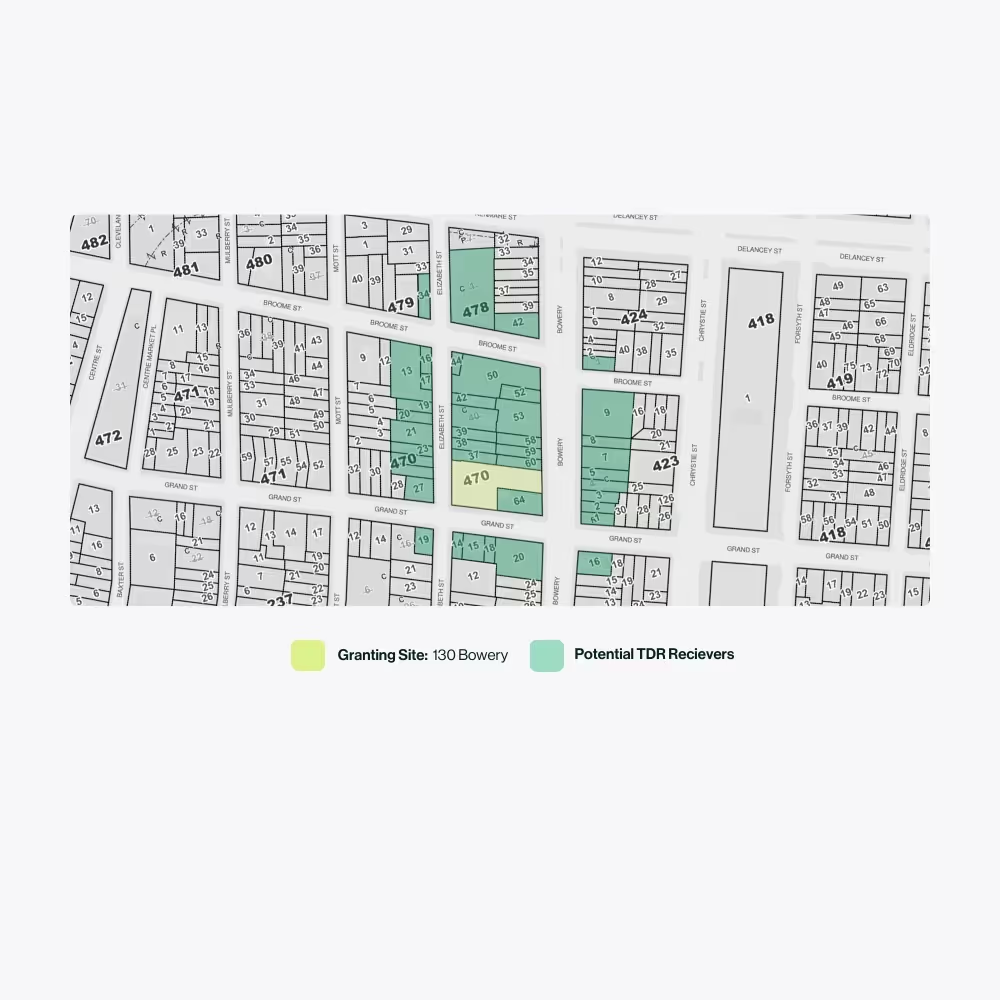


.avif)
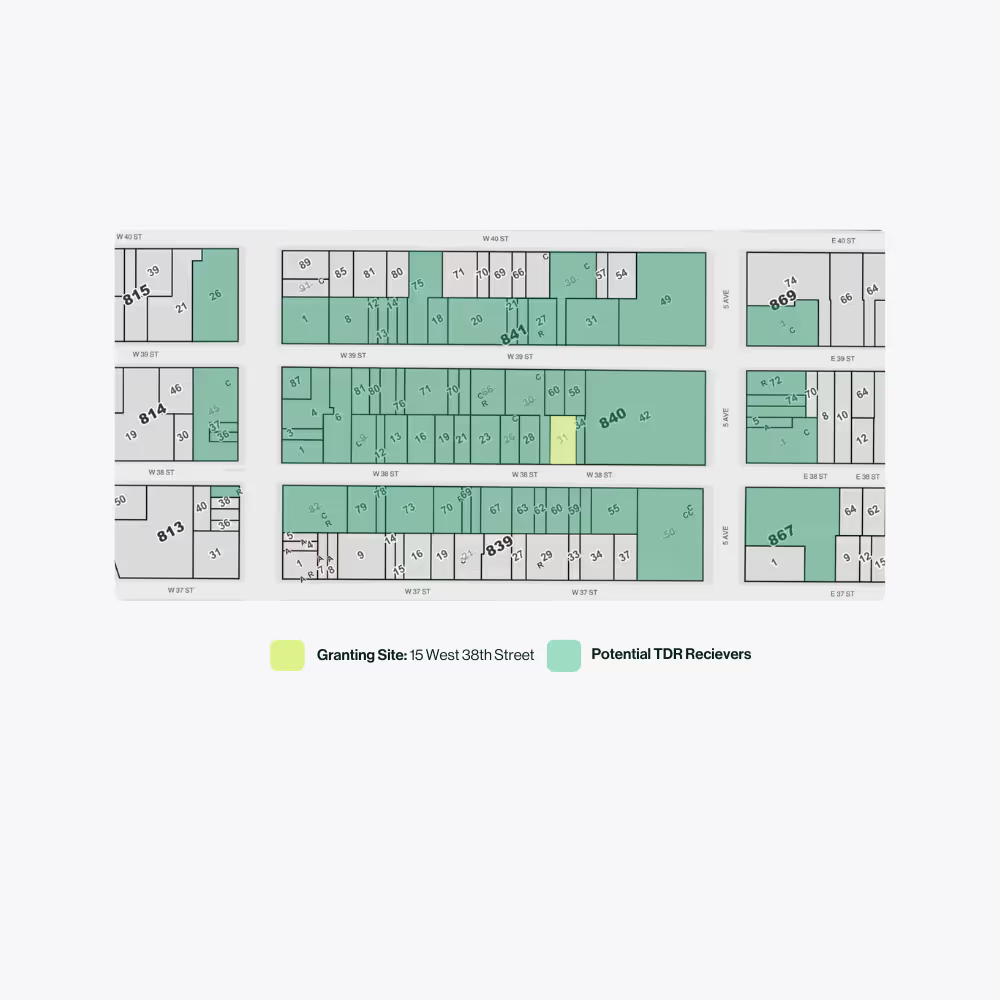
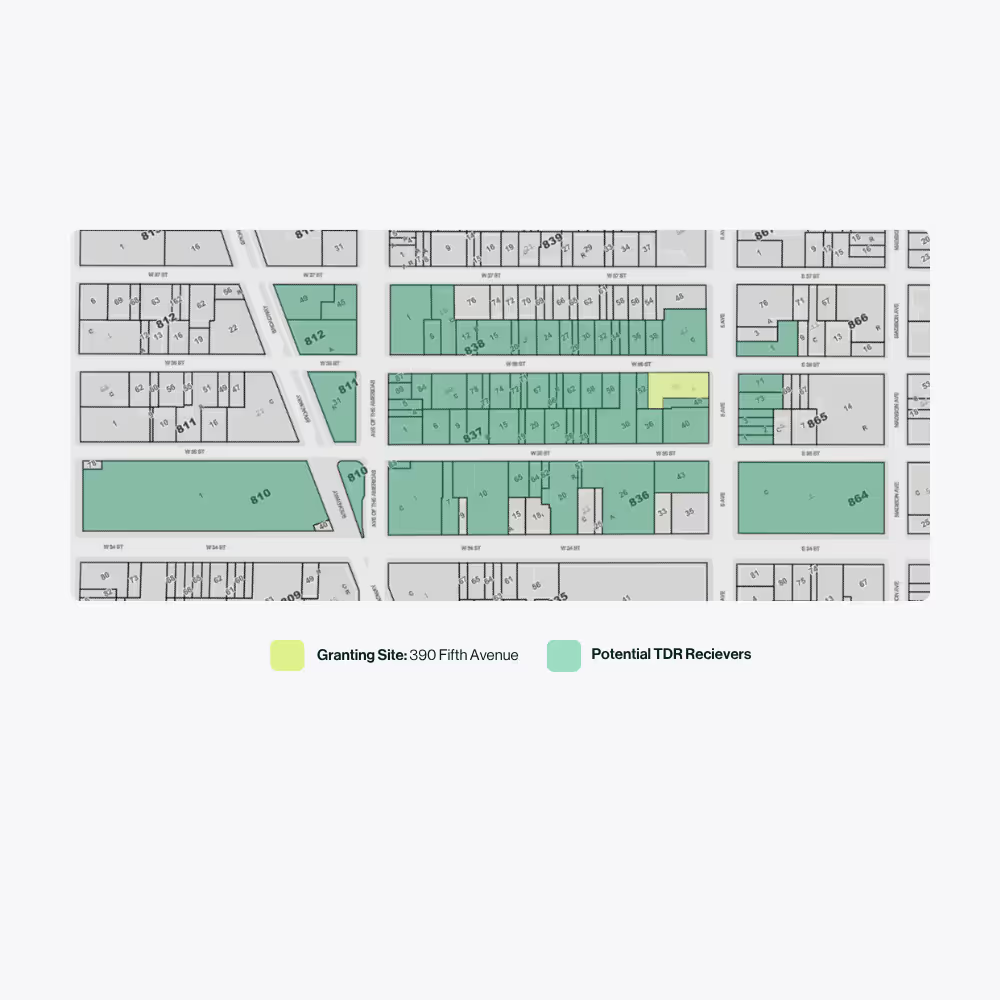
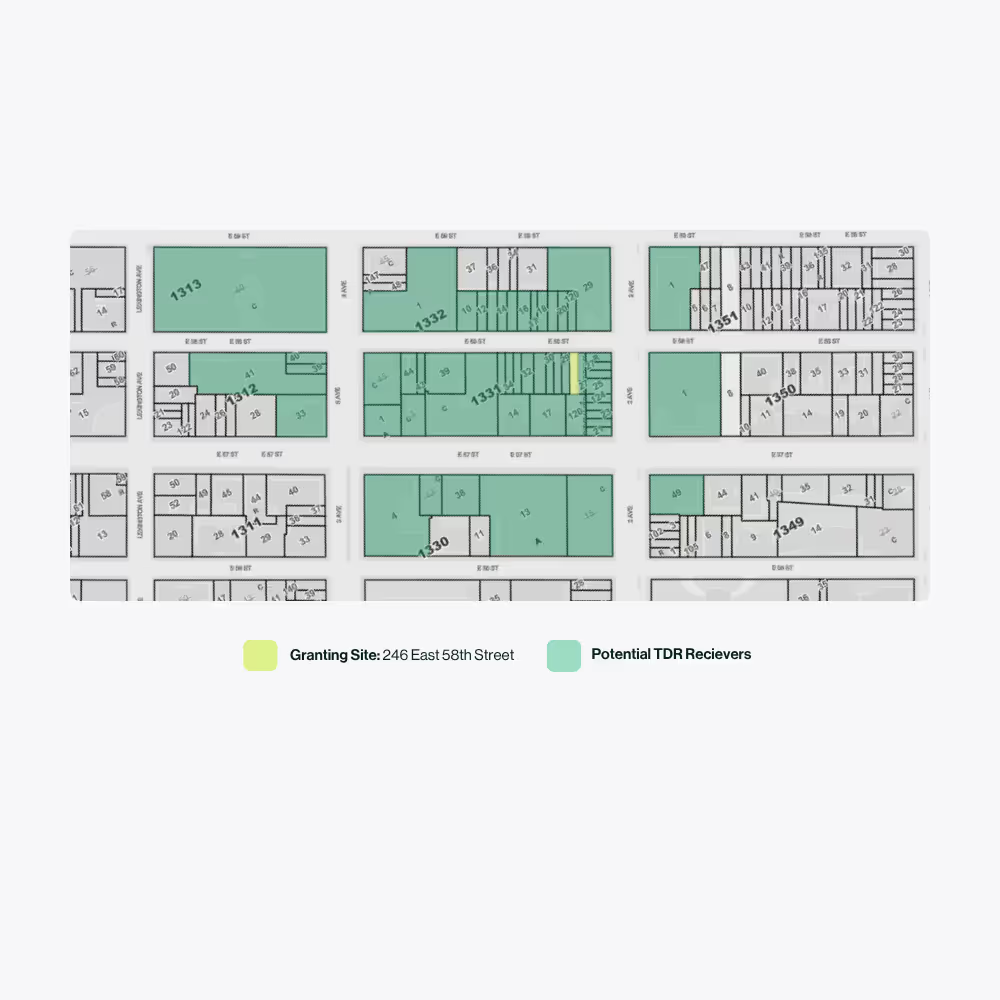

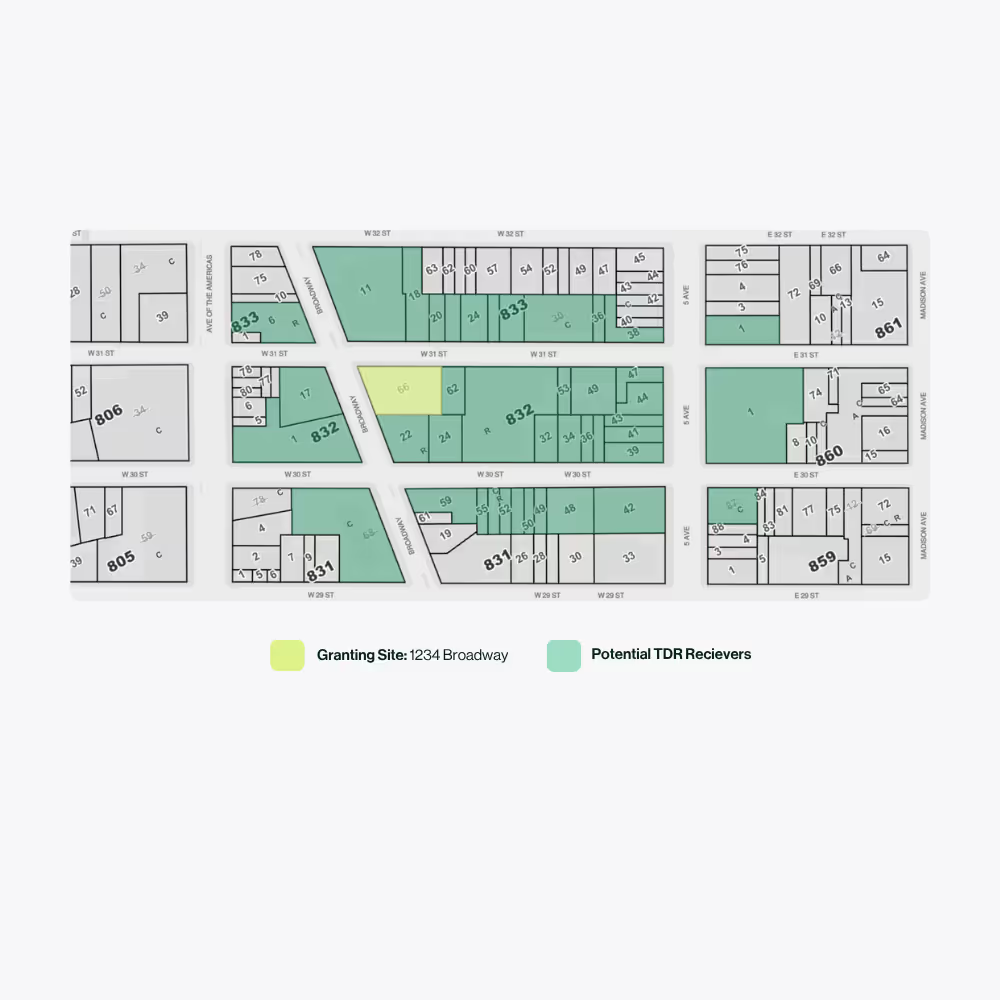




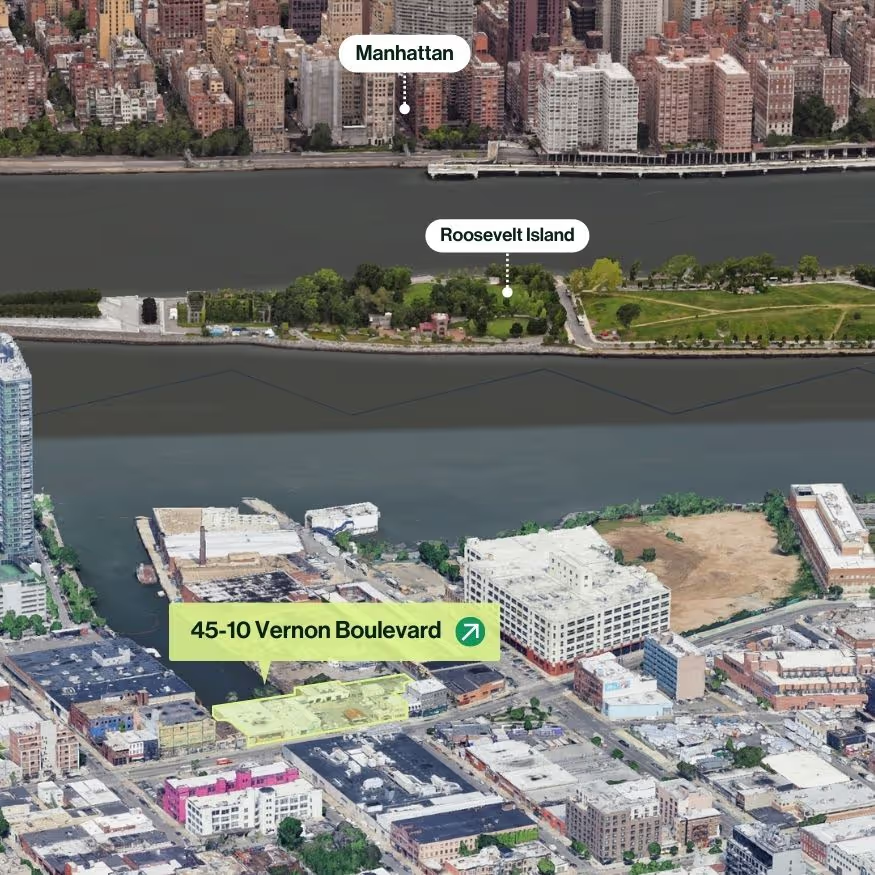
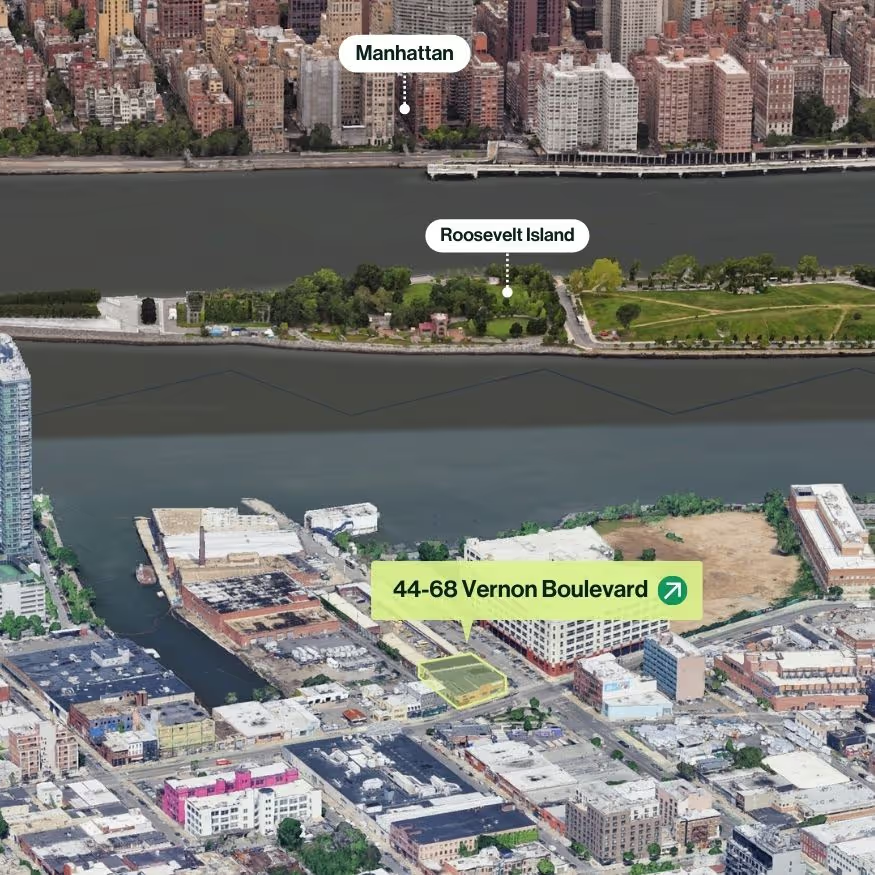



.avif)